
When your triglyceride levels climb above 500 mg/dL, you’re not just dealing with a number on a lab report-you’re walking into a minefield. One wrong step, and you could end up in the hospital with acute pancreatitis, a condition that kills 5% of those who get it. At the same time, those same high numbers are quietly damaging your heart, increasing your risk of heart attack and stroke over time. The scary part? Most people don’t feel a thing until it’s too late.
Why High Triglycerides Can Trigger Pancreatitis
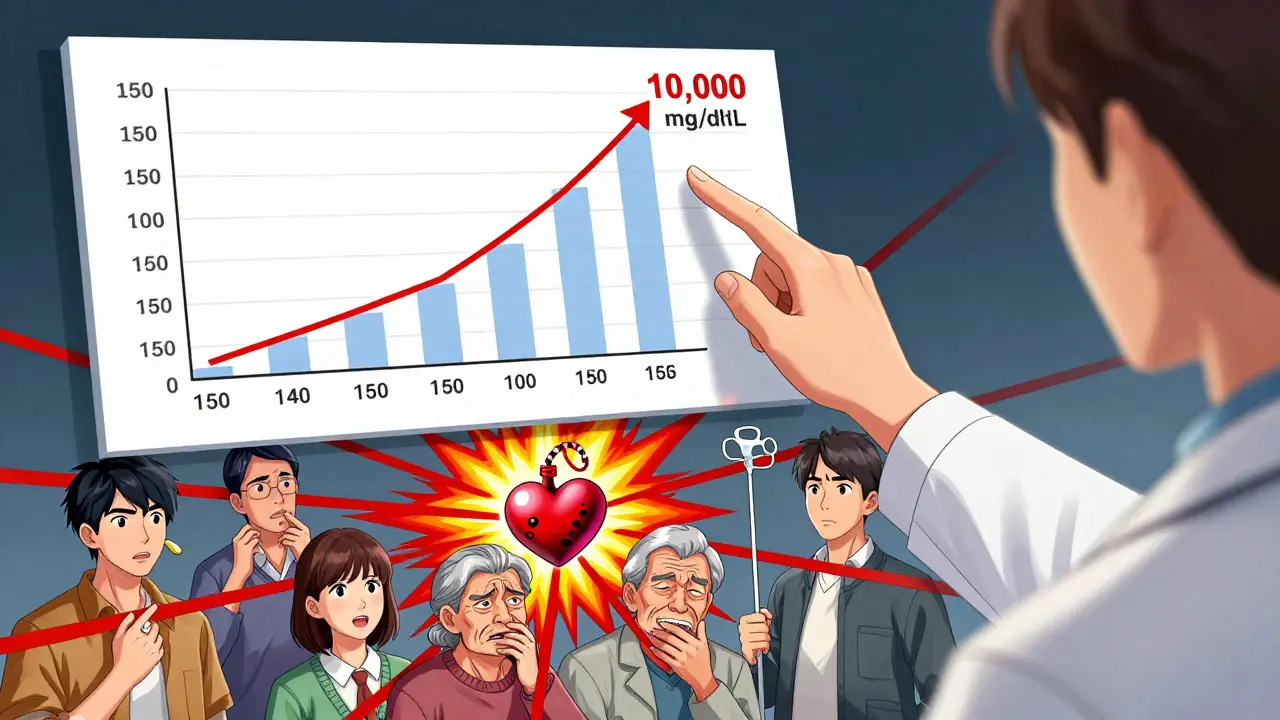
Triglycerides themselves aren’t toxic. But when they pile up-especially above 1,000 mg/dL-your body starts breaking them down in ways that hurt you. Pancreatic enzymes, meant to digest fat, go into overdrive. They chop triglycerides into free fatty acids and lysophosphatidylcholine, which tear through the delicate lining of your pancreas. This isn’t just inflammation. It’s chemical burning. The result? Swelling, tissue death, and sometimes organ failure. Studies show that when triglycerides hit 1,000-1,999 mg/dL, about 1 in 10 people will have an episode of pancreatitis. At levels above 2,000 mg/dL, that jumps to 1 in 5. Even more alarming: the JAMA Internal Medicine study of over 113,000 people found that every time triglycerides rose by 89 mg/dL (about 1 mmol/L), the risk of pancreatitis went up by 17%. That’s not a small bump. That’s a steep slope. And here’s the twist: some people with triglycerides over 10,000 mg/dL never get pancreatitis. Others have it at 400 mg/dL. Why? It’s not fully understood. Genetics, how fast your body clears fat, and other hidden factors play a role. That’s why doctors can’t just rely on one number. They have to look at your whole picture-your weight, your blood sugar, your alcohol intake, even your medications.How High Triglycerides Hurt Your Heart
While pancreatitis is sudden and dramatic, the damage to your heart is slow and silent. High triglycerides don’t just sit there. They mix with other fats in your blood, forming particles that slip into artery walls. Over time, they help build plaque-just like LDL cholesterol. But here’s what most people don’t know: high triglycerides often come with low HDL (the “good” cholesterol) and small, dense LDL particles. That’s the perfect storm for heart disease. The European Atherosclerosis Society found that 70% of deaths in people with severe hypertriglyceridemia are from heart attacks or strokes-not pancreatitis. That’s the real killer. Even moderate levels-between 200 and 500 mg/dL-raise your risk of cardiovascular events. The European Society of Cardiology now officially calls nonfasting triglycerides above 177 mg/dL an independent risk factor for heart disease. That means you don’t need to be severely high to be in danger. The good news? Lowering triglycerides doesn’t just prevent pancreatitis-it cuts your heart attack risk. The REDUCE-IT trial showed that people taking 4 grams of pure EPA (a type of omega-3) daily cut their risk of heart attack, stroke, or death by 25%. But not all omega-3s work the same. The STRENGTH trial, which used a mix of EPA and DHA, showed no benefit. That’s why doctors now recommend specific, prescription-grade formulations-not over-the-counter fish oil pills.When to Worry: The Real Triglyceride Thresholds
There’s confusion out there because different groups use different numbers. The American College of Gastroenterology says: if your triglycerides are above 500 mg/dL, you need to act. The European Atherosclerosis Society says: if they’re above 177 mg/dL, you’re at higher heart risk. Both are right-just for different reasons. Here’s how to think about it:- Below 150 mg/dL: Normal. Keep doing what you’re doing.
- 150-199 mg/dL: Borderline high. Time to improve diet and activity.
- 200-499 mg/dL: High. You’re at increased heart risk. Lifestyle changes are essential. Statins may be added.
- 500-999 mg/dL: Very high. Pancreatitis risk rises. You need medication (like fibrates) plus strict diet.
- 1,000+ mg/dL: Dangerous. Emergency-level risk. Immediate treatment needed to prevent pancreatitis.
What Actually Works to Lower Triglycerides
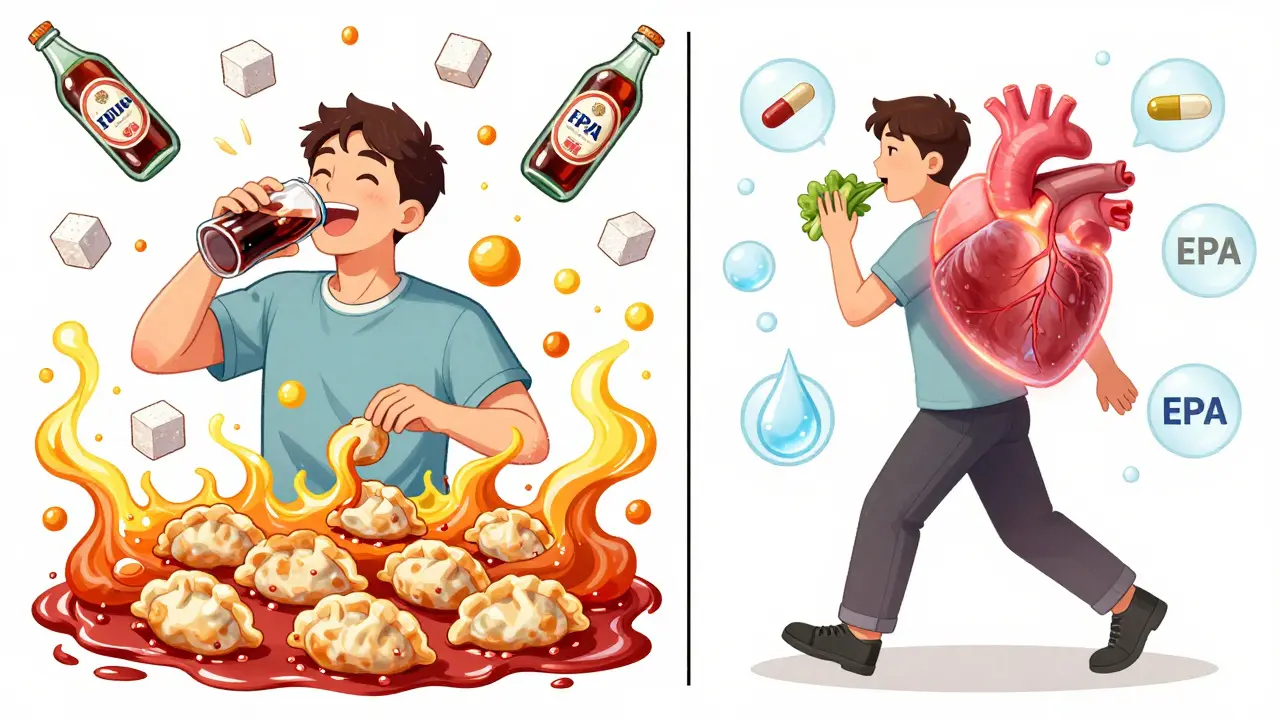
Lifestyle changes are the foundation. But they’re harder than people think. Cutting out sugar and refined carbs can drop triglycerides by 30-50% in 12 weeks. Alcohol? Even one drink a day can spike them by 200%. That’s why doctors tell patients with levels over 500 to quit completely. But diet alone isn’t always enough. Here’s what works:- Fibrates (fenofibrate, gemfibrozil): First-line for levels over 500. Reduce triglycerides by 30-50%. They also raise HDL.
- Prescription omega-3s (icosapent ethyl): Only EPA, not mixed EPA/DHA. 4 grams daily cuts heart events by 25%. Costs around $400/month.
- High-intensity statins (atorvastatin 40-80 mg): Best for people with both high triglycerides and high LDL. Reduces overall cardiovascular risk.
- Newer drugs: Volanesorsen and olezarsen target specific proteins that make triglycerides. Used for rare genetic conditions. Volanesorsen can slash levels from 2,800 to under 500 in six months-but costs $450,000 a year and isn’t covered by most insurers.
Hidden Triggers You Might Be Ignoring
You might be doing everything right-eating clean, exercising, not drinking-and still have high triglycerides. Why? Something else is pushing them up. Common hidden triggers:- Uncontrolled diabetes: HbA1c above 9% can double triglycerides in weeks.
- Estrogen therapy: Birth control pills or hormone replacement can raise levels by 200-400%.
- Propofol: The IV sedative used in surgeries and ICU stays can cause sudden spikes.
- Thyroid problems: Hypothyroidism slows fat clearance.
- Medications: Beta-blockers, diuretics, and some antivirals can interfere.
What Patients Really Struggle With
Real people share their stories online. On patient forums, 68% say sticking to a <20g fat/day diet is nearly impossible. No cheese. No nuts. No avocado. No olive oil. That’s not just hard-it’s isolating. One man in South Africa told his doctor he’d rather risk pancreatitis than give up his weekend braai. Others say their doctors don’t understand. One woman was told she had “alcoholic pancreatitis” because she drank one glass of wine a week. She’d never touched alcohol before. Her triglycerides were 3,200 mg/dL from undiagnosed familial chylomicronemia syndrome. The biggest gap? Time. Lifestyle changes take 6-8 weeks to work. But if your triglycerides are over 1,000, you can’t wait. That’s why doctors often start medication right away while you work on diet.What to Do Next
If you’ve been told your triglycerides are high, here’s your action plan:- Get a fasting lipid panel. Nonfasting numbers can be misleading. You need the real picture.
- Ask your doctor: “Am I at risk for pancreatitis?” If your level is over 500, you are.
- Eliminate sugar and alcohol. Cut out soda, juice, candy, pastries, and all forms of alcohol.
- Switch to whole foods. Eat vegetables, lean proteins, legumes, and whole grains. Avoid processed carbs.
- Start walking 30 minutes a day. Even light activity cuts triglycerides by 20-30%.
- Ask about medication. If your level is over 500, you likely need more than diet.
- Check your HbA1c and thyroid. Rule out hidden causes.
Can high triglycerides cause heart attacks?
Yes. High triglycerides contribute to plaque buildup in arteries, lower HDL cholesterol, and increase small, dangerous LDL particles. Studies show people with triglycerides above 200 mg/dL have a significantly higher risk of heart attack and stroke-even if their LDL is normal. The REDUCE-IT trial proved that lowering triglycerides with prescription omega-3s reduces cardiovascular events by 25%.
What’s the fastest way to lower triglycerides?
The fastest way is stopping alcohol and sugar. Cutting out all added sugars and alcohol can drop triglycerides by 30-50% in just two weeks. For levels over 500 mg/dL, medication like fibrates or prescription omega-3s can bring them down even faster-often within days to weeks. Lifestyle changes take longer, but they’re the only way to sustain results.
Can I lower triglycerides without medication?
Yes, for mild to moderate levels (150-499 mg/dL). Cutting sugar, alcohol, and refined carbs, losing 5-10% of body weight, and exercising daily can reduce triglycerides by 20-50%. But if your level is above 500 mg/dL, medication is usually needed to prevent pancreatitis. Diet alone won’t act fast enough.
Are fish oil supplements good for high triglycerides?
Over-the-counter fish oil supplements usually don’t help. Most contain low doses of EPA and DHA and aren’t proven to lower triglycerides enough to prevent pancreatitis or heart disease. Only prescription-grade icosapent ethyl (pure EPA, 4g/day) has been shown in large trials to reduce heart attacks and strokes. Don’t rely on store-bought pills.
How often should I check my triglycerides?
If your triglycerides are normal, check them every 4-5 years. If they’re high (above 200 mg/dL), check every 3-6 months until they’re under control. During acute pancreatitis, levels are checked every 24-48 hours until they fall below 500 mg/dL. After that, monitor every 3-6 months to make sure they stay down.







I had triglycerides over 800 last year. Cut out soda, started walking 30 mins a day, and within 3 months they dropped to 180. No meds. Just real food and movement. Don't let anyone tell you it's impossible.
The entire medical-industrial complex is predicated on pathologizing lipid metabolism. Triglycerides aren't a disease-they're a biomarker of metabolic dysregulation, which itself is a symptom of systemic oxidative stress induced by ultraprocessed food ecosystems. You're not treating a number-you're negotiating with a biofeedback loop engineered by Big Pharma and the USDA.
This is so helpful thanks for breaking it down. I just got my numbers back and they were 450 and I was freaking out. Now I know what to do next.
Wait... so you're telling me the government didn't warn us about propofol?!!? They're hiding this! They knew! I had surgery last year and my triglycerides spiked to 3,000 after! I'm not the only one! The CDC has been suppressing data on anesthetic-induced hypertriglyceridemia since 2017!!
So let me get this straight. I can't drink my beer, eat my bread, or get anesthesia without risking pancreatitis or a heart attack? Sounds like my life is just a series of medical landmines with a side of $400 omega-3s.
In Nigeria we don't have this problem because we eat real food-yam, plantain, ogbono soup, not this American junk! You people think a pill fixes everything. No! Your body is crying for ancestral food! 🌿🔥
I'm so glad someone finally explained why my triglycerides won't go down even though I'm eating salad. I didn't realize my birth control could be doing this. Going to talk to my doctor tomorrow.
Cut sugar. Stop drinking. Move. Repeat.
I mean, if you're still on statins and not doing a keto reset, you're basically just paying the hospital to keep you sick. I went from 620 to 140 in 8 weeks on a carnivore diet. The science? Overrated. My body knows better than your lab report.
I just had a 3-hour ER visit because my triglycerides hit 1,200. I thought I was fine because I 'ate healthy.' Turns out 'healthy' was just a fancy word for oatmeal with maple syrup. I'm done. No more sugar. Ever. 🤬
You got this! I was where you are. It's not easy but every small change adds up. Start with one swap-like water instead of soda-and build from there. You're stronger than you think 💪
The REDUCE-IT trial was funded by Amarin. The STRENGTH trial was the real one. They cherry-picked EPA because DHA interferes with their patent. This isn't medicine-it's a corporate profit play dressed up as science. Also, fibrates cause rhabdomyolysis in 12% of cases. You're being sold a snake oil with a clinical trial logo.
I'm proud of everyone who's taking steps to get healthier. Even small changes matter. You're not alone in this. Keep going.
I used to think 'high triglycerides' meant I was fat. Turns out I was skinny and still had 580. Turns out my daily kombucha and fruit smoothies were sugar bombs. Now I drink water and eat eggs. My numbers are normal. The system lied to me.
I've been a nurse for 18 years and I've seen too many people ignore these numbers until it's too late. Please don't be one of them. Talk to your doctor. Get a lipid panel. Even if you feel fine. Your future self will thank you. You've got this.