
Before direct-acting antivirals (DAAs), curing hepatitis C felt like chasing a ghost. Patients spent a year on weekly injections, battled brutal side effects like depression and anemia, and still had less than a 60% chance of beating the virus. Today, that same infection can be cleared in as little as eight weeks-with pills, no injections, and a cure rate higher than 95%. The shift isn’t just incremental; it’s a revolution in how we treat liver disease.
How DAAs Changed Everything
Direct-acting antivirals don’t mess around. Unlike old interferon treatments that tried to boost the immune system and often made patients sicker, DAAs target specific parts of the hepatitis C virus itself. They block the proteins the virus needs to copy itself, stopping it cold. The first DAA, sofosbuvir (Sovaldi), hit the market in late 2013. Within a few years, it was clear: this wasn’t just an improvement. It was a complete overhaul.
By 2023, every major health body-from the WHO to the CDC-recognized DAAs as the gold standard. The cure rate? More than 95%. In real-world studies across the U.S., 97 out of 100 patients treated with DAAs achieved sustained virologic response (SVR), meaning the virus was undetectable 12 weeks after treatment ended. That’s the medical definition of cured.
And it’s not just for healthy people. People with HIV and hepatitis C co-infection? Same cure rates. People with advanced scarring (cirrhosis)? Still over 87% cured. Even those with liver cancer? DAAs can still work-though they’re often left out of treatment because of outdated rules.
The Numbers Don’t Lie: Real-World Cure Rates
Let’s look at the data from actual patients, not just clinical trials.
- A study of 6,634 insured U.S. patients between 2014 and 2021 found 97.3% were cured with DAAs.
- In a real-world group of 238 patients, 92.8% of those who completed treatment were virus-free at 12 weeks.
- For patients with no cirrhosis, cure rates hit 96.7% with sofosbuvir-velpatasvir.
- Even in those with cirrhosis, 87.1% still cleared the virus.
Compare that to the old interferon era: 40-60% cure rates, 6-12 months of treatment, and side effects so bad many patients quit. DAAs cut treatment time in half, removed the need for injections, and reduced serious side effects by over 80%.

Why Some People Still Aren’t Getting Treated
Here’s the uncomfortable truth: even with 97% cure rates, less than one in three people diagnosed with hepatitis C get treated within a year.
In the U.S., Medicaid patients are the worst off. Only 23% of them receive DAAs after diagnosis. Why? It’s not that the drugs don’t work. It’s that access is broken.
- Many clinics still require a liver specialist to prescribe DAAs-even though guidelines now say primary care doctors can handle it.
- Insurance companies often demand proof of liver damage before approving treatment, even though curing HCV early prevents damage.
- Patients in the Midwest and Northeast are 20-30% more likely to get treated than those in the West, even after adjusting for income, race, and disease severity.
And it’s worse in low- and middle-income countries. While 87% of them have registered at least one DAA, only 52% actually reimburse it. That means many people can’t afford the pills-even though generic versions now cost as little as $260 for a full course.
The Hidden Cost of Not Treating
Ignoring hepatitis C doesn’t make it go away. It just moves the damage underground.
Left untreated, HCV slowly destroys the liver over decades. By the time symptoms show up, it’s often too late: cirrhosis, liver failure, or liver cancer. A study estimated that if we do nothing, 776,000 HCV-related deaths will happen between 2015 and 2050. With DAAs? That number drops to 320,000. That’s over 450,000 lives saved.
But the damage isn’t just in the liver. Untreated HCV increases the risk of kidney disease, diabetes, and even heart problems. One study found that people who were cured with DAAs had 30% fewer cases of chronic kidney disease than those who never got treated.
And here’s the kicker: people with decompensated cirrhosis (late-stage liver failure) are 30% less likely to get DAAs-even though curing HCV at this stage improves survival and can delay or even prevent liver transplants.
What’s Holding Back Elimination?
The WHO wants to eliminate hepatitis C by 2030. That means treating 80% of all infected people and cutting deaths by 65%. We have the tools. We have the science. But we’re missing the system.
Here’s where we’re failing:
- Screening gaps: Most people with HCV don’t know they’re infected. Routine testing is still rare in primary care.
- Stigma: HCV is still wrongly linked to drug use. Many patients avoid doctors out of shame.
- Fragmented care: Patients bounce between specialists, clinics, and hospitals. No one takes responsibility for follow-up.
- Cost confusion: Even in countries with public healthcare, bureaucratic delays block access.
Meanwhile, treatment rates in the U.S. dropped after 2019. The pandemic didn’t help. Clinics shut down. Patients vanished. And the virus kept spreading.
What Needs to Change
It’s not about making better drugs. We already have them. It’s about making them accessible.
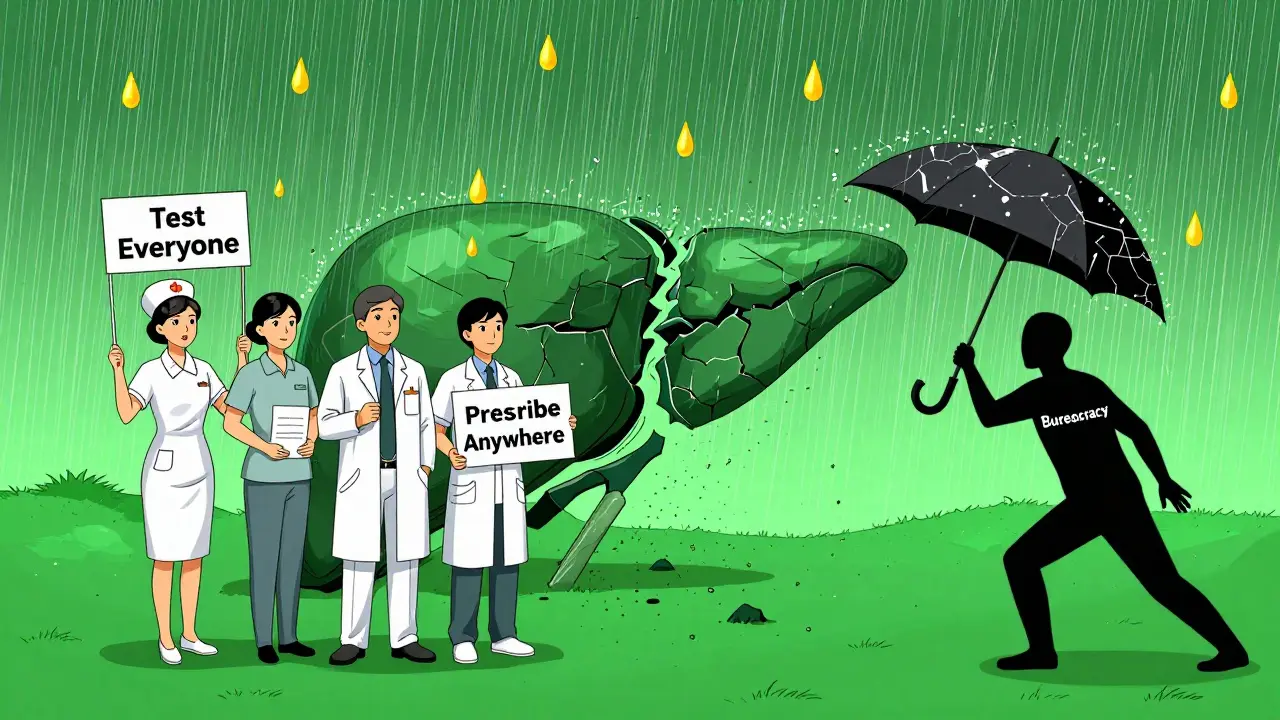
- Make DAAs available without pre-authorization. Let any doctor prescribe them.
- Test everyone once between ages 18 and 79-no exceptions.
- Use community health workers to find patients who dropped out of care.
- Push for universal reimbursement. No one should choose between rent and a cure.
- Train nurses and pharmacists to manage treatment. You don’t need a hepatologist to cure hepatitis C.
Imagine a world where a person walks into a clinic, gets a simple blood test, and leaves with a prescription that cures their infection in eight weeks. That world is possible. We’ve proven it. Now we just need to build the system to make it real for everyone.
What does it mean to have a sustained virologic response (SVR)?
SVR means the hepatitis C virus is undetectable in the blood 12 weeks after finishing treatment. This is the medical definition of being cured. If you achieve SVR, the virus is gone, liver damage can reverse, and you can no longer pass it to others.
Are DAAs effective for all hepatitis C genotypes?
Yes. Modern DAAs are pangenotypic, meaning they work against all six major strains of HCV. Regimens like sofosbuvir-velpatasvir and glecaprevir-pibrentasvir are designed to treat any genotype without needing to test for the specific type first. This simplifies treatment and speeds up care.
Can you cure hepatitis C if you have cirrhosis?
Yes. Even with advanced liver scarring, DAAs can cure over 87% of cases. In fact, curing HCV at this stage can stop further damage, reduce liver cancer risk, and improve survival. The problem isn’t effectiveness-it’s access. Many patients with cirrhosis are still denied treatment due to outdated policies.
Why are treatment rates so low in some areas?
It’s not about the drugs. It’s about systems. Many places require specialist approval, delay insurance authorization, or lack screening programs. Rural areas, low-income communities, and Medicaid populations face the biggest barriers. In the U.S., Medicaid patients are only 23% likely to get treated within a year of diagnosis.
How much do DAAs cost today?
When first introduced, a 12-week course cost over $80,000. Today, generic versions cost between $260 and $2,800 depending on the country and how it’s purchased. In many low-income countries, international aid programs supply DAAs for under $300. The cost is no longer the main barrier-it’s access and awareness.





Oh wow, look who finally noticed that we’ve had a miracle cure for decades and still let people die from it like it’s 1998. 🙃
Let me guess - you’re one of those people who thinks ‘access’ is a buzzword and not a moral failure.
Meanwhile, in the real world, Medicaid patients are still being told to ‘wait until their liver explodes’ before they get a $260 pill.
And somehow, this is still considered ‘healthcare’.
Not a system. Not a policy. Just pure, unadulterated cruelty wrapped in a white coat.
And yet, here we are, patting ourselves on the back for ‘scientific progress’ while people hemorrhage silently in rural clinics.
It’s not the virus that’s the enemy. It’s the bureaucracy that thinks cost-sharing is more important than life.
97% cure rate? Congrats. Now make it 100%.
Or are we just going to keep pretending innovation fixes everything when the real problem is human indifference?
At this point, I’m not even mad. I’m just… tired.
Of the lies. Of the delays. Of the ‘we’re working on it’ while people turn into statistics.
And don’t even get me started on how we treat people with cirrhosis like they’re already dead.
It’s not science that’s failing us. It’s our soul.
And no, I don’t want to hear about ‘budget constraints’ - we spend billions on drones we don’t need.
But a cure? Too expensive. Of course.
Let me tell you something - this is not just a medical issue, this is a geopolitical insult.
India has over 10 million HCV carriers, and yet our public health system is still stuck in the 1990s while the West has turned this into a commodity.
Generics? Yes. But who gets them?
Not the slum-dweller. Not the migrant laborer. Not the woman who can’t afford a single day’s wage to travel to a clinic.
DAAs are a triumph of Western science - but they’re a betrayal of global equity.
While your insurance denies coverage, my cousin in Bihar is drinking tea laced with unsterilized needles just to survive.
And you want to talk about SVR? Let’s talk about SVR - Survival Without Recognition.
Pharma giants patent, then ‘license’ generics to countries that can’t afford to negotiate.
It’s not a cure. It’s a colonial legacy in pill form.
Stop celebrating cure rates when the cure isn’t even in the same country as the patient.
97%? That’s the rate for those with a credit score.
For the rest? Silence. And death. Quiet. Unnoticed. Unreported.
While the emotional and political dimensions of this issue are valid and important, the clinical data remains unequivocal.
Direct-acting antivirals have demonstrated sustained virologic response rates exceeding 95% across all genotypes, including in populations with advanced fibrosis and co-infections.
Multiple peer-reviewed longitudinal studies, including those published in The Lancet and NEJM, have confirmed these outcomes in real-world settings, not just clinical trials.
The challenge is not therapeutic efficacy - it is structural implementation.
Systemic barriers such as pre-authorization requirements, fragmented care pathways, and lack of provider education are well-documented.
However, these are not inherent to the treatment itself but to administrative and institutional inertia.
Policy reforms that delegate prescribing authority to primary care providers, integrate screening into routine care, and eliminate cost-sharing barriers have already shown success in states like Vermont and Washington.
It is a solvable problem - not a failure of science, but a delay in governance.
Let us not confuse moral urgency with scientific uncertainty.
The tools exist.
The evidence is robust.
What is missing is the coordinated will to deploy them.
Cure rate is 97%. Access is 23%. The math is simple. Fix the system.
Thank you for sharing this comprehensive and deeply necessary overview.
It is both a scientific triumph and a moral indictment - and I believe we must hold both truths in tension.
The fact that we have the capacity to cure over 95% of hepatitis C cases with minimal side effects and short treatment durations is nothing short of miraculous.
Yet, the persistent disparities in access - particularly among Medicaid recipients, rural populations, and marginalized communities - reveal a profound gap between medical capability and social responsibility.
Every patient who is denied treatment due to bureaucratic hurdles is not just a statistic - they are a person with a family, a job, a dream.
Let us not mistake innovation for justice.
Let us not celebrate cure rates while ignoring care pathways.
It is time to restructure our systems to reflect the dignity of every human life.
Primary care providers must be empowered.
Screening must be universal.
Cost must be removed as a barrier.
And above all - we must stop waiting for someone else to act.
Change begins with the next person who walks into a clinic.
Let’s make sure they walk out cured.
Okay but like… 97% cure rate?? 🤯
And we’re still letting people slip through the cracks??
Imagine if this was cancer and we had this kind of success - we’d be throwing parades.
But HCV? Oh no, it’s ‘just’ liver stuff. And people who use drugs? Yeah, not our problem.
Ugh. I’m so mad.
My cousin got cured in 8 weeks with a $300 pill. She’s alive today because someone finally believed her.
Why does it have to be this hard??
Every single person deserves this. No questions. No forms. No waiting.
Just: test. Prescribe. Cure.
Repeat.
Let’s make this easy. Like, *really* easy.
It’s 2025. We have apps for everything. Why can’t we have an app for curing hepatitis C? 😤
Also - if you’re reading this and you’re scared to get tested? I got you. You’re not alone. You’re not broken. You’re just overdue. Go. Do it. I’ll wait. 💪❤️
Cure rate 97%
Access 23%
Guess who's still dying?
Not the CEOs.
Not the lawmakers.
Not the pharma execs.
Just the people who can't afford to be heard.
It is striking how the medical community has succeeded in developing a near-perfect therapeutic intervention, yet the public health infrastructure has not evolved commensurately.
There is a dissonance between technological achievement and institutional responsiveness.
The persistence of pre-authorization protocols, specialist gatekeeping, and geographic inequities suggests that the issue lies not in pharmacology, but in governance.
One might argue that the greatest obstacle to hepatitis C elimination is not the virus itself, but the inertia of systems designed for a different era.
It is worth noting that countries with universal healthcare models have achieved significantly higher treatment rates, even with limited resources.
Perhaps the lesson here is not about drug development, but about prioritization.
When a population’s health is treated as a right rather than a privilege, outcomes improve - not because of better science, but because of better ethics.
And ethics, unlike pharmaceuticals, cannot be patented.
bro like why are we still talking about this?? we got the cure for like 10 years now and people are still like ‘oh i’ll get to it next year’??
its a pill. 8 weeks. no injections. no side effects. 97% work.
if you got hcv and you ain’t treated yet you just ain’t trying.
also who even still uses interferon?? that shit is ancient like dial-up internet.
and yeah i know insurance is a nightmare but like… go to a community clinic. they got the pills. they dont care if you got medicaid or not.
stop being lazy. your liver doesn’t care about your drama.
There’s something deeply human about this story - not just the science, but the silence around it.
Hepatitis C doesn’t scream. It doesn’t make headlines. It doesn’t have a ribbon.
It’s quiet. It’s shame. It’s the person who never told their family. The one who got tested once and never went back.
And now we have the tools to end it - not just treat it, but erase it - and we’re still whispering about it.
I’ve worked in clinics across three states, and I’ve seen it: people who’ve lived with this for 30 years, scared to ask for help.
It’s not the virus that kills.
It’s the loneliness.
And the system that lets them stay alone.
Maybe the real cure isn’t in the pill.
Maybe it’s in the person who says, ‘I see you. I believe you. Let me help.’
That’s what we’re missing.
Not more drugs.
More humanity.
The emergence of direct-acting antivirals constitutes a paradigmatic shift in virological therapeutics, not merely an incremental advancement.
It represents the triumph of reductionist molecular intervention over immunomodulatory brute-force methodologies.
Where interferon sought to mobilize the host’s immune apparatus - often with catastrophic collateral damage - DAAs operate with surgical precision upon viral polymerase and protease domains.
Consequently, the therapeutic index has been inverted: efficacy ascends while toxicity descends.
Yet, the epistemological rupture has not been matched by an institutional one.
Healthcare systems, ossified by bureaucratic feudalism, continue to enforce preconditions that contradict the very logic of the intervention.
One might posit that the greatest barrier to elimination is not the cost of the drug, but the cost of the ideology that permits its withholding.
It is not merely a failure of logistics - it is a failure of moral epistemology.
We possess the means to cure.
But do we possess the will to acknowledge that cure is not a privilege - but a right?
Let’s take a step back from the data and the headlines - because what we’re really talking about here isn’t a virus. It’s a mirror.
Every time we delay treatment, every time we make someone jump through hoops to get a pill that costs less than a gym membership, we’re not just failing a patient - we’re failing our collective conscience.
Think about it: we have a cure that works better than 95% of cancer therapies, and we treat it like it’s a luxury item instead of a basic human right.
And who pays the price? The uninsured. The undocumented. The homeless. The ones who can’t afford to miss a day of work to go to a specialist.
Meanwhile, the same society that refuses them this pill will spend millions on a new drone program or a celebrity rehab center.
It’s not about affordability - it’s about value.
What do we value? Profit? Control? Bureaucratic order?
Or human life?
Because if we valued life, we wouldn’t have a single person left untreated.
Not one.
Not in a country with this much wealth.
Not in a world with this much science.
And yet - here we are.
Still debating.
Still delaying.
Still pretending that ‘someday’ is a strategy.
It’s not.
It’s cowardice dressed up as policy.
And it’s killing people.
Slowly.
Quietly.
And we’re all just watching.
So who’s really the virus here?