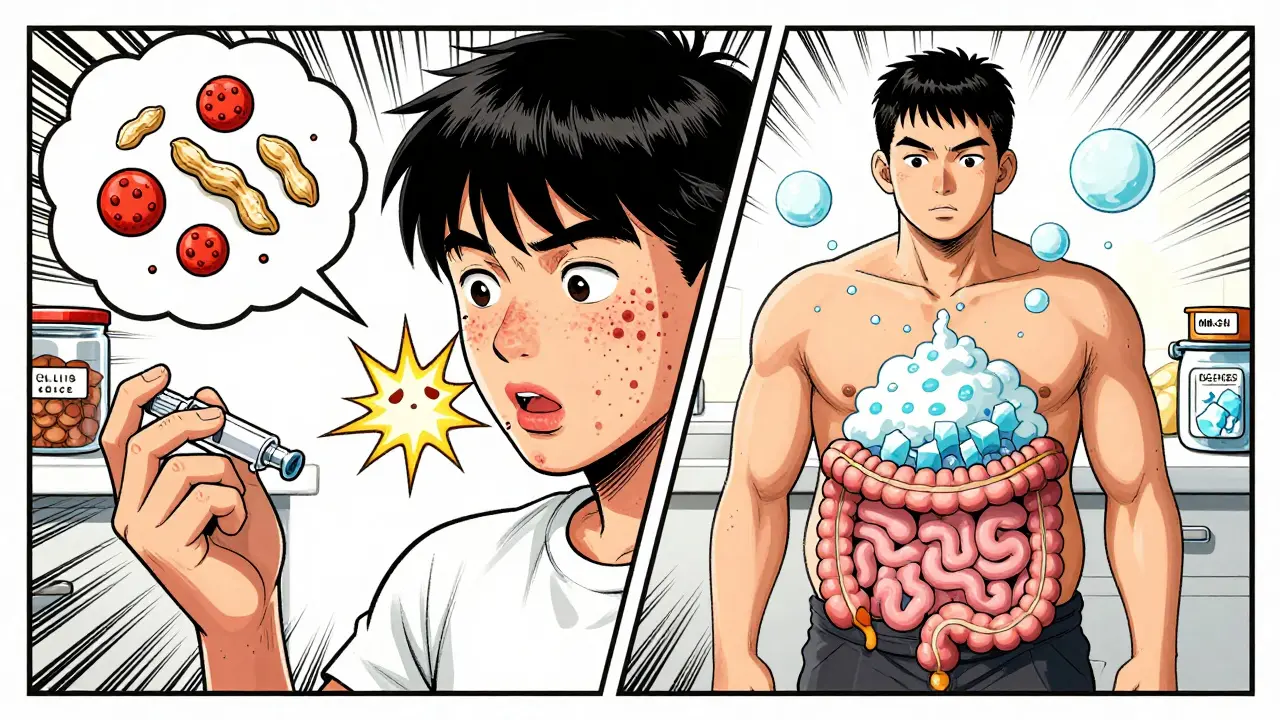
When your stomach churns after eating, or you feel bloated and crampy hours after a meal, it’s easy to blame it on food. But not all digestive trouble is the same. Is it a food allergy-something your immune system is fighting-or just a food intolerance, where your gut can’t handle the load? The difference isn’t just academic. It changes everything: what you can eat, how you live, and even whether you need to carry an emergency shot.
How Your Body Reacts: Immune System vs. Digestive System
A food allergy is an immune system overreaction. Your body sees a harmless food protein-like peanut or milk-as a threat. It makes IgE antibodies to fight it. When you eat that food again, those antibodies trigger mast cells to dump histamine and other chemicals into your bloodstream. That’s why symptoms hit fast: hives, swelling, trouble breathing, vomiting, or even a drop in blood pressure. In severe cases, it’s anaphylaxis. It can kill. And it doesn’t take much-even a tiny crumb can trigger it.
Food intolerance is different. No immune system involved. No antibodies. No histamine rush. Instead, it’s a digestive problem. Your body lacks the enzyme to break down a food. Lactose intolerance? That’s the classic example. You don’t make enough lactase, the enzyme that splits milk sugar. So undigested lactose slides into your colon, where gut bacteria feast on it. The result? Gas, bloating, cramps, diarrhea. It’s messy, uncomfortable, but not life-threatening.
Other intolerances work similarly. Sulfites in wine or dried fruit? Some people can’t metabolize them. Fructose in apples or honey? Too much overwhelms the transporters in the small intestine. Gluten? For most, it’s fine. But for some without celiac disease, it still causes bloating and fatigue-this is non-celiac gluten sensitivity. Still not an allergy. Just a digestive mismatch.
GI Symptoms: When, How, and What Else Is Happening
Let’s talk timing. With a food allergy, symptoms usually show up within minutes to two hours. Vomiting? Check. Abdominal pain? Yes. Diarrhea? Often. But here’s the key: you won’t get just stomach trouble. You’ll likely see skin rashes, swelling of the lips or tongue, wheezing, or dizziness. The body’s reacting system-wide.
With food intolerance, symptoms are slower and stay in the gut. Bloating? Yes. Gas? Always. Cramping? Common. Diarrhea? Maybe. But no hives. No throat closing. No trouble breathing. It’s just your gut telling you, “I can’t process this.” Symptoms usually start 30 minutes to several hours after eating. Lactose intolerance? Often hits 30 to 120 minutes after dairy. That’s why some people can handle a splash of cream in coffee but not a glass of milk.
And here’s something most people don’t realize: a food allergy can cause GI symptoms even if you’ve never had a reaction before. One study found that 40% of children with peanut allergy first noticed vomiting or diarrhea-not hives-as their earliest sign. So if you suddenly start getting stomach issues after eating something you’ve eaten before, don’t ignore it.

Testing: What Actually Works (And What Doesn’t)
There’s a flood of tests out there. Blood tests. Hair analysis. Electrodermal screening. Don’t fall for them. Only a few tests have real science behind them.
For suspected food allergies, the gold standard is a combination of three things:
- Skin prick test: A tiny drop of food extract is placed on your skin, then lightly pricked. If you’re allergic, a red, swollen bump (wheal) forms. A wheal 3mm or larger than the control usually means allergy.
- Specific IgE blood test: Measures how much IgE your blood has for a specific food. A result above 0.35 kU/L is considered positive. But here’s the catch: this test can give false positives. Someone might test positive but never react when they eat the food.
- Oral food challenge: This is the only definitive test. You eat increasing amounts of the food under medical supervision. If you react, you’re allergic. If not, you’re not. It’s slow, expensive, and requires a clinic visit-but it’s the only way to be sure.
For peanut allergy, there’s an even sharper tool now: component-resolved diagnostics. Testing for Ara h 2-a specific peanut protein-gives you 95% accuracy in predicting a true allergy. If your Ara h 2 level is above 0.23 kU/L, you’re at high risk for a severe reaction.
Now, for food intolerances:
- Lactose intolerance: The hydrogen breath test is the go-to. You drink a lactose solution. Your breath is tested every 15-30 minutes. If hydrogen levels rise more than 20 ppm above baseline, you’re malabsorbing lactose.
- Celiac disease: Requires a blood test for tissue transglutaminase IgA antibodies. If it’s above 10 U/mL, you need an endoscopy. Biopsy must show Marsh 3 damage-flattened villi in the small intestine. No biopsy? No diagnosis.
- Non-celiac gluten sensitivity: No blood test exists. You do an elimination diet. Cut out gluten for 4-6 weeks. If symptoms vanish, then slowly reintroduce it. If they return? Likely sensitivity.
And here’s the big red flag: IgG food sensitivity tests. These are sold online and in wellness clinics. They claim to show “food sensitivities” by measuring IgG antibodies. But the American Academy of Allergy, Asthma & Immunology says these tests are junk. Studies show they’re wrong over 70% of the time. You can have high IgG levels to foods you eat regularly and never have a problem. IgG doesn’t mean allergy or intolerance. It just means you’ve eaten the food.
Management: Avoid Everything or Just Cut Back?
If you have a food allergy, you must avoid it completely. No exceptions. The FDA requires top allergens to be clearly labeled on food. That’s peanuts, tree nuts, milk, eggs, wheat, soy, fish, shellfish, and sesame (added in 2023). Read every label. Even if you’ve eaten it before without issue, the next reaction could be worse. Always carry two epinephrine auto-injectors. They cost $550-$750 without insurance. Don’t skip this. Anaphylaxis doesn’t wait.
For food intolerances? It’s different. You often don’t need to quit entirely. Most people with lactose intolerance can handle up to 12 grams of lactose per day-that’s about one cup of milk. Hard cheeses and yogurt often have less lactose and are better tolerated. Lactase enzyme pills can help too. For sulfite sensitivity, avoid wine, dried fruit, and processed potatoes. You don’t need to cut out all processed food-just check labels for sulfites above 10 ppm.
Gluten? If you have non-celiac sensitivity, you might feel better on a low-gluten diet, not a zero-gluten one. Many people reduce wheat, rye, and barley but still eat oats or gluten-free grains without issue. The goal isn’t perfection-it’s comfort.

Don’t Self-Diagnose: What Else Could It Be?
Too many people assume their bloating or diarrhea is from food intolerance. But studies show 80% of self-diagnosed cases are wrong. Here’s what else could be going on:
- Irritable bowel syndrome (IBS): Affects 45% of people who think they have food intolerance. Symptoms overlap completely: bloating, cramping, diarrhea, constipation. But IBS isn’t caused by food-it’s triggered by stress, gut motility, or bacterial imbalance.
- Inflammatory bowel disease (IBD): Crohn’s or ulcerative colitis can mimic food intolerance. But IBD causes weight loss, bloody stools, and fever. It needs medication, not just diet changes.
- Functional dyspepsia: Stomach pain or fullness after eating. Often linked to acid or motility issues, not food.
And celiac disease? 75% of cases are still undiagnosed. People think they’re just “gluten sensitive,” but if they have celiac, they’re damaging their intestines every time they eat gluten. Left untreated, it can lead to osteoporosis, infertility, and even cancer.
That’s why doctors now say: before you cut out whole food groups, get tested. Rule out IBS, IBD, and celiac. Don’t assume it’s intolerance. Get the right diagnosis.
What’s Next: The Future of Testing
Science is moving fast. Researchers are finding new biomarkers. A 2024 study in Nature Communications identified a set of blood metabolites that can tell apart non-celiac gluten sensitivity from IBS with 89% accuracy. That’s huge. It means one day, a simple blood test might replace the long elimination diet.
Basophil activation tests are also being tested. These look at how immune cells react to food proteins-not just IgE levels, but actual cell behavior. It’s more precise than skin or blood tests.
And personalized nutrition is on the horizon. Your gut bacteria, your genes, your enzyme levels-all could guide what foods you can tolerate. No more guesswork.
For now, though, stick to the proven: if you suspect allergy, see an allergist. If you have chronic GI symptoms, see a gastroenterologist. Don’t trust online tests. Don’t cut out food without a plan. Your gut-and your health-deserve better than guesswork.
Can food intolerance turn into a food allergy?
No. Food intolerance and food allergy are completely different biological processes. One is digestive, the other immune. You can’t develop an allergy just because you have an intolerance. However, having one condition doesn’t protect you from developing the other. Someone with lactose intolerance could still develop a milk allergy-though that’s rare.
Is it safe to eat small amounts of a food you’re allergic to?
No. Even a tiny amount of an allergen can trigger a life-threatening reaction. The immune system doesn’t need much to react. Past reactions may have been mild, but the next one could be severe. That’s why strict avoidance and carrying epinephrine are non-negotiable for anyone with a diagnosed food allergy.
Can you outgrow a food allergy or intolerance?
Some children outgrow allergies to milk, eggs, soy, and wheat by their teens. Peanut and tree nut allergies are harder to outgrow, but about 20% do. Food intolerances like lactose intolerance usually don’t go away. In fact, lactase production often declines with age. Some people may find they tolerate more over time, but that’s due to gut adaptation, not a cure.
Why do some people react to foods they’ve eaten for years?
Allergies can develop at any age. Changes in gut health, stress, or immune system shifts can trigger a new reaction. For intolerances, enzyme levels can drop over time-like lactase declining with age. Or you might have eaten more of the food recently, pushing your body past its tolerance threshold. It’s not sudden-it’s cumulative.
Do I need to avoid all gluten if I have non-celiac gluten sensitivity?
Not necessarily. Many people with non-celiac gluten sensitivity can tolerate small amounts of gluten without symptoms. The goal isn’t perfection-it’s finding your personal threshold. Some can eat sourdough or oats without issues. Others need to avoid wheat entirely. Work with a dietitian to find your balance. Unlike celiac disease, there’s no permanent damage from small exposures.
If you’ve been guessing what’s wrong with your stomach, stop. Get tested. Know the difference. Your body will thank you.







Food intolerance and allergy are often conflated, and this post does a remarkable job clarifying the distinction. The immune-mediated nature of allergies versus the enzymatic deficiency in intolerances is not merely academic-it directly impacts clinical management and quality of life. I appreciate how the author emphasized the danger of IgG testing, which continues to be marketed aggressively despite being scientifically invalid. This misinformation leads to unnecessary dietary restrictions and financial exploitation.
For clinicians, the takeaway is clear: prioritize evidence-based diagnostics. Skin prick tests, specific IgE, and oral food challenges remain the gold standard. For intolerances, hydrogen breath tests for lactose and serology for celiac disease (followed by biopsy) are indispensable. Elimination diets should be structured, not self-administered.
It's also worth noting that non-celiac gluten sensitivity is a diagnosis of exclusion. Many patients labeled as such actually have IBS or small intestinal bacterial overgrowth. A multidisciplinary approach involving gastroenterologists and dietitians is essential.
Finally, the rise of personalized nutrition based on gut microbiome and metabolomic profiling holds tremendous promise. We are moving beyond one-size-fits-all dietary advice. The future lies in precision medicine, not guesswork.
yo so like i read this whole thing and im like wow this is sooo detailed but honestly like people just need to stop eating junk food and their guts will be fine. like why do you even need tests? just eat clean. no gluten no dairy no sugar. done. i had bloating for years and i just cut out all the bad stuff and now im fine. like why complicate it? also i think the whole allergy thing is overblown. people just have weak stomachs.
I’ve been there-years of bloating, thinking it was gluten, then realizing it was stress and IBS. This post? It’s the one I wish I’d read five years ago.
What really got me was the part about 80% of self-diagnosed intolerances being wrong. I cried reading that. Not because I was wrong-but because I’d been gaslit by wellness culture. ‘Detox’ teas, ‘anti-inflammatory’ diets, $80 probiotics… none of it helped. But when I finally saw a GI doc, got tested, and learned I had IBS? Life changed.
Also-thank you for calling out IgG tests. I lost $400 on one. I still have the receipt. It’s framed. As a reminder.
You’re not broken. You’re not ‘sensitive.’ You just need the right info. And you deserve to feel better without being scammed.
this was actually super helpful 😊 i used to think i was gluten intolerant but then i got tested and turns out i just eat too much bread lol. also i had no idea about the ara h2 test for peanut allergies-that’s wild. i’m gonna tell my cousin who’s allergic to peanuts. she’s always scared to eat anything. knowing there’s a more accurate test might help her feel safer. thanks for writing this!! 🙌
As a registered dietitian with over a decade in clinical nutrition, I cannot stress enough the importance of distinguishing between food allergy and intolerance. Misclassification leads to both unnecessary fear and dangerous neglect.
For example, a child presenting with chronic vomiting after milk ingestion may be labeled lactose intolerant, when in fact they have IgE-mediated cow’s milk allergy. Delayed diagnosis increases risk of anaphylaxis and malnutrition.
Equally concerning is the proliferation of unregulated at-home test kits. These are not diagnostic tools-they are commercial products. The FDA has issued multiple warnings against them.
Patients must be referred to board-certified allergists and gastroenterologists. No dietitian should advise elimination without confirmed testing. Your gut health matters. Your life matters. Don’t gamble with it.
i just want to say thank you for writing this. my sister has celiac and i always thought she was being dramatic about gluten. now i get it. it’s not about being picky-it’s about survival. i’m gonna start reading labels better. also i had no idea about the hydrogen breath test. that’s so cool. science is wild.
Let’s be clear: this article is scientifically sound but dangerously incomplete. It omits critical confounders such as FODMAPs, bile acid malabsorption, and SIBO-all of which mimic food intolerance. The author presents a binary: allergy or intolerance. Reality is multidimensional.
Furthermore, the dismissal of IgG testing as ‘junk’ is reductive. While not diagnostic, IgG titers may reflect food exposure patterns and immune modulation, particularly in chronic inflammatory conditions. Research in this area is nascent but not null.
Additionally, the assertion that non-celiac gluten sensitivity is ‘not real’ is outdated. Double-blind, placebo-controlled trials have confirmed symptom induction in susceptible individuals. The mechanism remains unclear, but the phenomenon is reproducible.
Science demands nuance. This post, while well-intentioned, oversimplifies a complex clinical landscape.
OMG I JUST REALIZED I’VE BEEN EATING WHEAT FOR 15 YEARS AND NEVER HAD A PROBLEM BUT NOW I GET BLOATED AFTER BREAD AND I THOUGHT IT WAS JUST ME BEING WEIRD BUT NOW I KNOW IT’S PROBABLY LACTASE DECLINE OR SOMETHING I DON’T EVEN KNOW BUT I’M SO RELIEVED THIS POST EXISTSSSS I’M TELLING EVERYONE
i just want to say i’ve been suffering for years and no one ever explained this to me. i thought i was broken. i thought i was crazy. now i know it’s not my fault. i’m not lazy. i’m not dramatic. my body just doesn’t work the way it’s supposed to. thank you for saying this out loud. i feel less alone.
This is fascinating. I’m curious-how do you explain the phenomenon where some people with celiac disease report feeling better on a low-FODMAP diet even after going gluten-free? Is it possible to have overlapping conditions? Or is it just the placebo effect?
this article is complete nonsense. everyone knows that food allergies are just a scam created by big pharma to sell epinephrine pens. i have a friend who stopped eating dairy and now he’s healthier than ever. he doesn’t need tests. he just listened to his body. science is just a tool of the elite. trust your gut. literally.