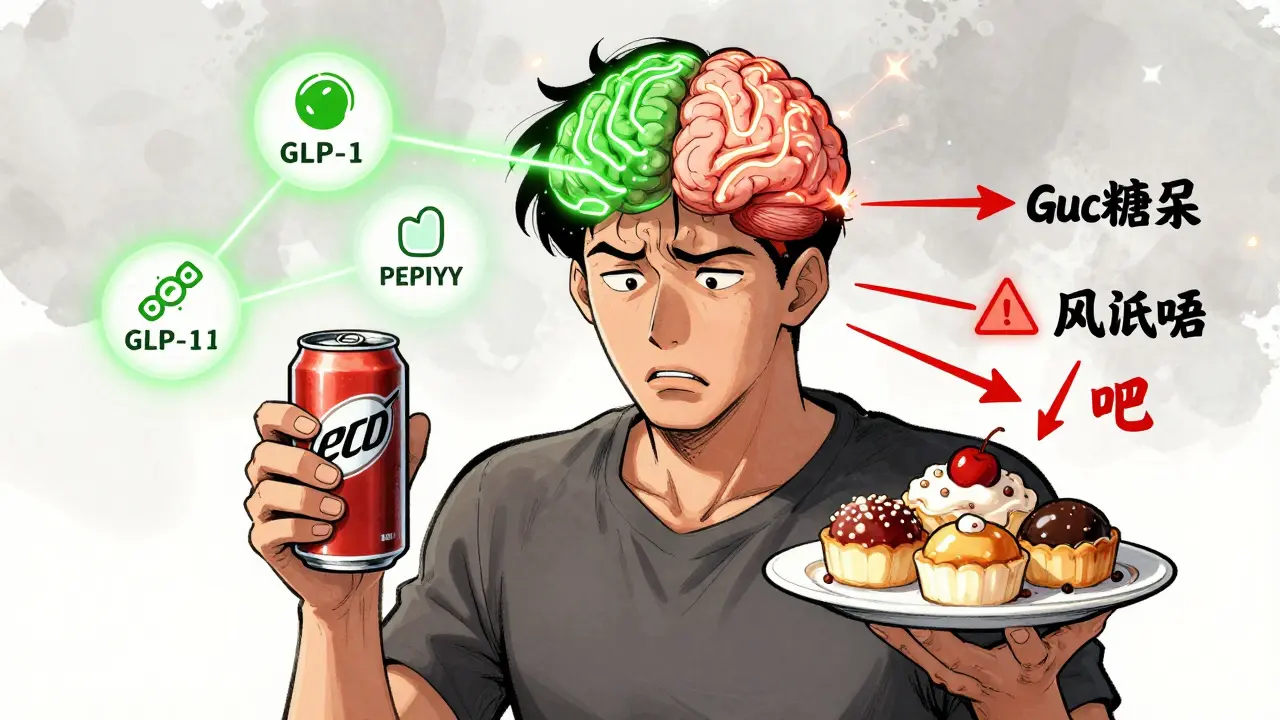
When you reach for a diet soda or sugar-free gum, you're probably trying to cut calories and avoid sugar spikes. But what if that choice is making you hungrier? That’s not just in your head-it’s happening in your brain, your gut, and your hormones. The truth about sugar versus artificial sweeteners isn’t as simple as calories in, calories out. For many people, swapping sugar for artificial sweeteners doesn’t lead to less eating. It can actually make you crave more.
Why Sugar Feels Different Than Sweeteners
Sugar doesn’t just taste sweet. It triggers a chain reaction in your body. When you eat it, your blood sugar rises, your pancreas releases insulin, and your gut sends signals to your brain saying, "I’m full." Key hormones like GLP-1 and peptide YY kick in, telling you to stop eating. That’s why a piece of fruit or a small serving of honey can feel satisfying. Artificial sweeteners? They don’t do that. They’re 200 to 600 times sweeter than sugar, but they don’t raise blood sugar or insulin. That means your body doesn’t get the signal that you’ve eaten something real. In a 2023 study from the University of Southern California, participants who drank a sucralose-sweetened beverage had 17% higher hunger ratings than those who drank sugar water. Their brains didn’t register the sweetness as energy. So even though they consumed zero calories, their bodies kept looking for more.The Brain’s Sweetness Trap
Your brain learns through experience. If you’ve eaten a lot of sugary foods, your brain links sweetness with energy. When you switch to artificial sweeteners, that link breaks. Over time, your brain starts to think: "Sweetness means I’m being tricked." And it responds by making you crave more. A 2016 study from the University of Sydney showed this clearly. Fruit flies fed sucralose for five days then ate 30% more food when given real sugar. The same pattern shows up in humans. People who drink diet soda daily often report stronger cravings for sweets later in the day. One Reddit user wrote: "I cut out soda for a week and my chocolate cravings dropped by half. I didn’t even realize how much I was chasing that sugar rush." This isn’t just about willpower. Functional MRI scans show that artificial sweeteners like sucralose change how the hypothalamus talks to the brain’s reward center. In women, this disruption was 40% stronger than in men. That might explain why so many women report increased hunger after switching to diet products.
Not All Sweeteners Are the Same
It’s easy to think "all artificial sweeteners are bad," but that’s not true. Different sweeteners affect your body differently.- Sucralose (Splenda): Linked to the highest increase in hunger. A 2024 study found it activated hypothalamic hunger centers by 34% in long-term users.
- Aspartame (Diet Coke, Sugar-Free Gum): Shows mixed results. Some people get stronger cravings; others don’t. A 2023 American Diabetes Association survey found 41% of users reported increased appetite.
- Acesulfame potassium (often paired with sucralose): Often used in diet sodas. Studies show it can raise insulin levels slightly in some people, confusing the body’s hunger signals.
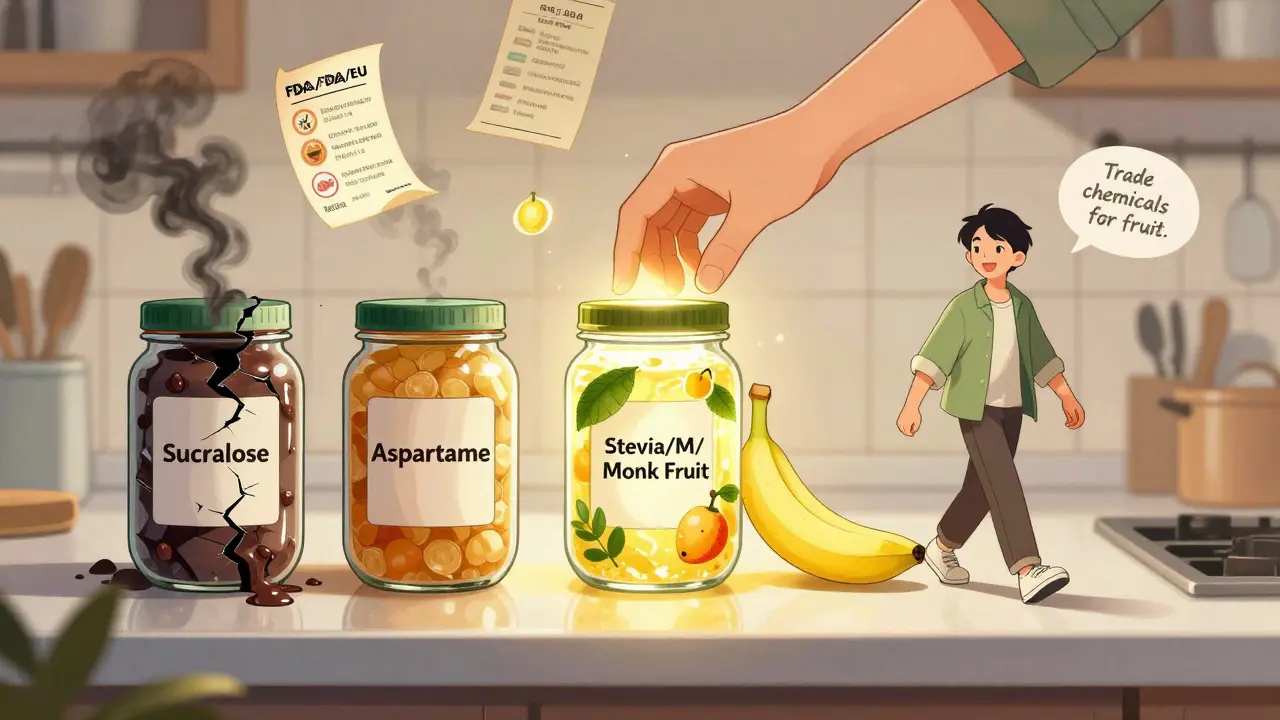
- Stevia and monk fruit: These come from plants. A 2023 Amazon survey found only 15% of users reported appetite issues-compared to 28% for sucralose. They also don’t trigger the same brain changes seen with synthetic sweeteners.
Even the FDA and European Food Safety Authority treat them differently. The EU limits aspartame to 40 mg per kg of body weight; the U.S. allows 50 mg. That’s because the science is still evolving-and some agencies are more cautious.
Who Gets Hit Hardest?
Not everyone reacts the same way. Your gender, weight, and metabolic health all play a role.- People with obesity: More likely to feel hungrier after artificial sweeteners. Their bodies may already have disrupted hunger signals, and sweeteners make it worse.
- Women: Brain scans show stronger changes in hunger centers. Hormonal differences may make them more sensitive to sweet-taste disruptions.
- Long-term users: The longer you use artificial sweeteners, the more your brain recalibrates. Studies show appetite increases become noticeable after 3 months or more.
- People with type 2 diabetes: Many report better blood sugar control, but 41% say they feel hungrier. That’s a trade-off many don’t expect.
One woman in her 50s from Durban told a local dietitian: "I switched to diet soda to lose weight. Instead, I started snacking more at night. I didn’t understand why-until I stopped using sweeteners altogether. The cravings vanished in three days."
What Actually Works?
If you’re trying to manage cravings and appetite, here’s what the science says:- Try a 2-3 week break: Stop all artificial sweeteners. Many people report reduced cravings after just a few days. This lets your brain reset its sweetness expectations.
- Pair sweeteners with protein: A 2021 study showed that adding protein (like Greek yogurt or cottage cheese) to a sweetened drink cut hunger responses by 22%. Your body needs protein to feel full. Sweeteners don’t provide that.
- Start with low-intensity sweeteners: Monk fruit (150x sweeter than sugar) and stevia are less likely to disrupt hunger signals than sucralose (600x sweeter). They’re also less common in processed foods, so you’re less likely to overconsume them.
- Don’t use sweeteners as a crutch: If you’re drinking diet soda because you’re stressed or bored, you’re not solving the real problem. Address the root cause-sleep, stress, or routine-instead of swapping sugar for chemicals.
- Give your taste buds time: After 4-6 weeks of cutting back on sweetness, your sensitivity to natural sugar increases. A banana will taste sweeter. A cup of tea won’t need sugar. You’ll start to enjoy food without needing it to be intensely sweet.
The Bigger Picture
The artificial sweetener industry is worth over $12 billion. Companies market these products as weight-loss tools. But science doesn’t back that up for everyone. In fact, a 2021 meta-analysis of 15 studies found that while sweeteners reduced daily calorie intake by 112 kcal on average, long-term users often gained back the weight-or more. Why? Because appetite isn’t just about calories. It’s about signals. If your brain thinks you’re being deceived, it fights back. And it’s not always by making you eat more-it’s by making you crave the wrong things: sugary snacks, processed foods, and high-carb comfort meals. The best strategy? Use sweeteners as a short-term tool, not a lifestyle. If you’re cutting sugar to manage diabetes or lose weight, a few weeks of artificial sweeteners can help. But don’t rely on them forever. Your body wants real food. Real energy. Real signals.One dietitian in Cape Town put it simply: "I tell my clients: Don’t trade sugar for chemicals. Trade sugar for fruit, nuts, and protein. The sweetness you’re looking for? It’s already there. You just need to let your taste buds remember it."
Do artificial sweeteners make you gain weight?
Not directly-but they can contribute to weight gain by increasing hunger and cravings. Studies show that while sweeteners reduce calories in the short term, long-term use (over 3 months) can lead to increased appetite, especially with sucralose and aspartame. This can cause people to eat more later in the day, undoing any calorie savings.
Is stevia better than sucralose for controlling appetite?
Yes, generally. Stevia and monk fruit are plant-based and less likely to disrupt hunger signals. A 2023 survey found only 15% of stevia users reported increased cravings, compared to 28% for sucralose users. They also don’t trigger the same brain changes seen with synthetic sweeteners like sucralose.
Why do I crave sweets more after drinking diet soda?
Diet soda tricks your brain. It gives you sweetness without calories. Over time, your brain learns that sweetness doesn’t mean energy, so it starts demanding more food to compensate. This is called "sweetness recalibration." It’s why many people report stronger cravings after weeks or months of regular diet soda use.
Can artificial sweeteners affect blood sugar?
Most don’t raise blood sugar directly. In fact, studies show sucralose has 86% less impact on blood glucose than sugar. But some people experience small insulin spikes, especially with aspartame and acesulfame potassium. This can confuse hunger signals and lead to cravings later.
Should I quit artificial sweeteners cold turkey?
Not necessarily. A sudden stop can cause temporary mood swings or headaches in some people. Instead, try reducing your intake over 1-2 weeks. Replace diet sodas with sparkling water and lemon, or switch to stevia-sweetened options. Most cravings fade within 10-14 days.
Are there any safe limits for artificial sweeteners?
Yes. The FDA allows up to 50 mg of aspartame per kg of body weight daily-that’s about 18 cans of diet soda for a 70 kg person. The EU sets a lower limit at 40 mg/kg. But safety doesn’t mean effectiveness. Even within these limits, long-term use may still affect appetite and cravings in sensitive individuals.






Let me guess: you think this is about willpower. It’s not. It’s about biohacking your neural reward pathways. Artificial sweeteners are a corporate-designed glitch in the system. They hijack your dopamine receptors like a rogue algorithm. You’re not craving sugar-you’re craving truth. And your brain knows it.
Stop treating food like a math problem. Calories don’t lie. But your neurons? They’re screaming.
Read the 2024 hypothalamic activation study again. It’s not speculation. It’s surveillance.
And yes-I’m talking to you, the person still drinking Diet Coke while reading this.
Based on the peer-reviewed data from the USDA’s 2023 Neuro-Gut Axis Report, the sucralose-induced ghrelin dysregulation in high-fructose consumers is statistically significant (p < 0.01). The FDA’s 50 mg/kg threshold is a relic of 1980s lobbying, not neuroendocrinology.
Stevia’s glycoside structure doesn’t activate T1R2/T1R3 receptors the same way synthetic analogues do. That’s why it doesn’t trigger the cephalic phase insulin response. You’re not ‘craving’-you’re in metabolic confusion.
TL;DR: Stop using artificial sweeteners as a crutch. Use whole foods. Or get a PhD.
OMG I JUST REALIZED WHY I’VE BEEN SNACKING AT 2AM
I switched to diet soda last year and now I’m eating entire bags of gummy bears like it’s my job
I thought I was being healthy
Turns out my brain is like ‘where’s the sugar??’ and it’s screaming at me like a toddler in a toy store
Deleted all my diet sodas today
WORTH IT
I used to drink diet soda every day. Now I don’t. I eat an apple instead. I feel better. End of story.
This is such an important topic and I’m so glad someone broke it down clearly.
I’ve been experimenting with cutting out artificial sweeteners for a month now and honestly? My cravings for sweets have dropped dramatically. I used to need something sweet after every meal. Now I’m fine with tea or even just water.
Also, my sleep improved. I didn’t even realize how much the nighttime sugar crashes were messing with me.
It’s not about deprivation-it’s about retraining. And it’s possible.
You’re all being manipulated. This isn’t science. It’s fearmongering disguised as nutrition. The food industry doesn’t want you to think critically. They want you to buy their ‘natural’ sweeteners at 3x the price. Stevia? It’s still a chemical isolate. Monk fruit? Extracted with solvents. You’re not ‘cleaning up’ your diet-you’re falling for a new marketing gimmick.
Real food doesn’t need labels. Real food doesn’t need ‘sweetness.’ You’ve been conditioned to need it. Break the spell. Eat meat. Eat vegetables. Eat fat. Don’t overthink it.
And stop trusting studies funded by ‘wellness’ brands.
So… diet soda makes you hungry? Wow. Groundbreaking.
I’ve known this since 2012. I just didn’t care because I liked the taste.
Now I drink sparkling water. Still tasteless. Still life.
The methodology of the referenced 2023 Amazon survey is deeply flawed. Self-reported appetite data lacks physiological validation. Moreover, the comparison between plant-derived sweeteners and synthetic ones ignores bioavailability, glycemic index, and receptor affinity dynamics. Without controlled, double-blind, longitudinal trials, these assertions remain anecdotal extrapolations.
Furthermore, the assertion that ‘your brain learns’ through sweet-taste conditioning conflates operant conditioning with neuroendocrine signaling. This is a reductionist narrative that appeals to lay audiences but lacks epistemological rigor.
Recommendation: Consult peer-reviewed meta-analyses in the American Journal of Clinical Nutrition, not Reddit.
You’re all wrong. The real issue is that sugar is a toxin. Artificial sweeteners are a necessary compromise. The hunger you feel? That’s your body detoxing. You think your brain is being tricked? No. It’s being reawakened.
Try fasting. Try ketosis. Try eating like a caveman.
Or keep drinking your diet soda and blaming science for your lack of discipline.
I’ve been sugar-free for 12 years. I don’t crave anything. Because I don’t need to.
So let me get this straight: you’re telling me that if I stop drinking diet soda, I’ll suddenly start enjoying the taste of a banana?
Like, the same banana I’ve been eating for 15 years that tastes like cardboard?
Oh wait. No. That’s not how it works. You’re not ‘resetting’ your taste buds. You’re just removing a stimulant and pretending it’s a spiritual awakening.
It’s not magic. It’s habituation. And yes, you’ll crave less sugar. But not because your brain ‘learned’ anything. You just stopped giving it a dopamine hit.
Stop selling this as enlightenment. It’s withdrawal.