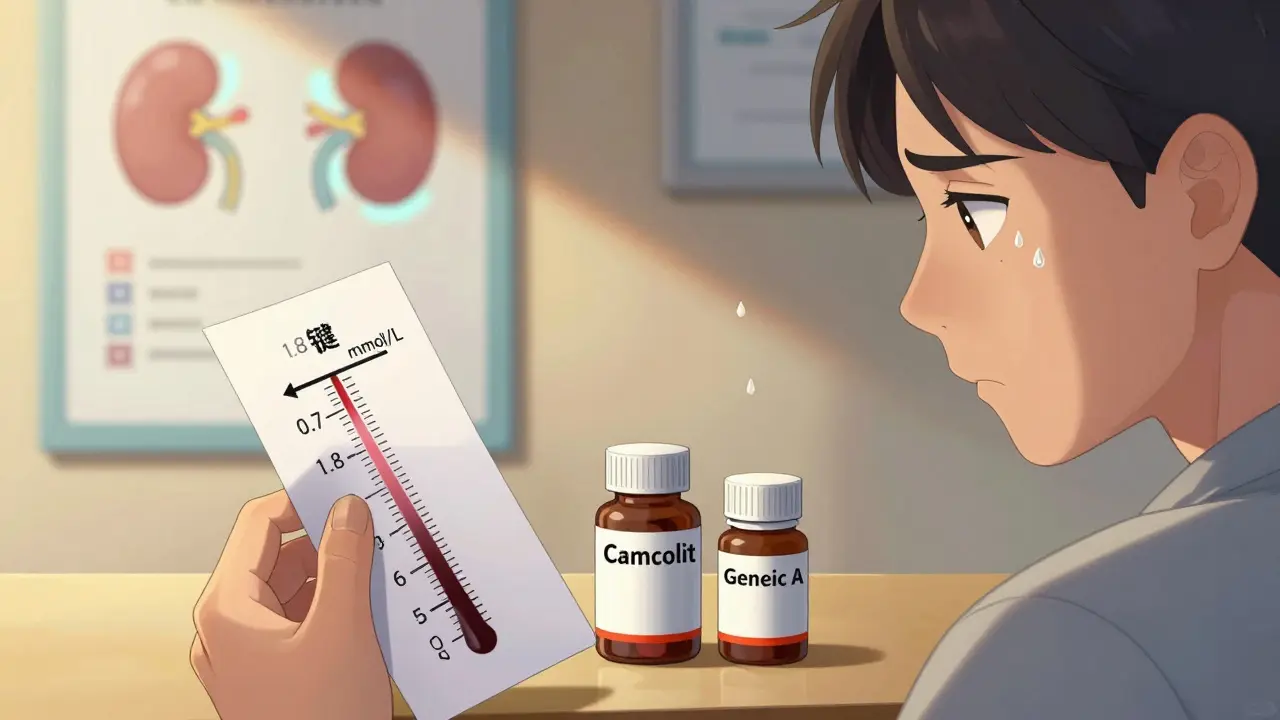
When treating bipolar disorder, lithium carbonate remains one of the most effective long-term mood stabilizers. But if you're prescribed a generic version, you can't assume it behaves exactly like the brand-name product-even if the label says it's the same. The real difference isn't in the active ingredient. It's in how your body absorbs it. And that tiny variation can push your blood levels from safe into dangerous territory.
Why Lithium Isn't Like Other Medications
Most drugs have a wide safety window. Take ibuprofen: 200 mg, 400 mg, even 800 mg-your body handles it without much fuss. Lithium isn't like that. Its therapeutic range is razor-thin: 0.6 to 1.2 mmol/L. Go below 0.6, and your mood might spiral. Rise above 1.5, and you risk seizures, kidney damage, or even cardiac arrest. This narrow window is why every dose adjustment, every switch in brand, every change in diet or hydration needs to be tracked with precision. And that’s where generic lithium carbonate gets tricky.Generics Are Bioequivalent-But Not Identical
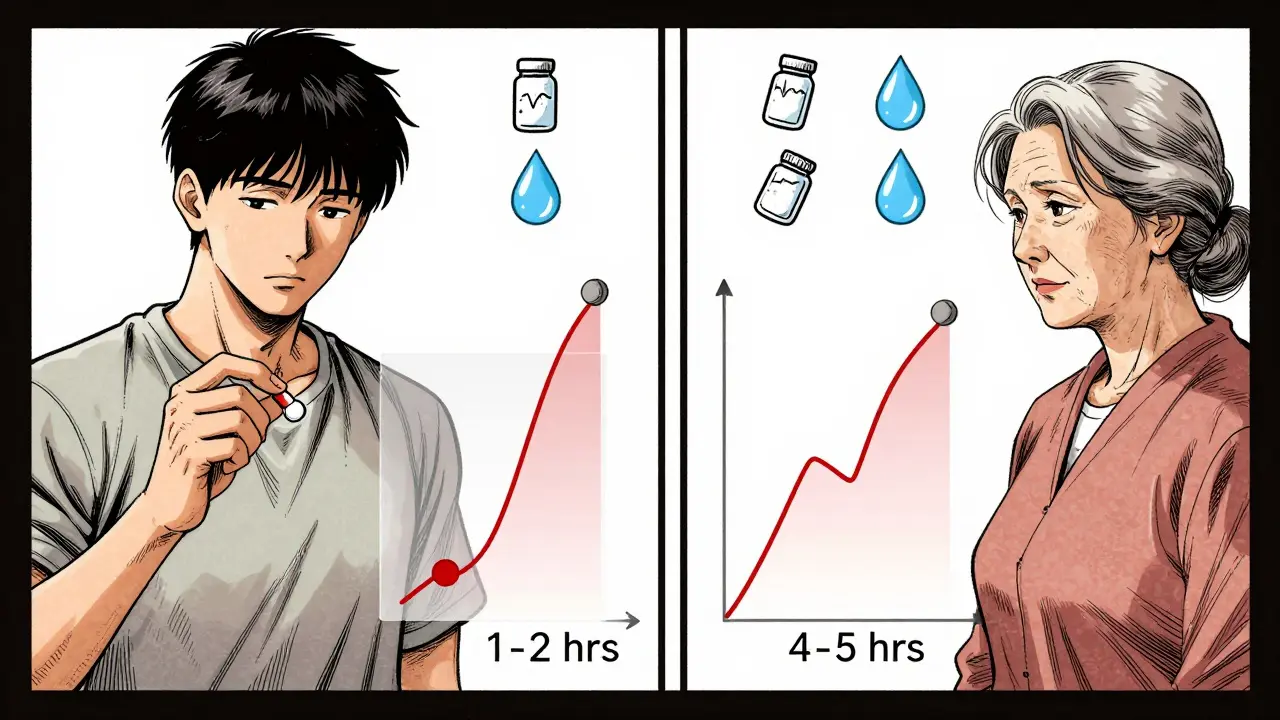
All FDA-approved generic lithium must prove it delivers 80-125% of the brand’s absorption rate. That sounds strict. But here’s the catch: that 45% range is huge for a drug with a 0.6 mmol/L safety margin. For example, one study found that switching from Camcolit (a sustained-release tablet) to Priadel led to an 11% increase in average serum levels-even though patients were given the same milligram dose. Another study showed up to 20% variation in peak blood levels between two different sustained-release generics. That’s not a fluke. It’s a pattern. Why? Because lithium isn’t just about how much enters your bloodstream. It’s about how fast it gets there. Standard-release tablets peak in 1-2 hours. Extended-release versions take 4-5 hours. That delay changes how your brain experiences the drug. A sudden spike in concentration-even within the "safe" range-can trigger tremors, nausea, or confusion. A slow, flat curve might leave you feeling foggy but stable.What Your Doctor Should Be Monitoring
If you’re on lithium, your blood level should be checked regularly. But here’s what most patients don’t know: when you draw that blood matters. - For standard-release lithium (taken 2-3 times daily), the blood test should be done 12 hours after your last dose. That’s when levels stabilize. - For once-daily extended-release (like Camcolit or Priadel), the test should be done 24 hours after the last dose. That’s when the true steady-state level shows up. If your doctor draws it too early or too late, you might get a false reading. And that could lead to a wrong dose adjustment. Other tests are just as critical:- Renal function: Lithium is cleared by your kidneys. If your eGFR drops below 60 mL/min, your risk of toxicity rises sharply. Use cystatin C-not just creatinine-to get a clearer picture.
- Thyroid levels: Up to 15% of long-term users develop hypothyroidism. Check TSH every 6-12 months.
- Sodium and hydration: Low sodium (from salt-restricted diets, diuretics, or excessive sweating) can cause lithium to build up. Even mild dehydration can push levels into the toxic range.
Dosing Isn’t One-Size-Fits-All
The standard maintenance dose for adults is 900-1200 mg of extended-release lithium per day. But age, sex, and weight change everything. - People under 40: 25-35 mmol/day (925-1300 mg lithium carbonate) - Ages 40-60: 20-25 mmol/day (740-925 mg) - Over 60: 15-20 mmol/day (550-740 mg) Women typically need 10-15% less than men, even after adjusting for weight. And older patients often need even lower doses because their kidneys slow down. One 2024 study found that patients over 80 received, on average, 437 mg less per day than those under 30. Yet many clinicians still use the same dose for everyone. That’s dangerous.Switching Brands? Check Your Levels
Here’s the most overlooked risk: switching between generic brands. If your pharmacy swaps Camcolit for a cheaper generic, your doctor might not know. But your blood level might jump 15-20%. In one study, four patients developed toxic lithium levels (1.32-1.88 mmol/L) after a brand switch-even though their dose didn’t change. The FDA says generics are bioequivalent. But bioequivalence doesn’t mean identical. It means they’re close enough to pass a lab test. It doesn’t guarantee your body will respond the same way. Always ask your pharmacist: "Is this the same formulation I was on?" If they say "yes," ask for the manufacturer’s name. If it’s different, insist on a serum level check within 7-10 days.
Target Levels Vary by Phase of Illness
There’s no single "correct" level. It depends on what you’re treating.- Acute mania: Target 0.8-1.2 mmol/L
- Maintenance: 0.6-0.8 mmol/L
- Preventing suicide: Studies show levels above 0.8 mmol/L reduce risk more effectively
- Elderly patients: Many experts recommend 0.4-0.6 mmol/L, with very close monitoring
What’s Changing in 2026
New research is making lithium care more precise: - The International Consortium on Lithium Genetics (ConLiGen) has identified over 30 gene variants linked to how people metabolize lithium. In the next few years, genetic testing may help predict your ideal dose before you even start. - AI-driven dosing tools are being tested in hospitals. They combine your age, weight, kidney function, and lab history to predict the right dose-down to the 50 mg. - The FDA now requires in vivo studies for extended-release lithium generics. That means manufacturers must prove their product behaves like the brand in real people-not just in test tubes. But until these tools become routine, the old rules still apply: Know your level. Know your brand. Know your body.What You Should Do Right Now
If you’re taking lithium carbonate:- Find out which brand or generic you’re on. Write it down.
- Ask your doctor when your last serum level was checked-and what the result was.
- Ask if your dose is adjusted for your age, kidney function, and gender.
- Never refill without checking the manufacturer name. If it changed, call your doctor before taking the next pill.
- Drink water consistently. Avoid extreme salt changes or diuretics.
- Get thyroid and kidney tests every 6 months, even if you feel fine.
Can I switch between lithium generics without checking my blood level?
No. Even though generics are approved as bioequivalent, studies show switching between brands can raise or lower your serum lithium level by 10-20%. That’s enough to cause toxicity or loss of effectiveness. Always check your level 7-10 days after any brand change.
Why is lithium still used when newer drugs exist?
Lithium is the only mood stabilizer proven to reduce suicide risk long-term. While newer drugs like quetiapine or valproate help with mania and depression, none match lithium’s ability to prevent relapse over decades. It’s also far cheaper. For many patients, especially those with bipolar I disorder, it remains the most effective option.
What’s the difference between immediate-release and extended-release lithium?
Immediate-release tablets peak in blood within 1-2 hours and require 2-3 doses daily. Extended-release versions (like Camcolit or Priadel) take 4-5 hours to peak and are taken once or twice daily. Extended-release forms cause fewer side effects like nausea and tremors because they avoid sharp spikes in blood levels. But they require different timing for blood tests.
Can I take lithium if I have kidney problems?
Lithium is cleared by the kidneys. If your eGFR drops below 30 mL/min, lithium is generally contraindicated. For mild to moderate kidney impairment (eGFR 30-60), your doctor may lower your dose and monitor you more closely. Always use cystatin C, not just creatinine, to assess kidney function accurately.
Do I need to avoid salt if I’m on lithium?
No-you shouldn’t avoid salt. In fact, sudden drops in sodium (from low-salt diets, vomiting, or excessive sweating) can cause lithium to accumulate to toxic levels. Maintain normal sodium intake. Don’t go on extreme diets or use diuretics without your doctor’s approval.



Lithium is one of those drugs that feels like walking a tightrope blindfolded. One day you're stable, next day you're nauseous and trembling. I switched generics last year and didn't think twice. Big mistake. My level jumped to 1.3. Took three weeks to get back to baseline. Never again. Always check the brand. Always.
Your body doesn't care what the label says. It cares what's actually in the pill.
Thanks for laying this out so clearly. I've been on lithium for 12 years and never knew the timing of blood draws mattered so much. My doctor always tested at 12 hours - turns out I was on extended-release. My levels were being underreported. Now I know why I felt foggy all winter.
Small changes, huge impact. Appreciate the detail.
I'm a clinician and I've seen this too many times. A patient comes in saying 'I feel worse since my last refill.' We check labs - level is up 0.4 mmol/L. Switched generics. No one told them. No one asked.
We need better pharmacy alerts. This isn't a tech problem. It's a system failure.
The FDA's bioequivalence standard is a joke. 80-125%? That's not equivalence - that's a casino. Lithium isn't aspirin. You can't treat a neurochemical disorder like a commodity.
This is why I refuse generics. I pay extra for brand. My brain isn't a cost center.
I bet this is all just Big Pharma pushing brand names to keep prices high. Generics are cheaper because they're not over-engineered. They're not trying to profit off your fear.
You're being manipulated. Trust your body. Not the label.
Lithium is the OG mood stabilizer - like a vinyl record in a Spotify world. But let’s be real: if your kidneys are on vacation and your sodium’s doing yoga, you’re basically brewing your own poison soup.
This isn't medicine. It's alchemy with a side of dehydration.
I’ve been on lithium for 15 years. My dose hasn’t changed. My brand hasn’t changed. My blood levels? Always steady.
It’s not magic. It’s consistency. Know your numbers. Stick to one source. Don’t gamble with your brain.
Did you know the FDA doesn’t require manufacturers to disclose which excipients are used in lithium generics? Some contain sodium stearate - which binds to lithium and alters absorption.
This is why your level spikes. It’s not random. It’s hidden. Someone’s hiding the ingredients. Why?
I switched to a new generic last month and felt like I was underwater for two weeks. My doctor said it was 'probably stress.' I checked my level. It was 1.4.
I demanded a return to my old brand. They said no. So I switched pharmacies. Now I'm stable again.
This is why you have to be your own advocate. No one else will.