Anticoagulant Timing Calculator
Calculate Safe Anticoagulant Timing
Use evidence-based guidelines from 2023 CHEST and 2024 ACC to determine when to stop and restart anticoagulants before surgery.
Patient Risk Scores (Optional)
Results
When to Stop:
When to Restart:
Special Considerations:
Emergency Surgery?
If surgery is unplanned:
Dabigatran: Idarucizumab (cost ~$3,700/vial)
DOACs (apixaban/rivaroxaban): Andexanet alfa (13% risk of stroke within 30 days)
Use reversal agents ONLY for life-threatening bleeding
Why Stopping Blood Thinners Before Surgery Isn’t One-Size-Fits-All
Imagine you’re scheduled for knee replacement surgery. You’ve been taking apixaban for atrial fibrillation for two years. Your surgeon says, "Stop your blood thinner." But when? How long? And what if you have a clot while waiting? This isn’t just a routine instruction-it’s a high-stakes balancing act. Too much anticoagulation, and you bleed out during surgery. Too little, and you could have a stroke or pulmonary embolism days later. The old way-bridging with heparin shots-has been thrown out for most patients. Today, it’s all about timing, risk scores, and knowing exactly which drug you’re on.
DOACs vs. Warfarin: The Big Shift in Practice
Before 2015, warfarin was the only game in town. Stopping it meant checking your INR, waiting days, and often giving you heparin shots to "bridge" the gap. But that approach increased bleeding without reducing clots. Now, direct oral anticoagulants (DOACs) like apixaban, rivaroxaban, dabigatran, and edoxaban are first-line for most patients. Why? They don’t need weekly blood tests. They leave your system faster. And most importantly, you don’t need bridging for most procedures.
Here’s the key difference: Warfarin takes days to clear. DOACs clear in hours. Apixaban? Half-life is 8-15 hours. Rivaroxaban? 5-9 hours. That means you can stop them just 1-3 days before surgery, not 5-7. And you can restart them faster too. The 2023 CHEST guidelines say: don’t bridge for DOACs unless you have a mechanical mitral valve or a recent clot. Most patients don’t.
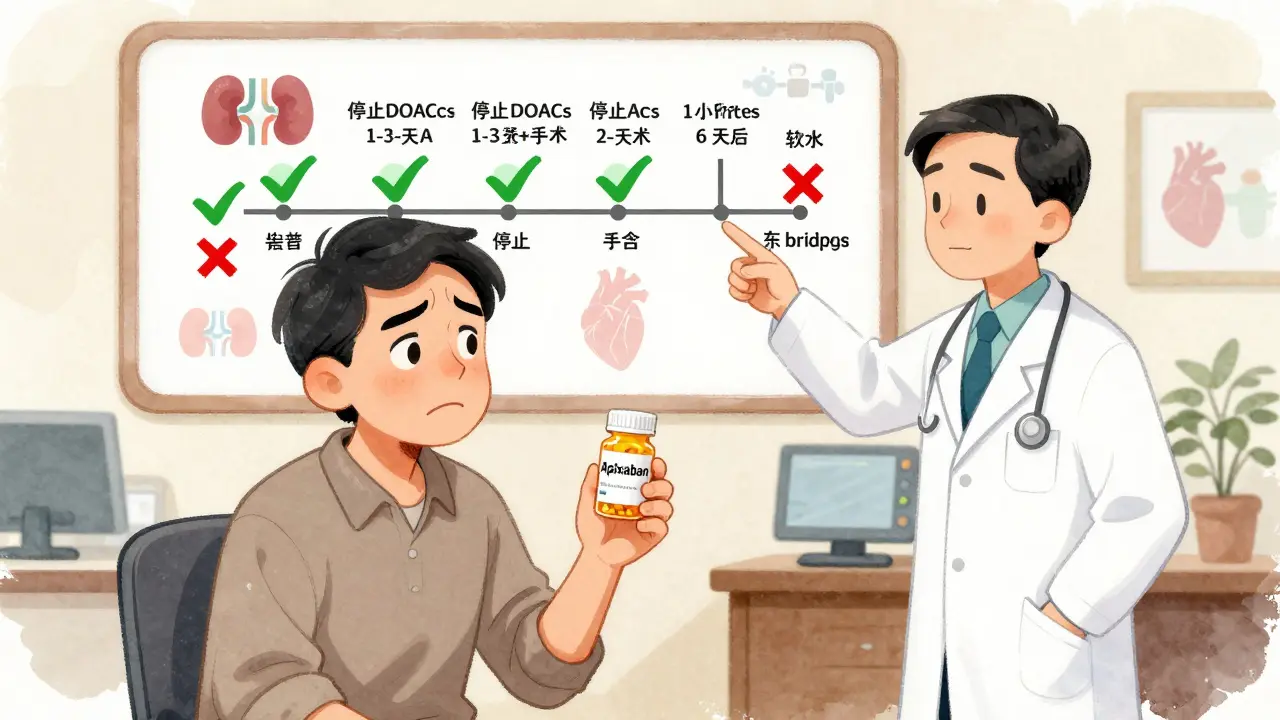
When to Stop: The Exact Timelines You Need
Stopping a blood thinner isn’t guesswork. It’s science. Here’s what the guidelines say for common procedures:
- Low bleeding risk procedures (cataract surgery, dental work, skin biopsies): Keep taking your DOAC. No interruption needed.
- High bleeding risk procedures (joint replacements, brain surgery, major abdominal surgery): Stop apixaban, rivaroxaban, or edoxaban 3 days before. Stop dabigatran 4 days before. Why the difference? Dabigatran is cleared by the kidneys and sticks around longer in older adults or those with kidney issues.
- Neuraxial anesthesia (epidural, spinal block): This is the most dangerous scenario. A spinal hematoma can paralyze you. Stop all DOACs 3 days before (4 days for dabigatran). No exceptions. Even if your kidney function is fine.
For warfarin, stop 5 days before surgery. Check your INR the day before. If it’s above 1.5, you might need vitamin K or fresh frozen plasma. But if it’s below 1.5, you’re safe to proceed.
When to Restart: The Most Overlooked Step
Most clinicians know when to stop. Fewer know when to restart. And that’s where complications happen. Restarting too early? Bleeding. Too late? Clots.
After surgery, wait at least 24 hours before restarting any anticoagulant. But the exact day depends on the procedure:
- Low bleeding risk: Restart on day 1.
- High bleeding risk: Wait until day 2 or 3. Use your surgeon’s judgment.
For patients with high clot risk-like those with a recent deep vein thrombosis or mechanical heart valve-some centers start with a low prophylactic dose (like 2.5 mg of apixaban once daily) on day 1, then switch back to full dose on day 2. This is called a "step-up" approach. It’s not in every guideline, but it’s used in top hospitals.

The Two Risk Scores That Decide Your Fate
You can’t manage anticoagulants without knowing two scores. One tells you your risk of bleeding. The other tells you your risk of clots.
- CHA2DS2-VASc: Measures stroke risk in atrial fibrillation. Points for age, heart failure, diabetes, high blood pressure, prior stroke, vascular disease, and female sex. Score of 2 or higher? You’re at risk. A 3-day break in anticoagulation? Your stroke risk is less than 0.1%. That’s why bridging isn’t needed.
- HAS-BLED: Measures bleeding risk. Points for high blood pressure, liver/kidney disease, stroke history, labile INR, elderly, drugs/alcohol. Score of 3 or higher? You’re at higher risk of bleeding. That doesn’t mean stop anticoagulation-it means be extra careful with timing.
Here’s the truth: 32% of bad outcomes happen because someone misapplied these scores. A 70-year-old with kidney disease and high blood pressure? HAS-BLED score of 4. They’re not a candidate for heparin bridging. They’re a candidate for careful DOAC timing.
Emergency Surgery? What to Do When There’s No Time
What if you’re in a car crash and need emergency surgery? You’re on rivaroxaban. You haven’t stopped it. What now?
You need reversal agents. But they’re expensive and risky.
- Dabigatran: Use idarucizumab. It works in minutes. Cost? About $3,700 per vial.
- Apixaban, rivaroxaban, edoxaban: Use andexanet alfa. It works fast. But here’s the catch: 13% of patients in trials had a stroke or heart attack within 30 days after reversal. That’s higher than the baseline risk.
Don’t use reversal unless you’re actively bleeding or about to operate. And don’t use it for prophylaxis. The 2024 ACC guidelines say: "Reversal agents should be reserved for life-threatening bleeding." They’re not a substitute for good planning.
Why Bridging is Outdated-And When It Still Matters
The PAUSE study in 2018 changed everything. It followed over 3,000 patients on DOACs who stopped their meds before surgery. No bridging. No heparin. Result? Bleeding rates were low. Clot rates? Almost zero.
So why do some hospitals still bridge? Because of old habits. Or because they’re managing a mechanical mitral valve. That’s the one exception. For mechanical mitral valves, guidelines still say: consider bridging. But even here, new data from 2023 CHEST says: "Suggest against bridging." Some centers are already dropping it.
For patients with recent venous thromboembolism (VTE) in the last 3 months? That’s another gray zone. If it’s within 1 month, you might need bridging. After 3 months? Probably not. The 2022 ASH guidelines are clear: "The risk of bleeding from bridging outweighs the small theoretical benefit."

The Hidden Cost of Poor Management
It’s not just about bleeding and clots. It’s about money, time, and hospital performance.
The 2023 NSQIP data shows that improper anticoagulant management causes 8.7% of preventable surgical complications. That means hospitals lose money. Patients stay longer. Some need ICU care. Some die.
And here’s the kicker: 89% of hospitals follow DOAC discontinuation rules. But only 63% get the restart right. That’s the gap. That’s where the mistakes happen. A patient goes home on day 2 after hip surgery, gets a clot on day 4, and comes back. All because someone forgot to restart the drug.
What’s Next? The Future of Blood Thinner Management
The next big thing? Ciraparantag. It’s a universal reversal agent-works on all DOACs, heparin, even warfarin. It’s in Phase 3 trials as of 2025. Early data shows it reverses anticoagulation in under 10 minutes. No more waiting for expensive, risky drugs. If approved, it could make emergency surgery much safer.
But even with new drugs, the core principle won’t change: match the interruption to the risk. Whether it’s 2025 or 2035, you’ll still need to ask: What’s the surgery? What’s the clot risk? What’s the bleeding risk? That’s the only way to keep patients safe.
Final Takeaway: Don’t Guess. Calculate.
There’s no room for intuition here. If you’re managing anticoagulants before surgery, you need a checklist:
- What drug is the patient on? (DOAC or warfarin?)
- What’s their CHA2DS2-VASc score?
- What’s their HAS-BLED score?
- What’s the procedure’s bleeding risk? (Low? High? Neuraxial?)
- When do you stop? When do you restart?
- Do you need reversal agents? (Only if bleeding or emergency.)
Use the guidelines. Use the scores. Don’t rely on memory. Don’t assume. A 75-year-old with kidney disease on apixaban isn’t the same as a 45-year-old on warfarin. Tailor it. Or someone could die.






man i’ve seen too many patients get screwed because someone just "guessed" the timing on apixaban. one dude had a spinal block done 2 days after his last dose-kid ended up paralyzed. docs think they’re being careful but they’re just lazy. the guidelines are clear: 3 days for most, 4 for dabigatran. no exceptions. if you’re skimping on time, you’re gambling with someone’s spine.
the HAS-BLED score is so underutilized. i’ve had residents tell me "oh, he’s old, so we’ll bridge"-but if their HAS-BLED is 4 and CHA2DS2-VASc is 2, bridging is the *riskier* choice. it’s not about age, it’s about balance. we treat risk like it’s binary when it’s a spectrum. this post should be mandatory reading for every med student.
yeah sure. guidelines. whatever.
wait so if you have kidney issues you stop dabigatran 4 days before? i think i read that wrong… or was it 5? i’m so confused now. also, is it "apixaban" or "apixibin"? i keep spelling it wrong lol
let me tell you about my uncle in rural Nebraska-he had a knee replacement, was on rivaroxaban, and the hospital told him to stop 3 days out. he did. but then they didn’t restart it for 72 hours after surgery. he got a PE on day 4. they blamed "patient noncompliance." but he was on a 3-day dosing schedule, and no one told him when to start again. this isn’t just medical-it’s systemic failure. we treat patients like they’re supposed to memorize pharmacokinetics. the system is broken.
the PAUSE study is the cornerstone of modern anticoagulation management. it is not merely supportive evidence-it is definitive. to continue bridging in non-mechanical valve cases is to practice medicine as it was in 2012, not 2025. evidence-based practice is not optional.
One must consider the metaphysical weight of anticoagulation: the delicate dance between life and death, mediated not by divine will, but by half-lives and renal clearance rates. The DOAC revolution did not merely alter clinical practice-it redefined the human relationship with time itself. We now measure mortality not in years, but in hours. And yet, we still cling to the illusion of control. Is it not arrogance to believe we can predict clotting with scores? Or is it humility to acknowledge that, even with perfect calculation, the body retains its mysteries?
everyone says don’t bridge but what if the real reason is pharmaceutical companies pushing DOACs because they make more money? heparin’s cheaper and we’ve been using it for decades. who funded the PAUSE study? who owns the patents on andexanet? someone’s making bank off this "new science"
what about patients who take their DOACs at night? if they stop 3 days before surgery, does the timing of the last dose matter? like if they took it at 11pm on day -3, is that effectively the same as taking it at 8am? i’ve never seen this addressed. also-what if they’re on a twice-daily dose? does that change the window? just wondering.
THIS. THIS RIGHT HERE. 🙌 finally someone lays it out without the fluff. i work in OR nursing and 7/10 times, the anticoagulation restart is forgotten. we get the patient to recovery, they’re all groggy, and no one says "hey, take your apixaban." then we get a call 3 days later: "my leg is swollen." please, hospitals-put a checklist on every pre-op form. or better yet, automate it in the EHR. we can do better. we owe our patients that.
you think ciraparantag is the future? nah. it’s just another drug that’ll cost $15k a dose and only be available in academic centers. meanwhile, in the real world, nurses are still guessing when to restart rivaroxaban because the resident didn’t document it. the real innovation isn’t the reversal agent-it’s the damn checklist. if you’re not using one, you’re not a clinician-you’re a gambler with a stethoscope
why are we trusting american guidelines? in India we know better. we have seen too many patients die from blood thinners. we just stop everything and wait. no scores, no science. if the patient bleeds, it’s God’s will. if they clot, it’s God’s will. we don’t need your charts. we have faith.