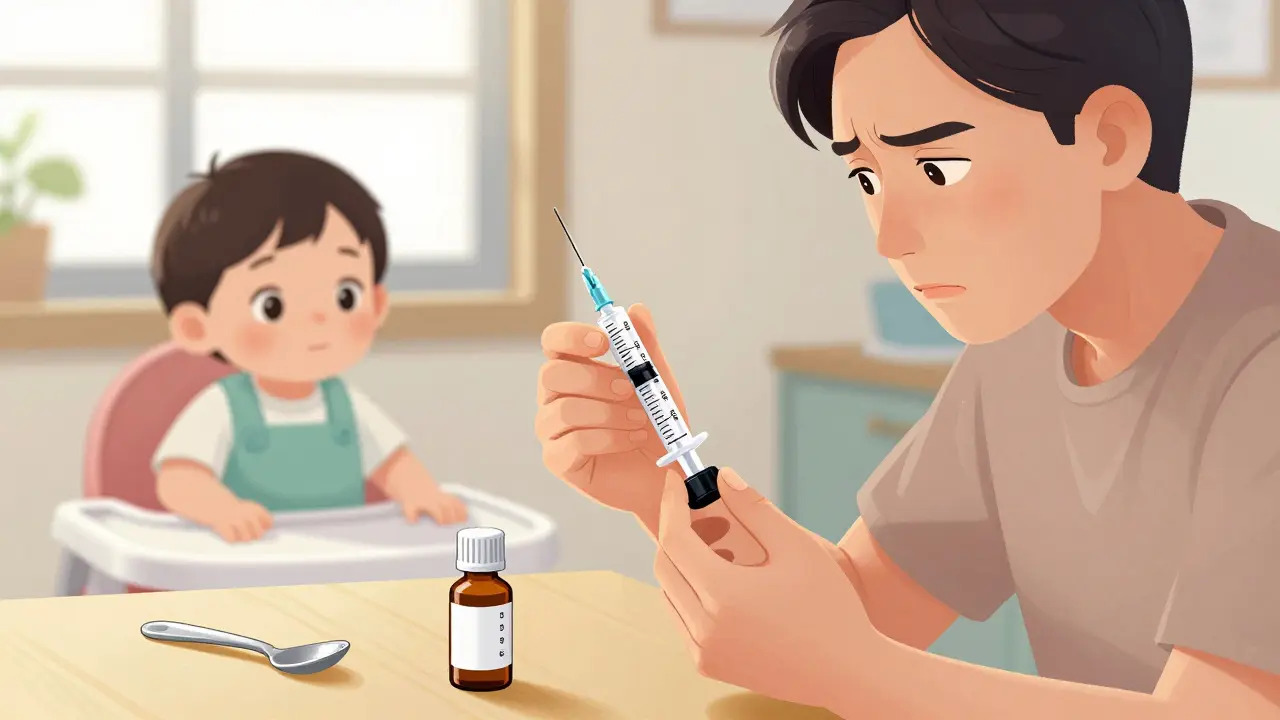
Giving liquid medicine to a child isn’t as simple as pouring it into a spoon. One wrong milliliter can mean the difference between helping your child feel better and causing harm. In fact, dosing syringes are the most reliable tool for giving kids their medicine - and they’re not just for hospitals. Parents use them every day at home, and getting it right matters more than you think.
Why Dosing Syringes Are the Only Safe Choice
Kitchen spoons, medicine cups, and even the little plastic spoons that come with the bottle? They’re all risky. A 2016 study found that household teaspoons vary wildly - anywhere from 2.5 to 10 milliliters. That’s a 400% error rate. Even the dosing spoons provided by pharmacies have a 22% chance of being wrong. When your child needs 2.5 mL of acetaminophen, and you give them 3.8 mL because the spoon looked "about right," you’re overmedicating. Too little, and the fever won’t break. Too much, and you risk liver damage. Oral syringes, on the other hand, are designed for precision. They’re marked in 0.01 mL, 0.1 mL, or 0.2 mL increments depending on size. They’re calibrated to stay within 5% of the correct dose. That’s why the American Academy of Pediatrics, the FDA, and the Institute for Safe Medication Practices all say: use an oral syringe, not a spoon. In 2023, a study showed that parents who switched from cups to syringes reduced their child’s fever spikes by 3°F - not because the medicine changed, but because they finally gave the right dose.Choosing the Right Syringe Size
Not all syringes are made the same. The size you pick depends on how much medicine your child needs:- 1 mL syringe - for doses under 1 mL. Marked in 0.01 mL steps. Best for infants on antibiotics or heart meds.
- 3 mL syringe - for doses between 1 and 3 mL. Marked in 0.1 mL steps. Most common for fever reducers like acetaminophen or ibuprofen.
- 5 mL syringe - for 3 to 5 mL doses. Marked in 0.2 mL steps. Used for larger volumes like some antibiotics or antihistamines.
- 10 mL syringe - for doses over 5 mL. Marked in 0.5 mL steps. Less common, but useful for older kids on higher doses.
Never use a 10 mL syringe for a 1.5 mL dose. The markings are too far apart - you’ll guess, and guessing kills accuracy. Always match the syringe size to the dose. If your doctor prescribes 2.3 mL, grab the 3 mL syringe. Not the 5 mL. Not the cup. The 3 mL.
How to Draw the Correct Dose
It’s not just about pulling the plunger. Here’s how to do it right:- Shake the bottle for 10-15 seconds. Liquid meds like amoxicillin or ibuprofen settle. If you don’t shake, the first dose might be too weak, the next too strong.
- Remove the cap. Check the syringe cap - if it’s still on, you’re risking a choking hazard. The FDA reported 12% of incidents involved parents forgetting to remove the cap before use.
- Insert the syringe tip into the bottle. Don’t touch the tip to anything else. Keep it clean.
- Pull the plunger slowly until the top edge of the black rubber stopper lines up exactly with the dose mark. Don’t go past it. Don’t eyeball it. Use the line.
- Check the mark from eye level. Hold the syringe up to the light. Look straight on. Tilting your head gives you a false reading.
Pro tip: Many parents draw the dose, then check the bottle again. That’s smart. If the bottle says 160 mg per 5 mL and your child needs 120 mg, that’s 3.75 mL. If you’re using a 3 mL syringe, you can’t draw 3.75 mL. You need a 5 mL syringe. Always double-check the math and the tool.
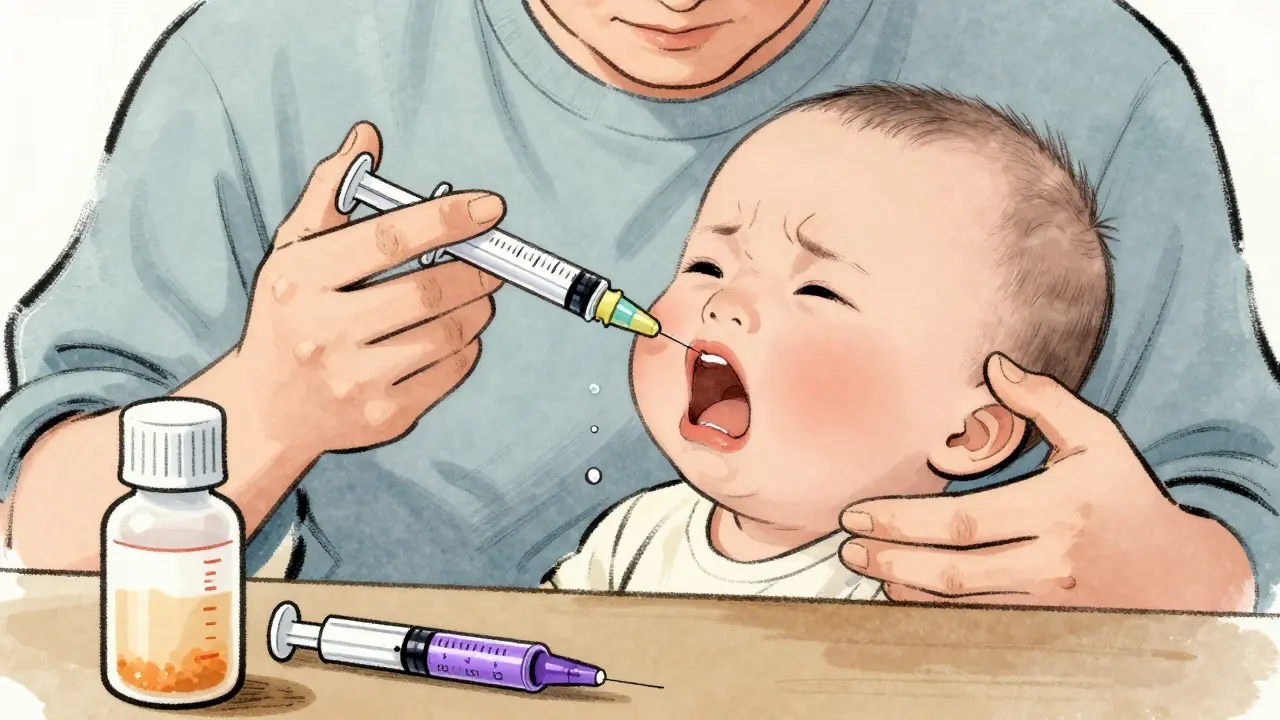
How to Give the Medicine Without a Fight
Even if you measure perfectly, the child might spit it out. Here’s how to get it in:- Hold your child upright. Never lie them flat. That’s how choking happens.
- Place the syringe tip between the cheek and the gum - not at the back of the throat. Squirtting it toward the throat causes gagging and vomiting. A 2023 study found 15% of kids choked because parents aimed too far back.
- Push the plunger slowly. Give 0.5 mL at a time. Wait 5-10 seconds between each push. Let them swallow. Rushing makes them gag or spit.
- Don’t force it. If they’re resisting, pause. Try again in 30 seconds. A calm parent = a calmer child.
Some parents swear by giving a little cold water or juice after to wash the taste away. That’s fine - as long as you wait until the full dose is swallowed. Don’t mix the medicine into a full bottle of juice. You’ll never know if they drank it all.
What About Thick Medicines Like Amoxicillin?
Antibiotics like amoxicillin are thick. They stick to the sides. One in five parents struggle to draw them into the syringe. Here’s how to fix it:- Shake the bottle harder. Five seconds isn’t enough. Shake for 15 seconds - like you’re trying to wake it up.
- Use a 5 mL syringe. Thicker liquids move better in larger tubes.
- Let the medicine sit at room temperature for 10 minutes. Cold meds are thicker.
- Hold the syringe upside down after drawing. Tap the side gently to help the liquid flow down. Then turn it right-side up and check the mark again.
Some parents try to use a needle to draw it. Don’t. Oral syringes are labeled “for oral use only” for a reason. In 2009, 137 kids were accidentally given oral meds through IV lines because someone reused a syringe. That’s why FDA rules now require every oral syringe to say “For Oral Use Only.”
Color-Coded Syringes and Smart Tech
Newer syringes are easier to use. Some come with color-coded plungers: green for acetaminophen, purple for ibuprofen. That’s huge. A mom on Reddit said switching to color-coded syringes cut her dosing mistakes in half. She used to mix them up after night feeds. In 2023, the FDA approved the first syringe that changes color when you draw the right dose - blue turns to green. In trials, it reduced errors by 37%. And by late 2025, smart syringes with Bluetooth will connect to your phone. They’ll remind you when the last dose was given, track if you missed one, and even warn you if you’re about to give too much. These aren’t sci-fi - they’re coming fast.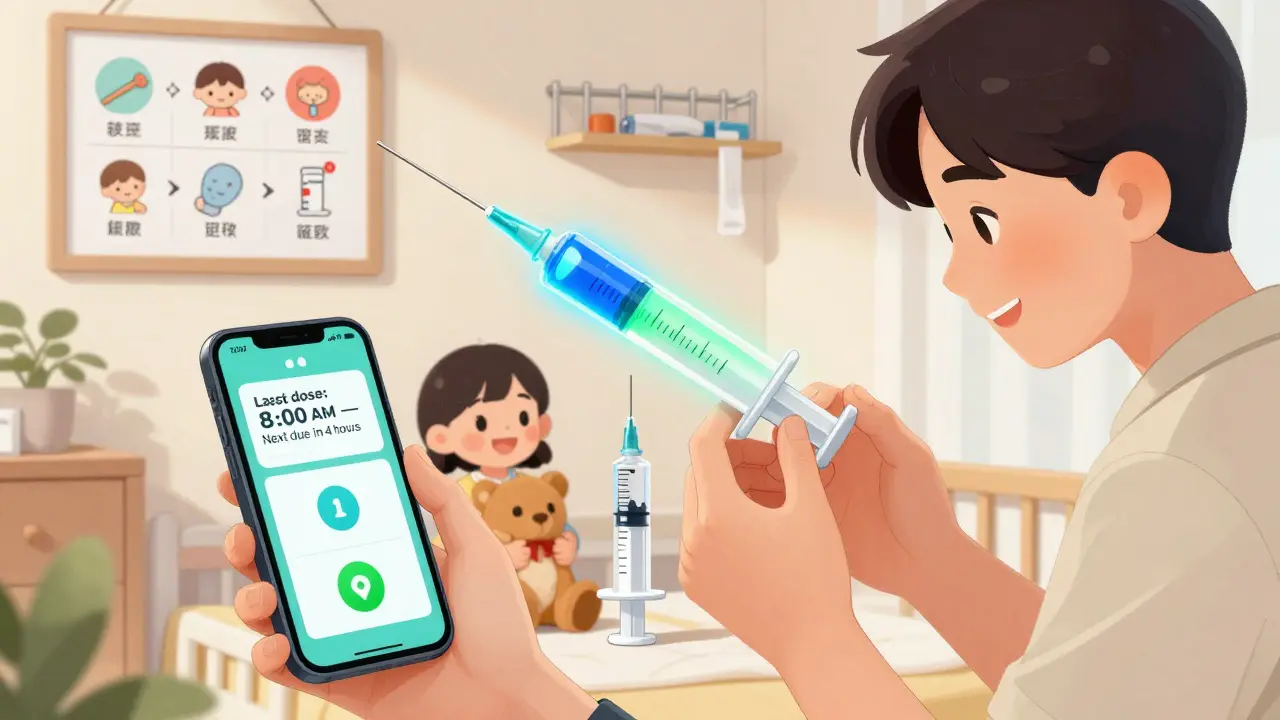
Common Mistakes (And How to Avoid Them)
Most errors aren’t from bad intent. They’re from bad habits. Here are the top mistakes parents make:- Using a kitchen spoon - even if it says "teaspoon." It’s not calibrated.
- Not shaking the bottle - settles cause inconsistent doses.
- Forgetting to remove the cap - choking risk.
- Administering too fast - kids gag and spit.
- Using the wrong syringe size - 10 mL for a 2 mL dose? Too imprecise.
- Not checking the mark from eye level - parallax error is real.
The fix? Practice with water first. Draw 2 mL of water. Give it to a stuffed animal. Do it slow. Feel the plunger. See how the liquid moves. Then do it with the real medicine. Training takes 8-12 minutes. Most parents get it right after one try.
What If You Don’t Have a Syringe?
If your pharmacy didn’t give you one - ask for it. By law, they must provide a proper measuring device with every prescription. If they say no, ask to speak to the pharmacist. You have the right to a syringe. For over-the-counter meds like children’s Tylenol, buy a syringe separately. They cost less than $2 online or at any pharmacy. Look for ones labeled "oral syringe, no needle, metric-only." Avoid anything with a spoon attachment. Stick to syringes.When to Use a Cup Instead
For kids over 4 who can reliably drink from a cup, and doses over 5 mL, a medicine cup is okay. But only if:- It’s the one that came with the bottle (not a random cup)
- It’s marked in mL, not teaspoons
- You read the line at eye level
- You don’t let them drink from it while running around
Even then, a syringe is still safer. But if your child refuses the syringe and you’re giving 8 mL of cough syrup? A cup is better than forcing it - as long as you’re careful.
Can I reuse a dosing syringe?
Yes - if you clean it properly. Rinse with warm water after each use. Don’t use soap unless it’s plastic and labeled dishwasher-safe. Let it air dry. Never boil it or put it in the dishwasher unless the manufacturer says it’s safe. Reusing a dirty syringe can spread germs. But reusing a clean one is fine.
What if I give the wrong dose by accident?
Don’t panic. Call your pediatrician or poison control immediately. Have the medicine bottle handy - they’ll need the concentration (like 160 mg/5 mL) and how much you gave. Don’t wait for symptoms. Even small overdoses of acetaminophen can cause liver damage hours later. Underdosing isn’t usually dangerous, but it won’t help the illness.
Why do some syringes have two sets of numbers?
Some syringes show both mL and teaspoons. Ignore the teaspoon numbers. The FDA banned teaspoon measurements in prescriptions in 2018 because they caused 20% of dosing errors. Only trust the mL markings. If your syringe has both, use the mL side. Always.
Are there syringes for babies who won’t swallow?
Yes. For newborns or babies who can’t swallow, some syringes have soft, flexible tips designed to gently release medicine along the inside of the cheek. Don’t use a regular syringe for this - it’s too stiff. Ask your pharmacist for a "neonatal oral syringe." They’re designed for tiny mouths and slow delivery.
Can I mix medicine with food or juice?
Only if the doctor or pharmacist says it’s okay. Some medicines lose effectiveness when mixed. Others taste worse. If you do mix it, use a small amount - just enough to hide the taste. Make sure your child eats or drinks the whole thing. If they leave half, you’ve given half the dose.
If you’re ever unsure - ask your pharmacist. They’re trained for this. Show them the bottle. Show them the syringe. Ask: "Is this the right size?" They’ll tell you. It’s not a dumb question. It’s the smartest thing you can do.





Let me just say this: if you're still using a kitchen spoon, you're a danger to society. I've seen parents wing it with "a little more than a teaspoon" and then wonder why their kid ended up in the ER. It's not just negligence-it's criminal. The AAP, FDA, and every pediatrician in the country agree: oral syringes only. No exceptions. No excuses. Stop making excuses and get your act together.
And don't even get me started on mixing meds with juice. That's how kids learn to hate medicine and parents learn to lie about doses. It's a slippery slope to chaos.
If you don't have a syringe, go buy one. They're $1.79 at CVS. You're not too busy for your child's life. You're just lazy.
And yes, I've reported a few of you to child services. Someone has to.
PS: If you're reading this and still using a teaspoon, I'm coming to your house with a syringe and a lecture. You've been warned.
Accuracy is ethics.
They want you to use syringes because the pharmaceutical companies own the syringe makers. They make more money off you using their branded tools. Why do you think they banned teaspoons? It’s not about safety-it’s about control. The FDA? They’re in bed with Big Pharma. Same people who hid the truth about acetaminophen and liver damage. You think this is about your kid? It’s about profit.
And don’t get me started on the color-coded syringes. That’s just a distraction. They’re training you to trust the system, not your instincts. You’re being programmed.
Next thing you know, they’ll require you to scan the syringe with your phone before giving the dose. Welcome to the medical surveillance state.
I use a spoon. I shake it twice. I trust my gut. And my kid’s fine. Because I’m not a sheep.
okay but what if the syringe cap is still on?? like i swear i did that once and my baby choked?? and now i just use the dropper that came with the bottle?? i mean it's not like i'm giving them insulin??
also i think the 10ml ones are for big kids?? i have twins and one of them is tiny and i use the 1ml and the other one is a beast and i use the 5ml and i just eyeball it and it's fine??
also i heard if you freeze the medicine it tastes better?? is that true??
also i think the color coded ones are kinda cute?? my son likes the purple one
Wow this is so helpful 😊 i just had my first baby and i was terrified of giving meds 😭 i thought spoons were fine because my mom did it that way
but now i bought a 3ml syringe and practiced with water on my stuffed bear 🧸 and it felt so much better 😊
also i love that you said to check at eye level i always looked from the side and thought i was right 😅
thank you for not making me feel dumb for not knowing this 🤍
ps my baby actually likes the syringe now she thinks it's a water gun 🤪
This is an exceptionally well-researched and clearly articulated guide. Thank you for taking the time to compile this with such precision and care. As a nurse with over 15 years in pediatric care, I can confirm every point made here is evidence-based and clinically sound.
Parents often underestimate the complexity of pediatric dosing, and this resource bridges a critical gap between medical knowledge and home practice. The emphasis on syringe selection, proper technique, and avoiding common pitfalls is exactly what families need.
I distribute this guide to every new parent I encounter. If you’re reading this and haven’t yet adopted an oral syringe, please do so today. It’s the single most effective step you can take to protect your child’s health.
The entire paradigm of pediatric dosing is a colonial construct rooted in Western biomedical hegemony. Why must we submit to the tyranny of metric precision when traditional herbalists have administered botanicals with intuitive, holistic methods for millennia? The syringe is not a tool of safety-it is a symbol of epistemic violence.
Furthermore, the fetishization of calibration ignores the phenomenological reality of the child’s body. Dose is not merely volumetric-it is energetic, contextual, relational. A mother’s intuition, her breath, her touch-these are the true calibrators.
And let us not forget: the FDA is a corporate entity. The ‘study’ cited? Funded by syringe manufacturers. The 3°F reduction? A placebo effect of anxiety reduction, not pharmacological accuracy.
Let the child be. Let the mother be. Let the spoon be.
I don't know why people make such a big deal about this. In India we just use the cap of the bottle or a small spoon. My cousin gave his kid medicine with a teaspoon and the kid is now a doctor. So clearly it works. You think the American way is the only way? That's arrogance. We have 1.3 billion people and we don't have syringes for every kid. You think we're all killing our children? No. We're just not scared of everything like you Americans. You make everything a crisis. One time I gave my nephew 4 mL instead of 3 mL and he just laughed and played more. So what? You're overcomplicating life. Just give the medicine and move on. Stop reading all these articles and trust your gut. Your gut is smarter than some study from 2023.
USA is the only country that takes this seriously. In Europe, they use teaspoons. In Mexico, they use the cap. In Canada, they just guess. Why? Because they don’t have the same paranoid medical culture we do here. We turn everything into a lawsuit waiting to happen. You don’t need a syringe. You need a little common sense.
And don’t get me started on color-coded syringes. That’s not medicine-that’s daycare. Next thing you know they’ll make syringes with cartoons on them and play music when you draw the dose.
My kid’s been on antibiotics three times. I used a spoon every time. He’s 8. He’s in second grade. He’s fine. Stop scaring parents with fake science.
This was so reassuring to read. I’ve been second-guessing myself every time I give medicine-am I doing it right? Is the syringe clean enough? Did I shake it long enough?
Thank you for breaking it down so clearly. I’m going to practice with water tonight and show my husband. He thinks I’m overreacting, but now I have proof.
Also, the part about not aiming at the back of the throat? I had no idea. My daughter used to gag every time. Now I know why.
You’re not just teaching us how to give medicine-you’re teaching us how to be calmer, more confident parents. That’s worth more than any pill.
The real issue isn’t the syringe-it’s the medical industrial complex’s obsession with quantification. You reduce a living, breathing child to a milliliter on a plastic tube. You think precision is safety? No. It’s control.
What about the child who refuses the syringe? What about the child who’s terrified of the black rubber tip? You don’t ask. You just force it because the study says so.
There’s a difference between accuracy and compassion. You’ve forgotten the latter. The child is not a data point. The dose is not a calculation. It’s a moment. A connection. And sometimes, a spoon is more human than a syringe.
I switched to syringes last month after reading this and it’s been a game-changer. My daughter used to spit everything out. Now she actually swallows it. No gagging. No tears. Just calm.
Also, the tip between cheek and gum? Genius. Why didn’t anyone tell me this before?
And yes, I did the water practice. It felt weird at first but now I’m weirdly proud of how precise I am. Like I’m a scientist with a toddler.
Thank you for making me feel capable instead of guilty.
Thank you for the comprehensive overview. I appreciate the attention to detail regarding syringe selection, technique, and safety considerations. As a parent of a child with chronic medication needs, precision is non-negotiable.
I would add one practical note: always label your syringes with masking tape if you have multiple medications. We use different colors and write the drug name and time of last use. It prevents confusion after late-night doses.
Also, storing syringes in a sealed container in the fridge (if the medication allows) helps maintain sterility. We use a small ziplock bag labeled with the child’s name.
Small habits make a big difference.
This is the kind of post that reminds me why I love this community. No fluff, no judgment, just clear, compassionate, evidence-based guidance.
I’ve been a pediatric nurse for 12 years and I’ve seen too many kids hurt because of dosing errors. Not because parents are careless-because they were never taught.
I’ve started handing out free oral syringes at my clinic. They’re cheap. They’re safe. They’re lifesaving.
If you’re reading this and you’re unsure-ask. Ask your pharmacist. Ask your pediatrician. Ask a stranger on Reddit. There’s no shame in not knowing. There’s only shame in not learning.
Thank you for writing this. You helped someone today.
Trust the system. But verify.