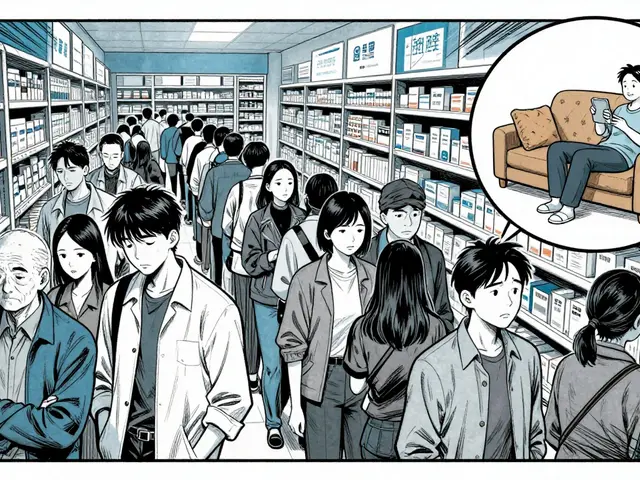
Imagine waking up every morning knowing exactly when and how to take your medicine. No second-guessing. No missed doses. No anxiety about whether you took that blood pressure pill last night. For millions of people managing chronic conditions, this isn't just a convenience-it's the difference between staying healthy and ending up in the hospital.
Here is the hard truth: roughly half of all patients with chronic diseases do not take their medications as prescribed. According to a landmark analysis published in the New England Journal of Medicine in 2012, non-adherence is widespread. The consequences are severe. Research from Stanford Medicine in 2021 found that patients who skip doses have a 30-40% higher chance of experiencing a disease flare-up. This isn't just about feeling slightly unwell; it costs the U.S. healthcare system an estimated $100-$289 billion annually in avoidable complications and hospitalizations.
But here is the good news: building a routine you can stick to doesn't require superhuman willpower. It requires strategy. By anchoring your medication to existing habits, using simple visual cues, and leveraging the right tools, you can transform a chore into an automatic part of your day.
The Power of Habit Stacking
Willpower is a finite resource. If you rely on remembering to take your meds out of thin air, you will eventually fail. Instead, use a technique called "habit stacking." This means linking your new medication habit to an action you already do automatically every single day.
Stanford Medicine researchers observed that 78% of patients improved their adherence simply by pairing medication with consistent daily activities. Think about your morning routine. Do you brush your teeth? Feed the dog? Make coffee? Pick one of these anchor actions.
- Morning Doses: Place your pills next to your toothbrush or coffee maker. Brushing your teeth showed a 72% effectiveness rate for morning and evening dose adherence in clinical observations.
- Evening Doses: Link medication to winding down, such as charging your phone or setting out clothes for tomorrow.
- Mealtime Doses: If your doctor says food is okay, taking meds with breakfast or dinner achieves 68% effectiveness. Just confirm with your provider first-some drugs, like certain antibiotics or thyroid medications, require an empty stomach.
The key is consistency. If you move your coffee routine around, your medication routine breaks. Keep the anchor solid.
Visual Cues and Organizational Tools
Your brain is wired to notice changes in your environment. Use this to your advantage. Visual reminders reduce the cognitive load required to remember tasks.
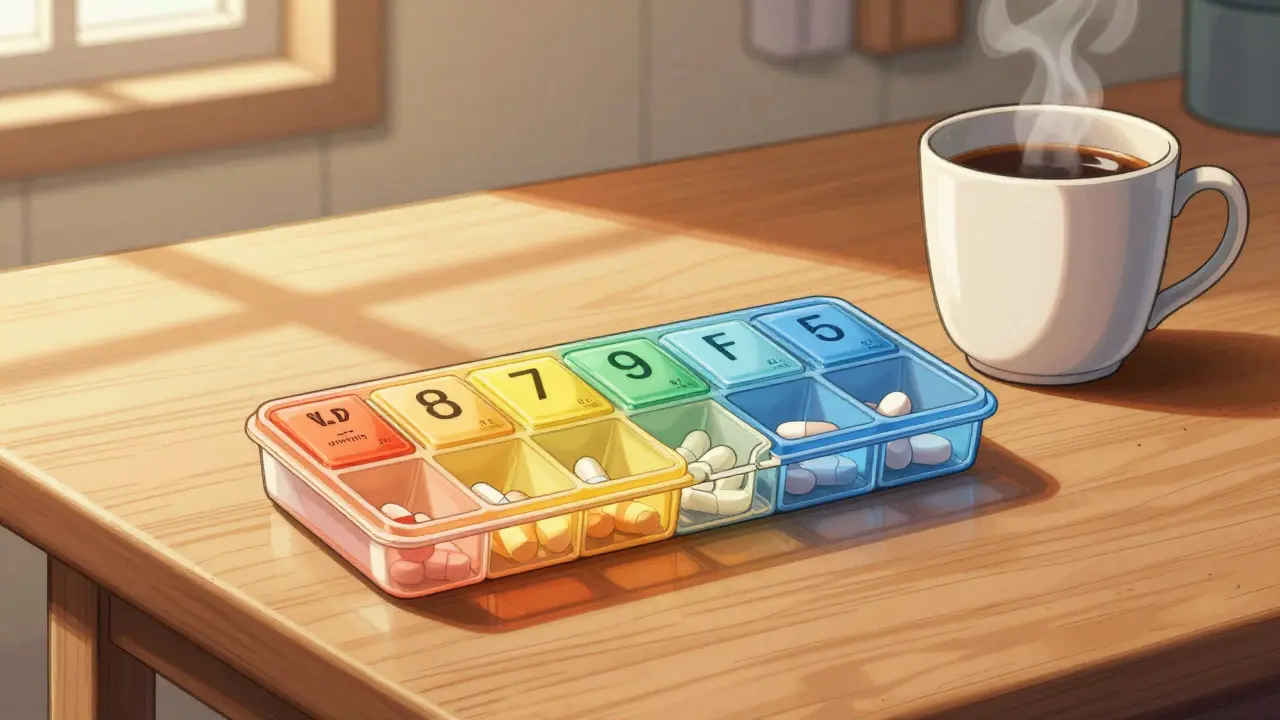
Pill organizers are arguably the most effective low-tech tool available. Data from the American Heart Association (2021) shows that weekly organizers with compartments for each day and dosing time (AM/PM) can reduce missed doses by up to 25%. Multi-compartment weekly organizers improve adherence by 35% compared to standard bottles.
Why do they work? They provide immediate visual feedback. When you see an empty slot for Tuesday morning, you know you've taken it. When you see a full slot, you haven't. This eliminates the "did I take it?" panic that leads to double-dosing or skipping entirely.
For those who prefer analog tracking, medication calendars where you physically check off doses demonstrated a 32% reduction in missed doses in trials published in the PMC journal (2011). AdventHealth’s 2023 survey of 5,000 patients found that 76% of those using check-mark calendars maintained over 90% adherence rates.
Technology: Friend or Foe?
Smartphones are powerful reminders, but their effectiveness depends heavily on age and digital literacy. A 2020 study by MedStar Health found that 63% of patients aged 50-75 reported improved adherence with phone alarms. However, ProMedica (2023) noted a sharp drop-off: smartphone alarms achieve 75% adherence in patients under 65, but only 45% in those over 75.
If you are tech-savvy, set recurring alarms labeled clearly (e.g., "Take Blood Pressure Meds"). But beware of notification fatigue. If you silence them once, you might do it again.
For older adults or those less comfortable with smartphones, consider timer caps that beep when due. These maintain 62% effectiveness across all age groups. Alternatively, the "flip bottle method" suggested by ProMedica involves turning your medication bottle upside down after dosing. This simple physical cue reduced double-dosing incidents by 22% in clinical observations.
Simplifying Your Regimen
Complexity is the enemy of adherence. Dr. Robert L. Page II, a medication adherence specialist at the University of Colorado, notes that simplifying routines to once-daily dosing reduces complexity by 40% compared to multiple daily doses.
If you are taking multiple medications, talk to your doctor or pharmacist about consolidation. Can some doses be taken together? Can extended-release formulations replace short-acting ones? Medicare data reveals that adherence rates drop from 75% for single-medication regimens to just 50% for four or more medications.
Color-coding can also help. The American Heart Association recommends using colored labels (blue for morning, red for afternoon, yellow for bedtime). This simple visual distinction improved correct dosing by 28% among visually-oriented patients.

Overcoming Common Pitfalls
Even the best plans face disruptions. Travel, illness, and side effects are common reasons routines break. ProMedica’s 2022 analysis identified travel disruptions (reported by 63% of patients) and complex multi-dose regimens (57%) as top failure points.
To handle travel, keep a small backup supply in your carry-on bag. Never check your medications. For side effects, never stop taking a medication without consulting your provider. Intentional non-adherence due to side effects affects 49% of patients, according to ProMedica. Your doctor may adjust the dosage or switch medications rather than leaving you untreated.
Dr. Elizabeth Stuart from Johns Hopkins Bloomberg School of Public Health emphasizes collaborative approaches. Her 2022 research in JAMA Internal Medicine showed that patients who help design their own routines increase adherence by 37% compared to provider-determined schedules. You are the expert on your life; make sure your schedule reflects your reality.
| Strategy | Effectiveness Rate | Best For | Potential Drawback |
|---|---|---|---|
| Habit Stacking (e.g., brushing teeth) | 72% | Most adults | Requires consistent daily anchor |
| Weekly Pill Organizer | 35% improvement | Visual learners, polypharmacy | Requires weekly setup time |
| Smartphone Alarms | 75% (under 65) | Tech-savvy users | Drops to 45% for over 75s |
| Medication Journals | 78% | Highly engaged patients | High cognitive effort required |
| Buddy System | 58% | Those with support networks | Dependent on partner reliability |
Building Your Plan: A 7-Day Transition
Don't try to change everything overnight. MedlinePlus recommends a 7-day transition period.
- Day 1-2: Audit your current meds. List them all, including times and food requirements.
- Day 3: Choose your anchor habits (e.g., coffee, dinner).
- Day 4: Purchase your tools (pillbox, calendar, or apps).
- Day 5: Set up your system. Fill the pillbox for the week ahead.
- Day 6-7: Practice the new routine. Expect minor hiccups and adjust.
Setting up a weekly pill organizer should take no more than 20 minutes. Many patients find Friday evenings optimal for refilling, creating a weekend ritual that prepares them for the week ahead.
What is the best way to remember to take medication twice a day?
The most effective method is habit stacking. Pair your morning dose with a consistent activity like brushing your teeth or making coffee, and your evening dose with another fixed routine like watching the evening news or charging your phone. Using a pill organizer with AM/PM compartments provides visual confirmation that you have taken both doses.
Can I take all my medications at once?
Not necessarily. Some medications interact negatively if taken together, while others require an empty stomach or specific timing relative to meals. Always consult your doctor or pharmacist before consolidating doses. They may recommend extended-release versions or adjusted schedules to simplify your routine safely.
What should I do if I miss a dose?
General advice is to take the missed dose as soon as you remember, unless it is almost time for your next dose. Never double up to make up for a missed dose unless specifically instructed by your healthcare provider. If you are unsure, check the medication leaflet or call your pharmacist for guidance specific to your drug.
Are smartphone apps better than pill boxes?
It depends on your age and tech comfort. Smartphone alarms are highly effective (75% adherence) for users under 65 but less so (45%) for those over 75. Pill boxes offer a tangible, visual check that works well for all ages and don't rely on battery life or technical skills. Many experts recommend combining both for maximum security.
How can I manage medication side effects without stopping treatment?
Never stop taking prescribed medication abruptly due to side effects. Contact your doctor immediately. They may adjust the dosage, switch to a different medication in the same class, or suggest timing changes (like taking it with food) to mitigate effects. Unintended non-adherence due to side effects is a major cause of health complications.