
Why Your Blood Sugar Spikes Every Morning
You wake up, check your meter, and your blood sugar is 190 mg/dL-even though you ate a light dinner, took your meds, and slept well. This isn’t laziness. It’s not poor discipline. It’s the dawn phenomenon, a natural body process that turns into a problem when you have diabetes.
Between 3 a.m. and 8 a.m., your body starts preparing for the day. Hormones like cortisol and growth hormone kick in. They tell your liver to pump out glucose so you have energy to wake up. In someone without diabetes, the pancreas responds by releasing just enough insulin to keep things balanced. But if you have Type 1 or advanced Type 2 diabetes, your body can’t make or use insulin properly. So that glucose builds up. By the time you roll out of bed, your numbers are high.
This isn’t rare. About half of all people with Type 1 diabetes and half of those with Type 2 deal with this every single morning. Studies show it’s just as common in teens, adults, and seniors. It’s not a mistake. It’s biology.
Dawn Phenomenon vs. Somogyi Effect: Don’t Mix Them Up
Many people think morning highs mean they took too little insulin the night before. But that’s not always true. There’s another condition called the Somogyi effect-a rebound high caused by a low during the night.
Here’s how to tell them apart:
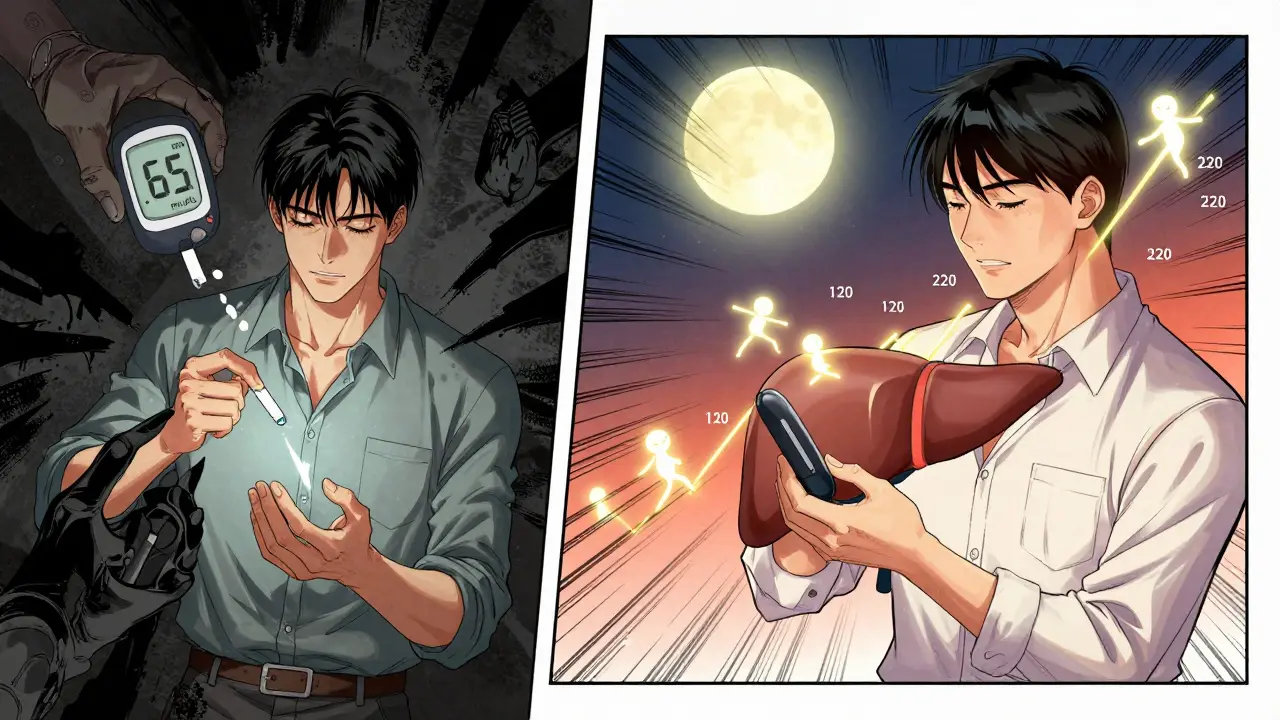
- Dawn phenomenon: Blood sugar rises steadily from 3 a.m. onward. No low before it. Glucose might be 100 mg/dL at 3 a.m. and 190 mg/dL at 7 a.m.
- Somogyi effect: Blood sugar drops below 70 mg/dL sometime between midnight and 3 a.m., then spikes back up as the body tries to recover.
The only way to know for sure? Check your blood sugar at 3 a.m. for three nights in a row. If it’s low, it’s Somogyi. If it’s normal or high and climbing, it’s dawn phenomenon.
According to Medtronic’s analysis of 10,000 continuous glucose monitor (CGM) records, 68% of morning highs are from the dawn phenomenon. Only 22% are from rebound highs. Mistaking one for the other leads to the wrong fix-and can make things worse.
What Happens in Your Body During the Dawn Phenomenon
It’s not magic. It’s science. Around 3 a.m., your body starts releasing hormones that naturally raise blood sugar:
- Cortisol increases by 50-100%-this is your body’s natural alarm clock.
- Growth hormone surges up to 300-500%-it helps repair tissue and prepare muscles for activity.
- Glucagon tells your liver to break down stored sugar (glycogen) and make new sugar (gluconeogenesis).
Together, these hormones can push your liver to release 20-30% more glucose between 4 a.m. and 8 a.m. In a person without diabetes, insulin rises by 40-50% to match this. But if you have diabetes, that insulin response is missing or too weak. So glucose piles up.
That’s why your morning numbers can jump from 120 to 250 mg/dL overnight-even if you didn’t eat anything. It’s not your dinner. It’s your biology.
How Morning Spikes Hurt Your Long-Term Health
High morning blood sugar isn’t just annoying-it’s dangerous over time. Each 1% increase in your HbA1c raises your risk of diabetes complications by 21%. That’s from the UK Prospective Diabetes Study, one of the longest-running diabetes studies ever done.
If you’re consistently waking up with glucose over 180 mg/dL, your HbA1c can creep up by 0.5 to 1.2 percentage points just from this one issue. That’s enough to move you from “well-controlled” to “poorly controlled.”
And it’s not just numbers. People with uncontrolled dawn phenomenon report:
- Extreme thirst (65% of cases)
- Constant urination (78%)
- Chronic fatigue (82%)
- Blurred vision (34%)
In severe cases, especially with Type 1 diabetes, this can lead to diabetic ketoacidosis (DKA). One study found that people with persistent dawn phenomenon had 3.2 episodes of DKA per 100 patient-years. That’s not a small risk.
How to Manage the Dawn Phenomenon: Real Strategies That Work
You can’t stop your body from making hormones. But you can outsmart the effect. Here’s what actually works, based on real data and clinical trials.
1. Use a Continuous Glucose Monitor (CGM)
Stop guessing. Start seeing. A CGM shows you your glucose trend all night long. You don’t need to wake up to check. You just look at your phone in the morning and see if your line was flat, rising, or falling between 2 a.m. and 6 a.m.
Endocrinologists now say CGMs are essential for diagnosing dawn phenomenon. Dexcom, Abbott, and Medtronic devices show trend arrows and graphs that make it obvious. In one survey, 68% of CGM users said they understood their morning spikes better within three months.
2. Adjust Your Insulin (If You Use It)
If you’re on an insulin pump, you can increase your basal rate between 3 a.m. and 7 a.m. The T1D Exchange Registry found that 62% of users who did this saw morning glucose drop by 45-60 mg/dL.
For those on multiple daily injections, talk to your doctor about switching your long-acting insulin to bedtime instead of morning. Some newer insulins, like insulin icodec (once-weekly), show 28% better morning control than daily doses.
Automated insulin delivery systems (like Control-IQ or Omnipod 5) now have built-in dawn phenomenon algorithms. One trial showed a 58% reduction in morning highs.
3. Change Your Evening Meal
What you eat at night matters. A study from Joslin Diabetes Center found that cutting evening carbs to under 45 grams reduced morning spikes by 27%.
Avoid pizza, pasta, rice, bread, or sugary desserts after 7 p.m. Instead, focus on protein and healthy fats: grilled chicken, salmon, eggs, avocado, nuts, or cheese. These don’t spike glucose and help stabilize overnight levels.
4. Try a Smart Bedtime Snack
Some people find that a small, low-carb snack before bed helps. Try 15 grams of protein with 5 grams of fat-like a hard-boiled egg with a tablespoon of peanut butter, or a small handful of almonds with a slice of turkey.
Reddit users reported a 32% drop in morning highs when they added this kind of snack. But don’t overdo it. Too many carbs-even at night-will backfire.
5. Sleep Better
Poor sleep makes the dawn phenomenon worse. A review in Sleep Medicine Reviews found that people who slept less than 6 hours had morning glucose levels 15-20 mg/dL higher than those who slept 7-8 hours.
Try to keep a regular sleep schedule. Avoid screens an hour before bed. Keep your room cool and dark. If you have sleep apnea-which is common in people with Type 2 diabetes-get it treated. It’s linked to higher morning glucose.
What Doesn’t Work (And Can Make Things Worse)
Not every fix helps. Some common advice can actually hurt you.
- Adding more insulin at night without checking 3 a.m. levels: This can cause dangerous lows. One study found that 34% of people who adjusted insulin based only on morning highs ended up with more nighttime hypoglycemia.
- Skipping dinner: This can trigger the Somogyi effect. Your body thinks it’s starving and releases stress hormones that raise glucose.
- Drinking alcohol before bed: It may lower your glucose at first, but it disrupts liver function and can cause unpredictable highs later.
As Dr. John Buse from UNC said in JAMA Internal Medicine: “Aggressive treatment without confirmation often leads to more danger than the high itself.”

When to Talk to Your Doctor
If you’ve been waking up with high blood sugar for more than two weeks, it’s time to talk. Bring your CGM data. Show your 3 a.m. readings. Ask:
- Could this be the dawn phenomenon?
- Should I adjust my insulin timing or dose?
- Would a CGM help me track this better?
- Could a GLP-1 agonist taken at night help? (These are proven to reduce morning spikes in Type 2 diabetes.)
Don’t let your provider dismiss it as “just poor diet.” The dawn phenomenon is real, measurable, and treatable. The American Diabetes Association says checking overnight glucose is part of standard care for anyone with unexplained morning highs.
What’s Coming Next
The future of dawn phenomenon management is getting smarter. New artificial pancreas systems now start adjusting insulin as early as 2 a.m. based on predicted rises. The DIAMOND study is testing a dual-hormone approach using pramlintide to block glucagon’s sugar-releasing effect.
And research from Oxford has found seven genetic markers linked to stronger dawn responses. In five to seven years, we may be able to test for your personal risk and tailor treatment even more precisely.
For now, the tools we have-CGMs, smart insulin timing, and better nighttime eating-can make a huge difference. You don’t need to live with 200 mg/dL mornings. You just need the right plan.
Quick Summary
- The dawn phenomenon is a natural hormone surge that raises blood sugar in the early morning-it’s not your fault.
- It affects about half of all people with Type 1 and Type 2 diabetes.
- Check your blood sugar at 3 a.m. for three nights to tell it apart from the Somogyi effect.
- CGMs are the best tool for tracking and managing it.
- Lowering evening carbs, adjusting insulin timing, and improving sleep can all help.
- Don’t guess-use data. Over-treating can cause dangerous lows.




So let me get this straight-your body’s just gonna wake up like a lazy landlord and charge you extra glucose rent? And we’re supposed to be grateful? I’m starting to think diabetes is just the government’s way of making us pay for being born. 🤡
I’ve been dealing with this for 12 years. The 3 a.m. check changed everything for me. Turns out I wasn’t eating too much at night-I was just missing the real culprit. CGM was the game-changer. No more guessing.
I just want to say how deeply validating this post is. For so long I thought I was failing because my numbers were high in the morning, like I wasn’t trying hard enough or I was lazy-but this explains it so clearly. It’s not a moral failure, it’s physiology. I cried reading this. I’ve been carrying this shame for years, and now I finally feel seen. Thank you for writing this with such care and science.
If you’re on basal insulin, try moving it to bedtime. Works better for dawn phenomenon than morning dosing. Also, 15g protein + 5g fat before bed? That’s the sweet spot. No sugar, no crash.
The dawn phenomenon is essentially a circadian-driven hepatic gluconeogenesis surge amplified by insulin resistance. The Somogyi effect is a counterregulatory rebound from nocturnal hypoglycemia-neurohormonal activation of cortisol, glucagon, epinephrine. CGM trend arrows are non-negotiable for differential diagnosis. Also, GLP-1 RAs at night? Off-label but promising. Check out the 2023 ADA consensus.
They don’t want you to know this. Big Pharma doesn’t profit off ‘sleep better’ or ‘eat less carbs at night.’ They profit off new insulin pumps, new CGMs, new drugs. They’ll sell you a $10,000 device to fix a problem that’s solved by not eating pizza at midnight. Wake up. This is all a scam.
This is SO helpful!! 🙌 I just got my CGM last month and I was SO confused why I was high every morning. Now I know it’s not me being bad 😭 I tried the peanut butter + egg snack last night and my AM sugar was 132!!! Thank you for sharing this!! 💖
Let me be very clear: if you’re not checking your glucose at 3 a.m. and you’re blaming your diet or discipline for morning highs, you’re not just misinformed-you’re endangering yourself. This isn’t a lifestyle blog. This is clinical reality. The UKPDS data is clear. The Medtronic CGM analysis is irrefutable. If your doctor dismisses this, find a new one. Your HbA1c is not a suggestion. Your risk of neuropathy, retinopathy, and DKA is not a suggestion. Stop guessing. Start measuring. Your future self will thank you.
I used to skip dinner to avoid highs. Turned out I was triggering Somogyi. Now I eat a turkey slice and almond butter before bed. My fasting numbers dropped 50 points. Sleep and food timing matter more than you think.
It is imperative that individuals afflicted with diabetes exercise rigorous self-discipline in their dietary intake and nocturnal routines. The notion that biological imperatives absolve one of personal responsibility is not only scientifically fallacious but morally indefensible. The American Diabetes Association does not endorse the abdication of agency under the guise of physiological determinism. One must, therefore, maintain unwavering vigilance, regardless of hormonal fluctuations.