
For years, HIV treatment in Africa relied on medicines shipped from India, Europe, and the U.S. - expensive, slow to arrive, and vulnerable to global disruptions. Then, in May 2025, everything changed. The Global Fund bought its first-ever antiretroviral generics made in Africa: a first-line HIV treatment called TLD, produced by a Kenyan company, Universal Corporation Ltd. It wasn’t just a symbolic win. It was enough to treat over 72,000 people in Mozambique every year. This is no longer a future goal. It’s happening now.
Why African-Made HIV Drugs Matter
Sub-Saharan Africa carries 65% of the world’s HIV cases, yet for decades, it imported about 80% of its medicines. That meant delays when ships got stuck, price spikes when currencies dropped, and shortages when pandemics hit. During COVID-19, many African countries couldn’t get basic supplies because global supply chains broke down. HIV patients weren’t an exception. They were among the hardest hit.
Local production changes that. When medicines are made in Africa, they arrive faster. Prices drop because shipping and import taxes vanish. And when a country needs more, it doesn’t wait for a foreign factory to decide to increase output - it just turns on its own machines.
The TLD combination - tenofovir, lamivudine, and dolutegravir - is now the gold standard for first-line HIV treatment. It’s more effective, has fewer side effects, and blocks drug resistance better than older regimens. Before 2023, no African company had met the World Health Organization’s strict standards to make it. Then Universal Corporation Ltd did. And suddenly, the continent had a homegrown solution to its biggest health crisis.
The Global Fund’s Game-Changing Move
The Global Fund didn’t just buy the drug. It changed the rules. For years, it only bought from a handful of approved suppliers - almost all outside Africa. That kept African manufacturers locked out, no matter how good their quality was. In 2023, WHO prequalified TLD made in Kenya. But prequalification alone wasn’t enough. The Global Fund needed to act.
By purchasing African-made TLD in May 2025, the Global Fund sent a clear signal: African manufacturers are now eligible partners. This isn’t charity. It’s smart economics. African-made ARVs cost 20-30% less than imported ones, even after factoring in quality control. And because they’re produced closer to where they’re needed, delivery times dropped from months to weeks.
Mark Edington, Head of Grant Management at the Global Fund, said scaling up African-made health products will remain a top priority. That’s not empty talk. The organization’s next grant cycle (GC7) will open the door for more African countries to access these drugs. Mozambique was the first. Others will follow.
Beyond Pills: Diagnostics and Long-Acting Treatments
Getting people on treatment is only half the battle. You also need to know who has HIV - and what kind of treatment works best for them. That’s where diagnostics come in.
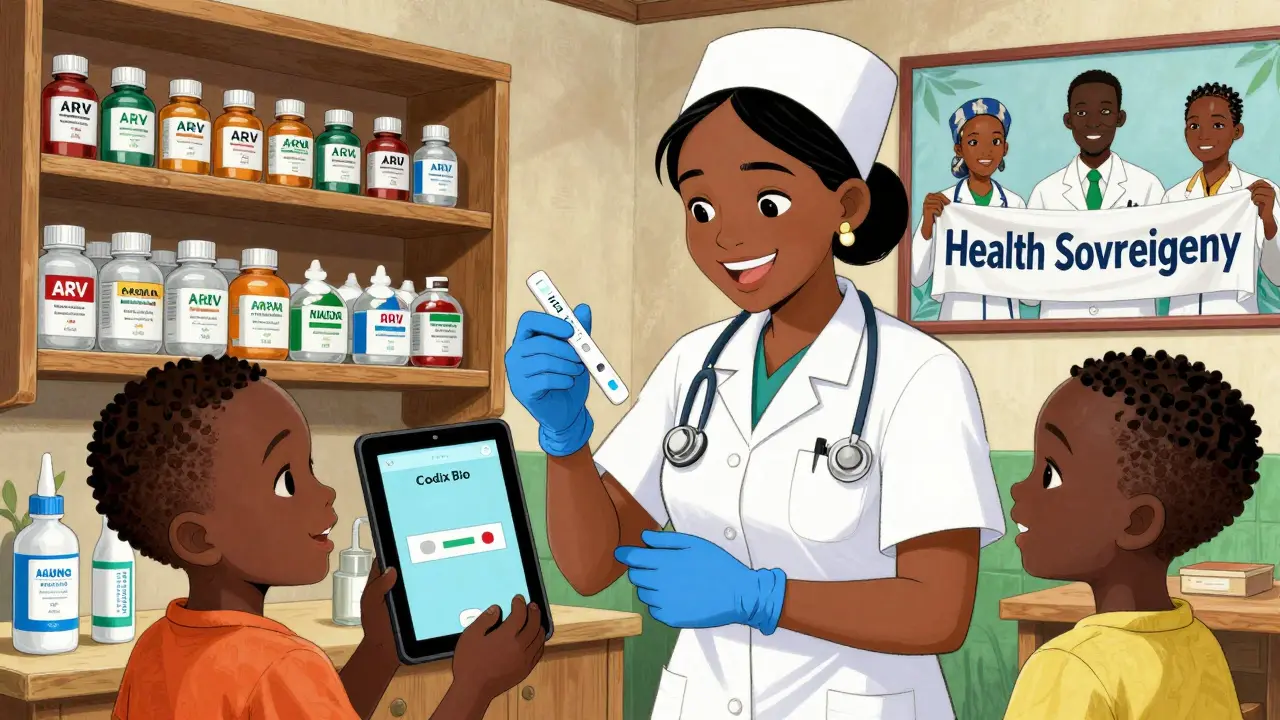
Codix Bio, a Nigerian company, is now producing rapid HIV tests under a license from SD Biosensor. This wasn’t just a sale of equipment. It was a full technology transfer, supported by WHO and the Medicines Patent Pool. Now, clinics in rural Nigeria, Uganda, and Zambia can test for HIV in minutes - with results as reliable as lab tests. No more waiting weeks for results. No more lost patients.
And then there’s the future: long-acting injections. In October 2025, South Africa became the first African country to approve a twice-yearly HIV injection - cabotegravir long-acting. No daily pills. Just two shots a year. For people who struggle with adherence, this is life-changing.
Six African manufacturers already have licenses from Gilead to make generic versions of this injection. Experts predict prices could drop 80-90% below the brand name once generics hit the market. Gilead isn’t waiting. It’s already working with the U.S. State Department and the Global Fund to supply its own version of lenacapavir - another long-acting drug for HIV prevention - to up to two million people across Africa over three years, at no profit, until local generics can take over.
The Numbers Behind the Progress
Since 2010, AIDS-related deaths in Africa have dropped by more than half - from 1.3 million to 630,000 in 2022. Why? Because more people are on treatment. In Eastern and Southern Africa, 93% of people living with HIV know their status. 83% are on antiretroviral therapy. 78% have suppressed viral loads - meaning they can’t transmit the virus.
That’s progress. But Western and Central Africa still lag: 81% know their status, 76% are on treatment, and only 70% have suppressed viral loads. That’s where African-made generics can make the biggest difference. Cheaper, faster, more reliable access means closing that gap.
Right now, Africa needs about 15 million person-years of first-line ARV treatment every year. The continent’s current manufacturing capacity? Still far below that. But new factories are coming. By the end of 2025, at least three new production facilities in South Africa, Nigeria, and Ethiopia are expected to start operations, thanks to funding from Unitaid, the Gates Foundation, and the Coalition for Epidemic Preparedness Innovations (CIFF).
The Bigger Picture: Health Sovereignty
This isn’t just about HIV. It’s about health sovereignty. When Africa can make its own medicines, it doesn’t have to beg for aid every time a new outbreak hits. It doesn’t have to wait for foreign companies to decide what’s profitable. It can respond to its own needs - whether it’s HIV, malaria, TB, or the next pandemic.
The African Union’s Pharmaceutical Manufacturing Plan for Africa (PMPA) aims to raise local production from just 2-3% of the continent’s needs to 40% by 2040. That’s ambitious. But it’s possible - if governments keep investing in regulation, training, and incentives.
Right now, the biggest bottleneck isn’t science. It’s policy. Regulatory systems vary wildly from country to country. One drug approved in Kenya might take years to clear in Nigeria. Harmonizing standards across the continent - something WHO and the African Medicines Agency are pushing - will be key.
And it’s not just about making pills. It’s about who designs them. African researchers are calling for ‘Africanizing research and development.’ That means designing drugs for the strains of HIV common here, not just copying what works in Europe or the U.S. It means building labs, training scientists, and letting African expertise lead the way.
What’s Still Missing?
Progress is real. But it’s still early. Only a fraction of the continent’s ARV needs are met by local manufacturers today. Most countries still rely on imports. Funding is uneven. Some governments prioritize short-term political wins over long-term health infrastructure.
And while long-acting injections are exciting, they’re still expensive for now. Until generics arrive in large volumes, they won’t be accessible to everyone. The same goes for new drugs like lenacapavir - Gilead’s no-profit model helps, but it’s temporary. Real sustainability comes when African companies can make and sell these drugs profitably, without subsidies.
Integration is another challenge. Too often, HIV programs run in isolation - separate from maternal health, tuberculosis care, or mental health services. The future isn’t just better drugs. It’s better systems. One clinic. One record. One team managing all chronic diseases.
The Road Ahead
By 2030, African-made antiretroviral generics could supply 20-30% of the continent’s treatment needs. That’s not enough to replace imports entirely - but it’s enough to make the system resilient. If a shipment from India gets delayed, Africa won’t panic. It’ll just turn to its own factories.
The players are in place: manufacturers like Universal Corporation, regulators gaining credibility, donors committed to local sourcing, and patients demanding better access. The question isn’t whether this model works. It already does. The question is: will African governments and global partners keep funding it? Will they keep pushing for policy change? Will they let African innovation lead?
The answer will determine whether millions of people in Africa get to live full, healthy lives - or remain stuck in a cycle of dependency.
Are African-made HIV drugs safe and effective?
Yes. All African-made antiretroviral generics approved for Global Fund procurement must pass WHO prequalification - the same strict standard used for drugs from India or Europe. This includes testing for purity, potency, stability, and bioequivalence. The TLD produced by Universal Corporation Ltd in Kenya met these benchmarks and has been used safely in Mozambique since May 2025. Regulatory agencies in South Africa, Nigeria, and Kenya are now among the most rigorous in the developing world.
How much cheaper are African-made ARVs than imported ones?
African-made first-line ARVs like TLD cost 20-30% less than imported versions, even after accounting for quality controls. For example, a year’s supply of imported TLD might cost $75-$85 per patient. Locally produced versions are priced at $55-$65. When you scale this across millions of patients, the savings run into hundreds of millions of dollars annually - money that can be reinvested in clinics, testing, and community health workers.
Why didn’t African countries make these drugs earlier?
For years, African countries lacked the regulatory capacity, manufacturing infrastructure, and market certainty to support local production. Many governments relied on donor funding to buy cheap generics from India. There was little incentive to build factories. Also, patent barriers and lack of technology transfer slowed progress. Only after the Medicines Patent Pool, WHO, and donors started actively supporting African manufacturers - with funding, training, and guaranteed demand - did real progress begin.
Can African manufacturers compete with Indian companies?
Indian manufacturers still produce more volume and at lower cost - they’ve been doing it for decades. But African producers are catching up fast. Their advantage isn’t price alone - it’s speed, reliability, and alignment with local needs. African-made drugs don’t face shipping delays or import taxes. They’re tailored to regional HIV strains and patient profiles. And with guaranteed demand from the Global Fund, African factories are scaling up quickly. In the next five years, they’ll be competitive on both cost and supply stability.
What’s next for HIV treatment in Africa?
The next big shift is toward long-acting injectables and combination therapies. Cabotegravir long-acting injections are already approved in South Africa, and generic versions are coming. By 2027, most new patients could start on injections instead of pills. Meanwhile, efforts are growing to integrate HIV care with other services - like diabetes and hypertension - so clinics don’t have to run separate programs. And more African researchers are leading clinical trials to test treatments optimized for African populations. The goal isn’t just access. It’s ownership.





So we’re just supposed to believe that African-made drugs are magically better now? 🤔 What’s next? Local moonshots and self-sufficient Wi-Fi? The world doesn’t work like a feel-good TED Talk.
lol the Global Fund just got woke 😂 next they’ll be buying African-made vaccines and asking Elon to tweet about it 🌍💊
Finally someone in Africa stopped waiting for white saviors to hand us medicine like we’re children 🙌 Nigeria’s been making pills since 2020 and nobody cared until the West noticed
This is the kind of progress that actually saves lives. No more waiting 6 months for a shipment that gets held up at some port because of paperwork. African factories = African dignity.
Let’s be real nobody cares about African manufacturing unless it’s cheaper than India and even then it’s just a PR stunt
Bro this is HUGE. Imagine if every African country could make their own meds instead of begging for scraps from Europe. This isn’t charity-it’s justice. 🙏🔥
Wow. I didn’t realize African regulators were now on par with the FDA. That’s actually impressive. 🤯
My cousin in Lagos just got his first long-acting shot last month. No pills. No stress. Just two shots a year. Life changed. 🙏
This isn’t just about HIV. It’s about power. For too long, Africa was told to wait its turn. Now they’re not asking-they’re producing. And the world better get out of the way. 🚀
Let me guess-next they’ll be manufacturing quantum computers in Accra and selling them on Amazon. This is the same narrative they’ve been pushing since the 80s: ‘Africa can do anything if we just believe!’ Meanwhile, the infrastructure is crumbling and the power grid can’t even run a fridge.
Yeah sure, 20% cheaper. But how many people actually got their meds on time? How many died waiting for the ‘local solution’ to scale? I’ve seen this movie before. It ends with a press release and a few empty clinics.
Real talk: if this works, it’ll be a blueprint for malaria and TB meds too. This isn’t a fluke-it’s a movement.
Let’s not romanticize this. African manufacturers still need foreign tech, foreign funding, foreign regulators to sign off. This isn’t independence-it’s outsourcing with better branding. And don’t get me started on the fact that the Global Fund only started buying African drugs after the WHO prequalified them. That’s not leadership-that’s compliance. The real win would’ve been if they’d invested in the infrastructure 15 years ago instead of waiting for a PR opportunity.
Meanwhile, rural clinics in DRC still don’t have refrigerators for vaccines. So yes, local production is cool-but it’s not magic. It’s just the first step in a 20-year journey we should’ve started in 2005.
And before you say ‘but they’re catching up!’-yes, they are. But that’s not because of genius. It’s because the world finally stopped ignoring them. That’s not progress. That’s guilt.
Regulatory harmonization remains the elephant in the room. The African Medicines Agency is a noble initiative, but without binding mutual recognition protocols, you’re just creating 54 different compliance labyrinths. The current patchwork of national agencies-NAFDAC, KEMSA, SAHPRA-operates in silos. Until there’s a single continental approval pathway, scaling is a fantasy.
Also, the cost advantage is misleading. When you factor in logistics, cold-chain maintenance, and local workforce training, the margin narrows significantly. The real value isn’t price-it’s resilience. And that’s something only time and data can validate.
As a Nigerian-American, this gives me chills. My grandmother died because the antiretrovirals never arrived. Now my cousin in Lagos gets the same meds in two weeks, made by people who look like her. This isn’t medicine. This is homecoming.