Warfarin & NSAID Risk Calculator
Risk Assessment Tool
This tool calculates your bleeding risk when taking warfarin with NSAIDs based on clinical evidence.
Results will appear here after calculation
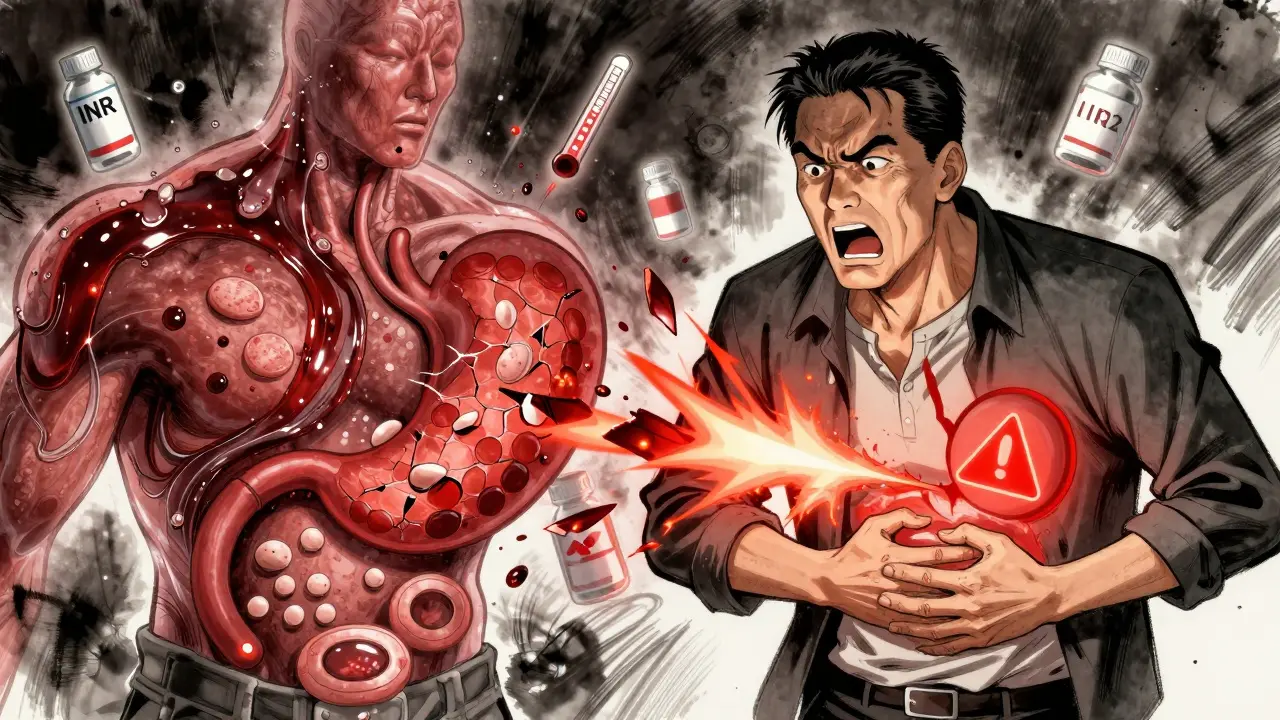
Every year, millions of Americans take warfarin to prevent dangerous blood clots-especially if they have atrial fibrillation, a mechanical heart valve, or a history of deep vein thrombosis. At the same time, nearly 17 million people reach for over-the-counter NSAIDs like ibuprofen or naproxen for a headache, back pain, or arthritis flare-up. What most don’t realize is that combining these two medications doesn’t just add side effects-it doubles your risk of serious bleeding.
Why This Combination Is So Dangerous
Warfarin works by blocking vitamin K, which your body needs to make clotting factors. Without those factors, blood takes longer to clot-exactly what you want to prevent strokes and clots. But NSAIDs? They attack clotting from a completely different angle. They shut down cyclooxygenase (COX) enzymes, which are essential for platelets to stick together and form clots at injury sites. At the same time, NSAIDs thin out the protective mucus lining in your stomach, making it easier for even small amounts of bleeding to turn into a full-blown ulcer or hemorrhage.This isn’t just additive-it’s multiplicative. Think of it like two broken brakes on a car. Warfarin slows your blood’s ability to clot. NSAIDs stop platelets from even showing up to the scene. Together, they make any small cut, bump, or internal tear far more likely to turn into a life-threatening bleed.
The Numbers Don’t Lie
A 2023 study from Aarhus University Hospital tracked over 10,000 patients on anticoagulants and found those taking NSAIDs had a 2.09 times higher risk of major bleeding compared to those who didn’t. That’s not a small uptick. That’s a dramatic jump.Not all NSAIDs are created equal when mixed with warfarin:
- Naproxen: 4.1 times higher bleeding risk
- Diclofenac: 3.3 times higher
- Ibuprofen: 1.79 times higher
- Meloxicam: High risk, especially if your warfarin dose is over 40 mg per week
And here’s what’s worse: people assume that COX-2 inhibitors like celecoxib are safer. They’re not. A 2020 meta-analysis showed they carry the same bleeding risk as traditional NSAIDs when taken with warfarin. The stomach lining still gets damaged. Platelets still get impaired. The risk doesn’t disappear-it just hides behind a different name.
Where the Bleeding Happens
It’s not just one type of bleed. This interaction attacks multiple organs:- Gastrointestinal bleeding: 2.24 times more likely. This is the most common-up to 62% of all cases.
- Intracranial bleeding: 3.22 times more likely. A stroke from internal bleeding in the brain.
- Pulmonary bleeding: 1.36 times more likely. Bleeding in the lungs can mimic pneumonia or heart failure.
- Urinary tract bleeding: 1.57 times more likely. Often mistaken for a UTI until it’s too late.
A 2021 study of 5,237 warfarin users found that when NSAIDs were involved, patients were hospitalized 78.4% of the time. Their average hospital stay? Over five days. That’s not a quick visit to the ER. That’s weeks of recovery, lost income, and potential long-term damage.
Real Stories, Real Consequences
The FDA’s adverse event database recorded over 1,800 bleeding events linked to warfarin-NSAID combinations between 2015 and 2020. But behind every number is a person.One Reddit user wrote: “Took ibuprofen for a headache while on warfarin. My hemoglobin dropped from 14 to 8 in 24 hours. Ended up in the ER, needed two units of blood. I didn’t even know it was dangerous.”
On Drugs.com, 87% of 1,452 reviews about this combo warn others to avoid it. The average safety rating? 2.1 out of 10. People aren’t just cautious-they’re terrified.
Why Doctors Still Prescribe It
You’d think after decades of warnings, this would be a non-issue. But it’s not. A 2023 analysis found that 42.6% of warfarin patients still get NSAID prescriptions every year. Why?- Patients don’t tell their doctors they’re taking OTC painkillers. A University of Michigan study found 68.2% of warfarin-related bleeds happened because the patient didn’t disclose NSAID use.
- Electronic health records in 41.7% of U.S. hospitals still don’t flag this interaction.
- Some doctors believe short-term use is “safe enough.” But the data says otherwise-even a few days of NSAIDs can spike INR levels.
A 2010 study showed that 39.8% of warfarin patients saw their INR jump by 15% or more after starting an NSAID. That’s not a minor fluctuation. That’s a red alert.
What You Should Do Instead
The safest pain reliever for people on warfarin? Acetaminophen (Tylenol). It doesn’t affect platelets or the stomach lining. It doesn’t raise INR. It’s not perfect-high doses can hurt your liver-but at standard doses (3,000 mg or less per day), it’s the clear winner.Other alternatives:
- Topical creams: Capsaicin, menthol, or lidocaine patches for joint or muscle pain.
- Physical therapy: Especially for chronic back or knee pain.
- Heat or cold therapy: Simple, effective, and zero drug interaction.
- Acupuncture or massage: Proven for arthritis and tension headaches.
If you absolutely must take an NSAID-for a sudden, severe injury, say-follow these steps:
- Use the lowest dose possible for the shortest time (no more than 3-5 days).
- Avoid naproxen, diclofenac, and meloxicam. Ibuprofen is the least risky-but still risky.
- Get your INR checked before starting the NSAID.
- Check it again 3-5 days after starting, then weekly until you stop.
- Take a proton pump inhibitor (like omeprazole) to protect your stomach lining.
- Watch for signs of bleeding: black or tarry stools, vomiting blood, unexplained bruising, dizziness, or sudden headaches.
The NOAC Myth
Many people think switching from warfarin to a newer anticoagulant like apixaban, rivaroxaban, or dabigatran makes this interaction safe. It doesn’t.A 2019 Circulation study showed NSAIDs still increase bleeding risk with all oral anticoagulants-even the newer ones. The ARISTOTLE trial found apixaban might be slightly safer than warfarin when NSAIDs are used, but the risk is still elevated. A 2020 study found dabigatran had lower bleeding risk than warfarin with NSAIDs, but rivaroxaban had similar risk. Bottom line: no oral anticoagulant is safe with NSAIDs.
And here’s the scary twist: while warfarin-NSAID co-prescribing dropped 27% between 2015 and 2022, NSAID use with NOACs went up by 35%. People think, “I’m on a newer drug now, so it’s fine.” It’s not.

What the Guidelines Say
The American College of Cardiology and American Heart Association give a Class I, Level B recommendation: “NSAIDs should be avoided in patients taking oral anticoagulants.” That’s the highest level of warning they give-meaning the risk is clear, serious, and well-documented.The Anticoagulation Forum and the American College of Chest Physicians are tightening their stance even further. The 2024 guidelines will explicitly say: “There is no safe level of NSAID use in patients on any oral anticoagulant.”
What You Can Do Today
If you’re on warfarin:- Check your medicine cabinet. Do you have ibuprofen, naproxen, or aspirin? Put them away.
- Ask your pharmacist: “Is this pain reliever safe with warfarin?” Don’t assume.
- Write down every OTC drug, supplement, or herbal product you take. Bring it to every appointment.
- Know the signs of bleeding: unusual bruising, blood in urine or stool, prolonged nosebleeds, severe headaches.
- If you accidentally take an NSAID, call your anticoagulation clinic or doctor immediately. Don’t wait.
This isn’t about being overly cautious. It’s about survival. Every year, over $1.8 billion is spent treating bleeding events caused by this avoidable interaction. Thousands of people end up in the hospital. Some die.
You don’t need to live in fear. But you do need to be informed. The right pain relief exists. You just have to choose it wisely.
Can I take ibuprofen with warfarin if I only use it once in a while?
No. Even a single dose of ibuprofen can raise your INR and increase bleeding risk. Studies show INR levels spike within 3-5 days of starting any NSAID-even short-term use. The risk isn’t just about frequency-it’s about the drug’s effect on platelets and stomach lining. If you need pain relief, use acetaminophen instead.
Is aspirin safer than other NSAIDs with warfarin?
No. Aspirin is an NSAID and a potent platelet inhibitor. It’s even more likely than ibuprofen to cause bleeding when combined with warfarin. Many people think aspirin is “just a heart pill,” but it’s still a blood thinner. Never take aspirin with warfarin unless your doctor specifically prescribed it for a reason-and even then, it’s a high-risk combination.
Do COX-2 inhibitors like celecoxib have less bleeding risk with warfarin?
No. Multiple studies, including a 2020 meta-analysis, confirm that COX-2 inhibitors like celecoxib carry the same bleeding risk as traditional NSAIDs when taken with warfarin. They may be easier on the stomach than ibuprofen, but they still impair platelet function and increase the risk of gastrointestinal and internal bleeding. Avoid them completely.
How often should I check my INR if I accidentally take an NSAID?
If you take an NSAID by accident, get your INR checked within 3-5 days. INR levels can rise sharply during this window. Continue checking every 2-3 days until you’ve been off the NSAID for a full week. Your anticoagulation clinic should guide you based on your baseline INR and warfarin dose.
What are the signs of bleeding I should watch for?
Watch for: black, tarry stools or bright red blood in stool; vomiting blood or material that looks like coffee grounds; unusual bruising without injury; prolonged nosebleeds; pink, red, or brown urine; sudden severe headache or dizziness; unexplained swelling or pain in joints or muscles. If you notice any of these, seek medical help immediately.
Can I use topical NSAIDs like diclofenac gel with warfarin?
Topical NSAIDs are absorbed through the skin in much smaller amounts, so they’re less likely to affect your INR. However, they’re not risk-free-especially if you apply them over large areas, use them daily, or have broken skin. The safest choice is still acetaminophen or non-drug options like heat therapy. If you use topical NSAIDs, monitor for bruising or unusual bleeding and check your INR if you’re concerned.
Is it safe to take NSAIDs after stopping warfarin?
It depends on why you stopped. If you stopped because your treatment ended (e.g., after a short-term blood clot), you can usually resume NSAIDs once your doctor confirms your clotting risk is gone. But if you stopped because you switched to another anticoagulant, NSAIDs are still dangerous. Always confirm with your provider before restarting any NSAID.







Just read this and my jaw dropped. I’ve been taking ibuprofen for my back pain while on warfarin for AFib. I had no idea. Time to toss the bottle and switch to Tylenol. Thanks for laying it out so clearly.
YES. YES. YES. I’ve been screaming this from the rooftops since my dad almost bled out in 2021. People think OTC means ‘safe’-NOPE. Acetaminophen is your BFF. Topical creams? Great. Heat packs? Even better. Stop risking your life for a headache.
Of course the FDA doesn’t warn people. Big Pharma doesn’t want you to know Tylenol is cheaper and safer. They make billions off NSAIDs and warfarin combos. This is a profit-driven massacre. You think your doctor knows? Half of them still prescribe it. Wake up.
Who cares about your stupid bleeding risks? In Nigeria, we take whatever works. If ibuprofen helps my knee, I take it. You Americans overthink everything. This is why your healthcare costs are insane. Just take the pill.
Let’s be honest: 87% of reviews on Drugs.com say it’s dangerous? That’s not data-that’s emotional noise. The real risk is in the statistical hazard ratios, not anecdotal fearmongering. Also, the study from Aarhus had a 95% CI of 1.82–2.41, which means the 2.09 is statistically significant but not clinically catastrophic for low-dose, short-term use. You’re conflating correlation with causation.
It’s not just the NSAIDs-it’s the systemic failure of the medical-industrial complex. Doctors don’t have time to educate patients. Pharmacies don’t flag interactions. EHRs are outdated. Patients don’t disclose OTC use because they don’t think it ‘counts.’ And then we wonder why 1.8 billion dollars is spent annually treating preventable hemorrhages. This isn’t a medical issue-it’s a societal collapse of responsibility. Every single person who takes an NSAID while on warfarin is complicit in their own potential death.
I’ve been on warfarin for 7 years. I used to take naproxen for arthritis until my INR spiked to 8.2. Never again. I use topical capsaicin now-works great. Also, my physical therapist taught me some stretches that cut my pain in half. No pills, no risk. Just takes a little effort.
So what? I’m 72, on warfarin, and I take two ibuprofen every Friday for my knees. I’ve been doing it for 10 years. My INR’s always stable. My doctor says it’s fine. You want me to stop? Fine. But don’t act like your study is the only truth. Real people live with this every day. Maybe your numbers don’t fit my life.