
One minute you’re walking up the stairs, and the next, you can’t catch your breath. No fever. No cough. No asthma inhaler helps. Your chest feels tight, but it doesn’t hurt like a heart attack. You think it’s anxiety. Maybe you’re just out of shape. But if this happens suddenly-especially if you’ve been sitting for hours, recently had surgery, or have a history of blood clots-pulmonary embolism could be silently killing you.
What Exactly Is a Pulmonary Embolism?
A pulmonary embolism (PE) is a blood clot that breaks loose, travels through your veins, and gets stuck in one of the arteries in your lungs. Most often, it starts as a deep vein thrombosis (DVT) in your leg-about 70% of the time. The clot forms because blood flow slows down, like when you’re on a long flight, bedridden after surgery, or sitting for hours at a desk. Once it breaks free, it doesn’t just float around. It blocks oxygen from reaching parts of your lung. Your body panics. That’s when shortness of breath hits.It’s not rare. In the U.S., about 60 to 70 people out of every 100,000 get a PE each year. Around 100,000 die from it annually. Many of those deaths happen because no one recognized the signs in time. The problem isn’t the clot itself-it’s how easy it is to miss.
Sudden Shortness of Breath: The #1 Red Flag
If you remember one thing about PE, remember this: sudden shortness of breath is the most common sign. In fact, 85% of people with PE report it. But here’s what makes it tricky: it doesn’t always feel like you’re running a marathon. Sometimes it’s just that you can’t take a full breath while sitting still. You used to climb two flights of stairs without trouble. Now, you’re gasping after one. That’s not normal.When the clot is large and blocks a major artery, the breathlessness hits fast and hard-like someone just turned off your oxygen. People describe it as a “weight on the chest” or “air hunger.” If you’re having trouble breathing even when you’re not moving, that’s a major red flag. Smaller clots might cause mild, intermittent breathlessness that comes and goes. That’s when people delay care, thinking it’s allergies, asthma, or stress.
Other symptoms often show up with it:
- Chest pain that gets worse when you breathe in or cough (74% of cases)
- Cough, sometimes with blood (23% of cases)
- Swelling or warmth in one leg (44% of cases)
- Rapid heartbeat (over 100 beats per minute)
- Feeling lightheaded or fainting (14% of cases)
None of these are unique to PE. But when they happen together-especially sudden breathlessness plus leg swelling-you’re looking at a medical emergency.
Why Diagnosis Is So Often Delayed
Doctors don’t always suspect PE because it doesn’t show up on a chest X-ray. Your lungs look fine. Your oxygen level might seem okay. You’re not coughing up phlegm, so it’s not pneumonia. You’re not wheezing, so it’s not asthma. Many patients visit their doctor two or three times before someone finally orders the right test.One patient on a health forum said she had shortness of breath for three weeks while climbing stairs. Her doctor told her it was anxiety. Another person in a Reddit thread described feeling breathless while watching TV-then fainting. That’s when they finally got a CT scan and found the clot.
Older adults, cancer patients, and people with a past history of clots are at higher risk. Cancer patients have nearly five times the risk of PE. But even then, symptoms get written off as side effects of treatment or aging. The truth? If you’ve had a clot before, your chance of another one within 10 years is one in three.
How Doctors Diagnose It: The Step-by-Step Process
There’s no single test that catches PE every time. But there’s a smart, proven system doctors use to rule it in or out quickly.Step 1: Clinical scoring
Before any blood test or scan, doctors use tools like the Wells Criteria or Geneva Score. These aren’t guesswork. They’re checklists: Do you have leg swelling? Recent surgery? Heart rate over 100? History of clots? Each answer adds points. A high score means PE is likely. A low score means it’s unlikely.Step 2: D-dimer blood test
If the score is low, they check D-dimer-a protein released when clots break down. If it’s negative and your risk is low, PE is ruled out with 97% accuracy. But here’s the catch: D-dimer goes up with age, infection, pregnancy, and cancer. So if you’re over 50, a negative D-dimer doesn’t rule out PE. Many hospitals now use age-adjusted thresholds: for someone 70, the cutoff is 700 ng/mL instead of 500. This cuts down unnecessary scans by more than a third.Step 3: CT Pulmonary Angiography (CTPA)
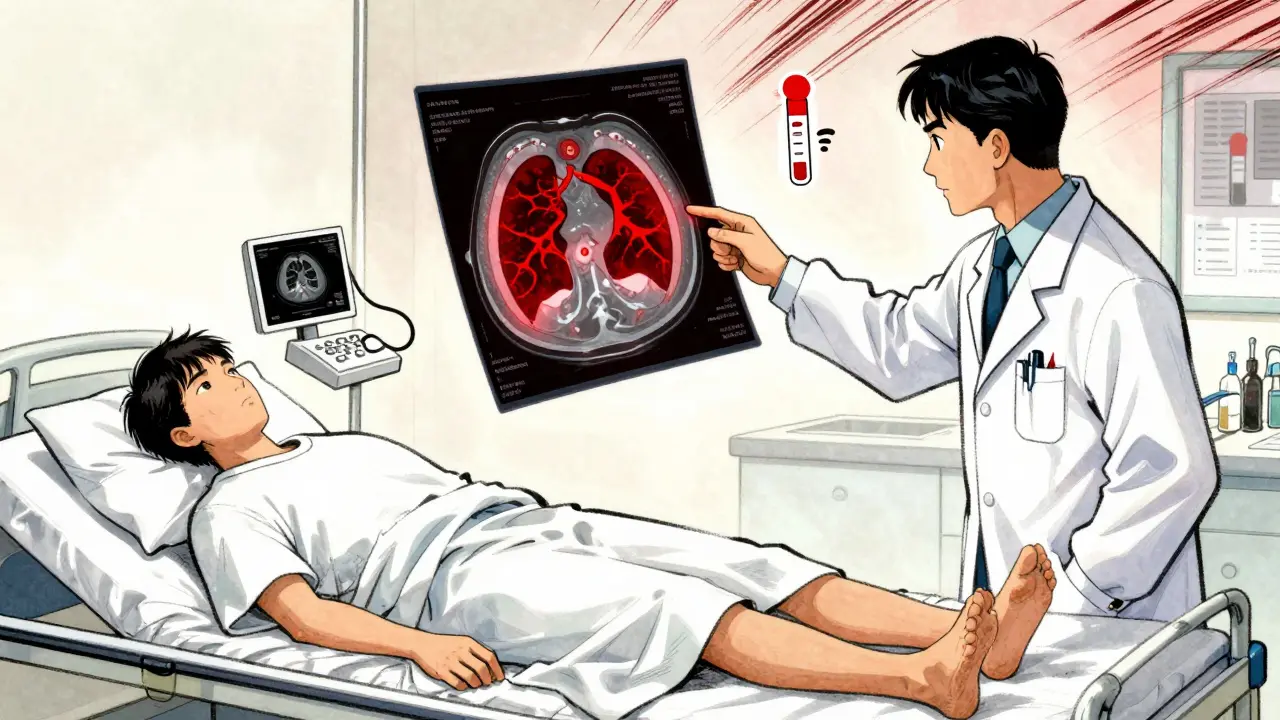
If the score is moderate or high, or if D-dimer is positive, they do a CTPA. This is the gold standard. It’s a CT scan with contrast dye that shows the arteries in your lungs. It finds 95% of clots. The radiation is low-about the same as a mammogram. But it’s not perfect. Small clots in the outer edges of the lungs can be missed. That’s why doctors don’t rely on the scan alone-they combine it with symptoms and risk factors.Step 4: Ultrasound for DVT
If you have swelling in one leg, they’ll do a compression ultrasound. It’s quick, painless, and 90%+ accurate for finding clots in the big veins of your thigh or calf. If they find a clot there, and you have shortness of breath, they treat you for PE-even without a lung scan.Step 5: Emergency cases
If you’re collapsing, your blood pressure is dropping, or you’re in shock, they don’t wait. They do an echocardiogram right at your bedside. If your right ventricle is swollen and struggling, that’s a sign of massive PE. Time is seconds, not hours.What Happens If You’re Diagnosed?
Treatment starts immediately. Blood thinners-like heparin or newer oral drugs like rivaroxaban-are given right away. They don’t dissolve the clot. They stop it from growing and let your body break it down naturally over weeks or months. Most people go home after a day or two if they’re stable.For massive PE with low blood pressure, things get urgent. Doctors might use clot-busting drugs (thrombolytics) or even a catheter to pull the clot out. A new approach called the Pulmonary Embolism Response Team (PERT) brings together specialists-radiologists, cardiologists, hematologists-to act fast. Hospitals with PERT teams have seen mortality drop by over 4%.
What You Can Do to Prevent It
You can’t always stop a clot from forming, but you can reduce your risk:- Movements matter: If you’re on a long flight or car ride, stand up, stretch your legs, or do ankle pumps every hour.
- After surgery, get up and walk as soon as you can-even if it’s just to the bathroom.
- If you’re hospitalized, ask about compression stockings or blood thinners.
- Know your history: If you’ve had a clot before, talk to your doctor about long-term prevention.
- Don’t ignore leg swelling, especially if it’s one-sided and painful.
Most people recover fully. But 1 in 3 will have another clot in the next decade. That’s why follow-up care matters.

What’s Changing in PE Diagnosis Right Now
New tools are making diagnosis faster and smarter:- AI-powered CT scans: Algorithms like PE-Flow can spot clots in CTPA scans with 96% accuracy, helping radiologists catch small ones they might miss.
- Biomarker panels: Researchers are testing combinations of D-dimer with other proteins to improve accuracy, especially in cancer patients.
- Point-of-care ultrasound: Emergency rooms are using portable ultrasound machines to check for clots in the legs and heart right at the bedside-cutting diagnosis time from hours to minutes.
These aren’t sci-fi. They’re in use now. Hospitals that use them have cut the time from symptom start to diagnosis from over two hours to under an hour. That’s the difference between life and death.
Don’t Wait for the Worst to Happen
Pulmonary embolism doesn’t care if you’re young, fit, or healthy. It strikes quietly. If you’ve had sudden shortness of breath-especially with leg swelling, chest pain, or a history of clots-don’t brush it off. Don’t wait for it to get worse. Don’t let a doctor tell you it’s anxiety. Push for a D-dimer test or a CTPA if your symptoms don’t make sense. Your lungs can’t tell you they’re failing until it’s too late. Be the one who speaks up.Can you have a pulmonary embolism without knowing it?
Yes. Small clots can cause mild, short-lived symptoms like brief breathlessness or a slight cough that fade quickly. Many people assume it was just a bad allergy or a virus. But even small clots can grow or lead to more clots. If you’ve had unexplained shortness of breath, especially after surgery, long travel, or if you have risk factors like cancer or a past clot, you should get checked-even if symptoms are gone.
Is a pulmonary embolism the same as a heart attack?
No. A heart attack is caused by a blocked artery in the heart, leading to heart muscle damage. A pulmonary embolism is a clot in the lungs, blocking blood flow to the lung tissue. Both can cause chest pain and shortness of breath, but PE doesn’t damage the heart directly-unless it’s massive and causes the heart to fail from strain. The treatments are completely different: heart attacks need stents or clot-busters for the heart; PE needs blood thinners for the lungs.
Can you get a pulmonary embolism from sitting too long?
Yes. Sitting for long periods-like during flights, car rides, or desk work-slows blood flow in the legs. This increases the chance of a clot forming. That’s why doctors recommend moving your legs every hour. The risk is higher if you’re overweight, on birth control, pregnant, or have a genetic clotting disorder. A 12-hour flight increases your risk by about 20% compared to normal.
Does a negative D-dimer test mean I don’t have a pulmonary embolism?
Only if you’re low risk. If your doctor says you’re low risk based on symptoms and history, and your D-dimer is negative, PE is very unlikely. But if you’re over 50, have cancer, or are hospitalized, D-dimer can be falsely negative. In those cases, even a negative test doesn’t rule out PE. Imaging like a CTPA scan is still needed.
How long does it take to recover from a pulmonary embolism?
Most people feel better in a few days to weeks after starting blood thinners. But full recovery can take months. The clot doesn’t disappear overnight-it slowly dissolves. You’ll need to take medication for at least three months, sometimes longer if you have ongoing risk factors. Some people develop long-term lung damage called chronic thromboembolic pulmonary hypertension (CTEPH), which causes ongoing breathlessness. That’s rare, but it’s why follow-up care matters.
Can you die from a pulmonary embolism if it’s not treated?
Yes. About 1 in 3 people with untreated PE will die within the first few hours or days. The clot blocks blood flow to the lungs, causing low oxygen, heart strain, and eventually heart failure. The bigger the clot, the faster it kills. That’s why sudden shortness of breath with no clear cause should never be ignored. Immediate treatment cuts death risk by more than half.
Are there any natural ways to prevent pulmonary embolism?
There’s no natural remedy that can prevent or treat a clot. But lifestyle changes reduce your risk: staying active, drinking water, avoiding long periods of sitting, and not smoking help. Some supplements like fish oil or garlic have mild blood-thinning effects, but they’re not strong enough to replace medical treatment. Never stop prescribed blood thinners for natural alternatives-this can be deadly.
When to Seek Help Immediately
If you have:- Sudden, unexplained shortness of breath
- Chest pain that gets worse when you breathe
- One swollen, painful leg
- Fainting or feeling like you’re going to pass out
Go to the emergency room. Don’t call your doctor’s office. Don’t wait until morning. PE doesn’t wait. The sooner you get a scan, the better your chances.





Sudden shortness of breath after a flight? I ignored it for days. Thought I was just out of shape. Turned out I had a clot the size of a grape. CT scan saved my life. Don't be me.
They say PE is common but nobody talks about how the whole system is rigged. D-dimer tests are unreliable because labs get paid per scan. Hospitals profit off fear. You think they want you to walk out healthy?
This post is LIFE SAVING 🙏 I had no idea leg swelling + breathlessness = emergency. My aunt almost died and no one connected the dots. Sharing this with everyone I know. Thank you!!
As someone who grew up in a country where hospitals don't have CTPA machines, I'm so grateful for this breakdown. In my village, people just assume breathlessness means 'old age' or 'weak lungs'. This needs to be translated into 10 languages.
I used to think PE was something that happened to 'other people'. Then I sat through a 14-hour flight, didn't move once, and woke up gasping. Now I stretch every hour. And I never, ever ignore a weird breathless feeling again.
The epistemological framework of PE diagnosis is fundamentally flawed. The reliance on clinical scoring assumes a binary risk model, but human physiology is a nonlinear dynamical system. D-dimer thresholds are statistically naive when applied to aging populations with comorbidities. We're treating symptoms with algorithmic reductionism.
How touching that someone took the time to write this with such care. Truly, the medical community needs more voices like yours. I'm forwarding this to my entire family. Especially my dad who had surgery last month. You've done good work.
The most important takeaway here is that PE isn't about the clot-it's about the delay. Most people get misdiagnosed because symptoms overlap with anxiety, asthma, or deconditioning. But the window for intervention is narrow. If you feel off, push for the test. Your life isn't a guess.
This is just fearmongering. In India we don't even test for PE unless you're dead. People just die quietly. Why are you making this sound like a crisis? It's just biology. Stop overmedicalizing.
I work in radiology. CTPA is overused. 30% of scans show tiny clots that would never cause harm. We're overtreating people because we're scared of lawsuits. The real problem is the medical system, not the clot.
I've been thinking about this for days... the existential weight of a silent clot. It's not just a medical condition-it's a metaphor for how we ignore the things that are slowly killing us. The breathlessness? That's our soul screaming. The leg swelling? That's the burden of modern life. We're all walking around with invisible clots-emotional, spiritual, societal. And nobody wants to face it.
I got diagnosed with PE last year. Took 3 ER visits. They told me I was 'anxious'. I cried in the parking lot. Then I Googled 'sudden breathlessness no cough' and found this exact article. I went back. They did the scan. I was lucky. Don't wait. Just go.
I just told my mom to read this. She's 71, had knee surgery, and keeps saying 'I'm just getting old'. I'm sending her this right now. If this saves one life, it's worth it. You're a hero!!