Pravastatin Side Effect Risk Calculator
This tool helps you understand your personal risk of statin side effects and whether pravastatin might be a suitable option for you. Based on your answers, it will show your risk level compared to other common statins.
Personal Health Information
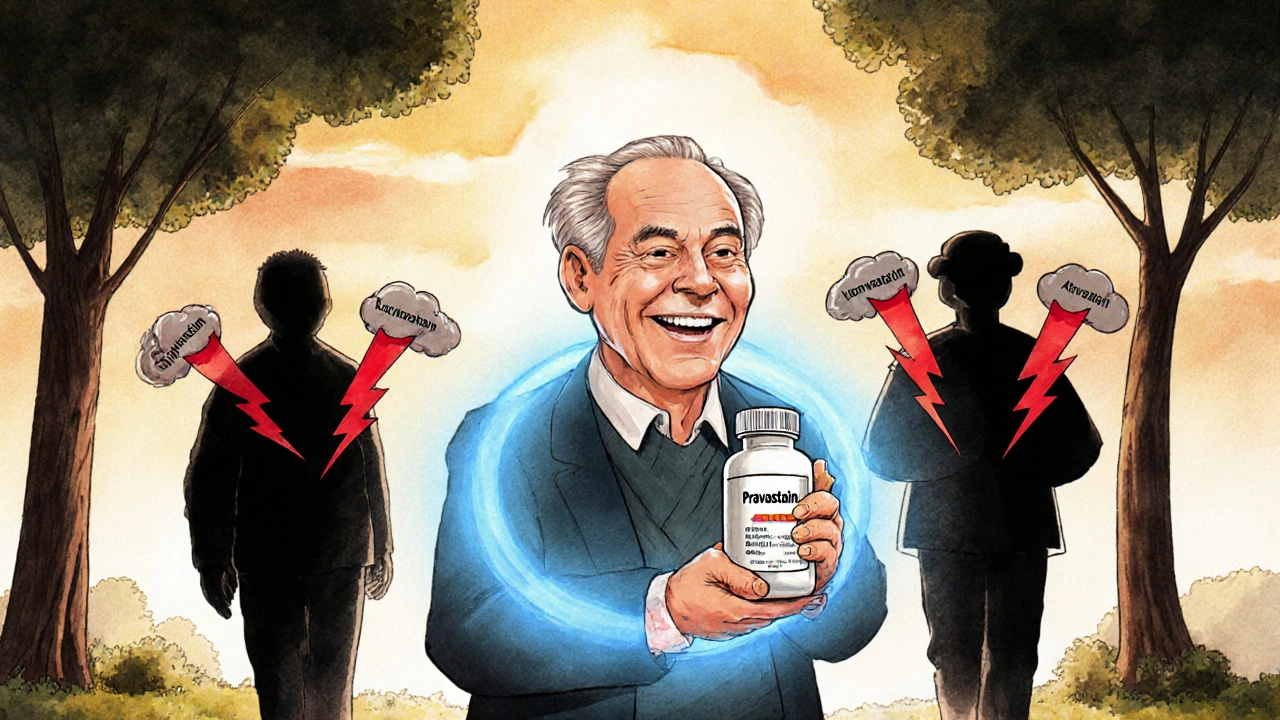
When you’re over 65 and your doctor recommends a statin for high cholesterol, the question isn’t just whether it works-it’s whether you can actually live with it. Many older adults have tried statins like simvastatin or atorvastatin and stopped because of muscle pain, fatigue, or stomach issues. But for many, pravastatin is a different story. It’s not the strongest statin, but it’s often the safest one for seniors, especially those juggling multiple medications and age-related changes in their bodies.
Why Pravastatin Stands Out for Seniors
Pravastatin is a hydrophilic statin, which means it doesn’t easily slip into muscle cells or cross the blood-brain barrier like other statins do. That’s a big deal. Lipophilic statins like simvastatin and atorvastatin get into tissues more easily, which increases the chance of muscle damage and brain-related side effects. Pravastatin, on the other hand, mostly stays in the bloodstream and is cleared by the kidneys. That’s why it’s preferred for older adults-especially those with kidney issues or who take five or more medications daily.According to a 2022 meta-analysis of over 118,000 patients published in The Lancet, pravastatin caused 28% fewer muscle-related side effects than other statins in people over 75. That’s not a small difference. For many seniors, muscle aches aren’t just annoying-they make it hard to walk, climb stairs, or even get out of a chair. When those symptoms disappear after switching to pravastatin, it’s not just a win for comfort-it’s a win for independence.
The Side Effects You Actually Need to Watch For
Pravastatin is generally well-tolerated, but it’s not side effect-free. The most common complaints from older adults are mild and often temporary:- Mild nausea or stomach upset-about 37% of elderly patients on WebMD reported this, but most found it faded after 2 to 4 weeks.
- Muscle soreness-though far less common than with other statins, it still happens. The key is knowing the difference between normal aging aches and true statin-induced myopathy. If pain is new, localized, or worse with movement, tell your doctor.
- Headaches and dizziness-rare, but reported in about 5% of users over 70.
- Increased blood sugar-all statins carry a small risk of triggering or worsening type 2 diabetes. Pravastatin has the lowest risk among them, but it’s still something to monitor, especially if you’re prediabetic.
Severe muscle damage (rhabdomyolysis) is extremely rare with pravastatin-less than 1 in 10,000 users. But if you notice dark urine, extreme weakness, or unexplained muscle pain, stop taking it and call your doctor immediately.
How It Compares to Other Statins in Seniors
A 2020 study of nearly 46,000 older adults found pravastatin had the lowest rate of statin-associated muscle symptoms at just 5.2%. Compare that to 11.7% for simvastatin and 8.9% for atorvastatin. That’s a huge gap.But here’s the trade-off: pravastatin isn’t as powerful. A 40mg dose lowers LDL (“bad”) cholesterol by about 26%. Atorvastatin at 20mg lowers it by 45%. So if your LDL is sky-high-say, above 190 mg/dL-pravastatin alone might not be enough. That’s why many doctors add ezetimibe, a non-statin cholesterol drug, to the mix. One Reddit user, a 75-year-old man, said after switching from simvastatin to pravastatin, his muscle cramps vanished. But his cholesterol didn’t drop enough, so his doctor added ezetimibe. Now he’s stable.
The American College of Cardiology and American Heart Association’s 2018 guidelines specifically recommend pravastatin for older adults because of its low interaction risk. It doesn’t rely on the liver’s CYP450 enzyme system, which is how many other drugs are broken down. That’s huge. The average 70-year-old takes 4.8 prescription medications. Pravastatin plays nice with blood pressure pills, diabetes meds, and even blood thinners. Simvastatin? Not so much.

Dosing and Monitoring: What Your Doctor Should Do
There’s no one-size-fits-all dose for seniors. Most start at 20mg daily, taken in the evening. The maximum dose is 80mg, but that’s rarely needed. For people with kidney problems-creatinine clearance under 30 mL/min-the max is 40mg.Here’s what good monitoring looks like:
- Baseline blood test-liver enzymes and creatine kinase (CK) before starting.
- Follow-up at 12 weeks-check liver function again and ask about muscle symptoms.
- Annual blood work-keep an eye on liver enzymes, kidney function, and fasting glucose.
- Ask about new muscle pain-don’t assume it’s just aging. Document when it started, where it hurts, and if it’s worse after activity.
A 2023 study in Annals of Internal Medicine found that clinics with clear protocols-medication reconciliation, patient education, and a follow-up within 6-8 weeks-had 40% fewer discontinuations. That’s the difference between someone staying on a safe, effective drug and quitting because no one checked in.
What Patients Are Really Saying
On Drugs.com, pravastatin has over 1,200 reviews from people over 65. The most common positive comment? “Switched from Lipitor to pravastatin, and my muscle pain disappeared.”The negative reviews? “Didn’t lower my cholesterol enough.” That’s the recurring theme. Pravastatin works great for tolerability, but not always for power. One 78-year-old woman wrote: “I stayed on it for a year, but my LDL stayed at 160. My doctor finally added ezetimibe-and it worked.”
On Reddit, users in r/elderly often share stories of switching to pravastatin after bad reactions to other statins. One user said: “After 3 years of leg cramps from simvastatin, pravastatin let me walk without pain. I just needed help from another pill to get my numbers down.”

When Pravastatin Might Not Be the Best Fit
Pravastatin isn’t for everyone. If you’re at very high risk for heart attack or stroke-say, you’ve had a prior event, have diabetes, or have very high LDL-your doctor may need something stronger. In those cases, a combination of pravastatin and ezetimibe, or even a low-dose rosuvastatin, might be better.Also, if your kidneys are severely impaired, stick to 40mg max. And if you’re taking fibrates (like gemfibrozil) for triglycerides, avoid pravastatin altogether-this combo increases muscle risk.
The American Geriatrics Society’s Beers Criteria, updated in 2023, still lists pravastatin as a preferred statin for older adults. Simvastatin over 20mg? They call it “potentially inappropriate.” That’s how strong the evidence is.
The Bigger Picture: Why This Matters
By 2050, 1.6 billion people worldwide will be over 65. That’s a lot of people needing cholesterol management. And as more older adults live longer with multiple conditions, the need for safe, simple, low-interaction drugs like pravastatin will only grow.The NIH is currently running the SPRINT-AGE trial, studying pravastatin in people over 80 with multiple health problems. Early results, expected in early 2024, could confirm what we already suspect: that for many seniors, safety trumps strength.
Pravastatin won’t fix everything. But for older adults who’ve been turned off by muscle pain, nausea, or complex drug interactions, it’s often the bridge that lets them stay on treatment-and live better.






Pravastatin saved my dad’s mobility. He was on simvastatin for years and couldn’t walk to the mailbox without stopping. Switched him over last year - no more cramps, no more complaining. He even started gardening again. Simple, safe, and it works for people who just want to stay independent.
Doctors need to stop pushing the strongest statin first. Sometimes the gentle one is the real winner.
As someone who has watched elderly relatives struggle with statin side effects, I can confirm that pravastatin is often the only viable option for seniors on polypharmacy regimens. Its hydrophilic nature minimizes tissue penetration, thereby reducing the risk of myopathy and central nervous system effects - a critical advantage when compared to lipophilic alternatives like simvastatin or atorvastatin. Moreover, its renal clearance pathway makes it preferable in patients with mild-to-moderate renal impairment, which is common in aging populations. The 28% reduction in muscle-related adverse events cited in The Lancet meta-analysis is not just statistically significant - it is clinically transformative for quality of life.
For many, the difference between staying on medication and discontinuing it entirely hinges on tolerability - not potency. And that’s why pravastatin deserves a stronger place in geriatric guidelines.
Oh please. Another ‘pravastatin is the holy grail’ post. My 79-year-old aunt took it for six months and her LDL barely budged. She’s now on ezetimibe + low-dose rosuvastatin and her numbers are finally under control. Just because it doesn’t wreck your legs doesn’t mean it’s doing its job.
Stop romanticizing mediocrity.
Okay but can we talk about how everyone’s acting like pravastatin is some magical miracle drug? 🙄
It’s not that it’s bad - it’s just… not a superhero. It’s the quiet kid in class who doesn’t get in trouble but also doesn’t win science fair. And that’s fine! But if your LDL is 200, you’re not gonna fix it with a gentle nudge.
Also - anyone else notice how every comment says ‘my dad’ or ‘my mom’? When’s the last time someone said ‘I’? Like… are we all just caregivers now? 😅
My uncle was on 80mg of simvastatin and could barely stand up in the morning. Switched to pravastatin 40mg - he’s back to walking his dog, playing with his grandkids, no muscle pain. Honestly? It’s not about lowering cholesterol the most. It’s about letting people live.
Doctors should be asking ‘what’s the least toxic option?’ not ‘what’s the strongest?’
While the anecdotal evidence presented is compelling, one must remain cognizant of the limitations inherent in observational data and patient-reported outcomes. The Lancet meta-analysis cited, though robust, does not account for confounding variables such as concomitant statin use, dietary adherence, or genetic polymorphisms in SLCO1B1 that influence statin pharmacokinetics. Furthermore, the assertion that pravastatin is ‘preferred’ for older adults lacks a prospective, randomized controlled trial specifically designed for the geriatric population with multimorbidity. Until such evidence emerges, clinical recommendations should remain cautious, not celebratory.
THIS. THIS IS THE POST I’VE BEEN WAITING FOR MY ENTIRE LIFE.
My grandma was on Lipitor and cried every time she tried to stand up from her chair. We switched her to pravastatin - and she started dancing in the kitchen again. Not exaggerating. She did the cha-cha with her walker. I cried. My mom cried. The dog cried.
Pravastatin didn’t just lower her cholesterol - it gave her back her dignity. And that’s worth more than any LDL number.
My mom’s on pravastatin and it’s been a game changer 🙌
She had that weird fatigue and leg cramps on atorvastatin - like, she couldn’t even lift her coffee cup. Switched to pravastatin 20mg and boom - energy back, no pain, just chill vibes 😌
Doc added ezetimibe and her LDL dropped to 98 - so it’s not all about the statin strength, it’s about combo play 💪
Also side note - if you’re over 70 and your doctor doesn’t check CK or liver enzymes before starting? Run. Or at least ask for a blood test. Seriously.
And yes, I’m that daughter who prints out articles and reads them to her mom at dinner 🤓
Pravastatin?? 😭 like the statin that barely does anything??
My cousin’s doctor gave her this because she’s ‘old’ and ‘can’t handle real meds’??
Meanwhile her cholesterol is 210 and she’s got a 30% 10-year risk and they’re giving her… what? A spa day in pill form??
Also why does everyone say ‘my dad’ like we’re all in some collective caregiving cult??
…I’m just saying - if you need real power, don’t settle for ‘gentle’
Also the Beers Criteria? That’s like a 2012 list??
…I’m out. 😒
i live in india and my uncle, 72, took simvastatin and got so weak he couldn't hold his tea cup
switched to pravastatin - no more shaking, no more pain
his cholesterol didn't drop much, but he could walk to temple again
that's more important than numbers, no?
we don't have fancy clinics here
but we know when someone smiles again
thank you for writing this
❤️
Did you know that pravastatin is metabolized differently in Asian populations? I read a paper once. It’s not just about age - it’s about ethnicity too. Your body’s enzymes change based on where your ancestors lived. So maybe pravastatin works better for some of us because of that. I think we need more personalized medicine. Like, genetic testing before prescribing. But no one wants to pay for that. 😔
Pravastatin isn’t flashy, but it’s reliable. My father had kidney disease and took five other meds. Simvastatin would’ve been a disaster. Pravastatin? Clean, simple, no interactions. He’s been on it for five years. No issues. No drama.
Good medicine doesn’t always shout. Sometimes it just whispers - and lets you live.