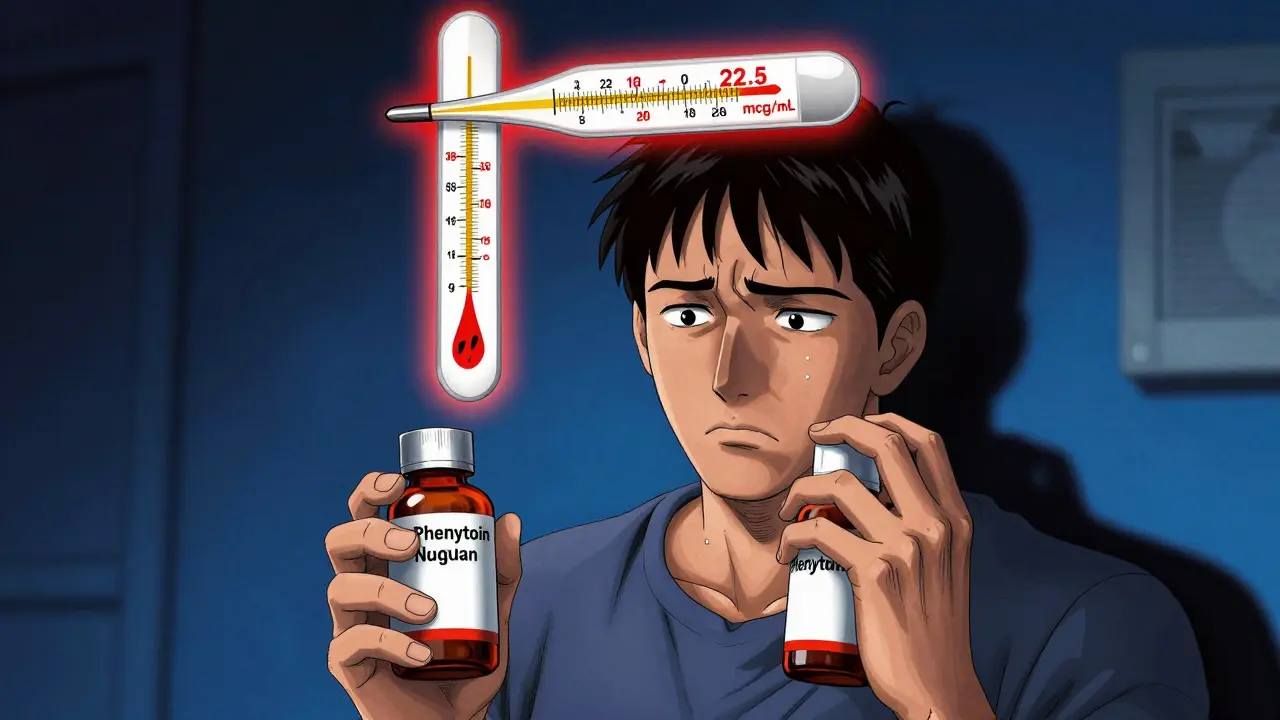
Switching from brand-name Dilantin to a generic version of phenytoin might seem like a simple cost-saving move-but for patients with epilepsy, it can be risky. Phenytoin isn’t like most medications. Even small changes in blood levels can lead to seizures or serious toxicity. That’s why therapeutic drug monitoring isn’t optional when switching between phenytoin formulations. It’s essential.
Why Phenytoin Is Different
Phenytoin has a narrow therapeutic window: 10 to 20 mcg/mL. That’s the range where it works without causing harm. Go below 10, and seizures may return. Go above 20, and you risk confusion, loss of coordination, or even coma. At levels over 50 mcg/mL, death can occur. But here’s the catch: phenytoin doesn’t follow normal rules. Its metabolism is non-linear. If you increase the dose by just 25-50 mg, the blood level might jump by 50% or more. This happens because the liver enzymes that break down phenytoin get saturated. Once they’re full, the drug builds up fast. Add to that: phenytoin is 90-95% bound to proteins in the blood. Only the 5-10% that’s free is active. So if a patient has low albumin-common in older adults, malnourished patients, or those with liver disease-their total phenytoin level might look normal, but their free level could be dangerously high.Generic Switches Aren’t Always Safe
The FDA says two phenytoin products are bioequivalent if their absorption profiles are within 80-125% of each other. That sounds fine-until you realize that for a drug with phenytoin’s narrow window, a 25% difference in absorption can push someone from 18 mcg/mL to 22.5 mcg/mL. That’s out of the safe range. Real-world reports confirm this. Patients stabilized on one generic brand have had seizures after switching to another. Others developed tremors, slurred speech, or dizziness after a switch that seemed chemically identical. Why? Because generics can differ in fillers, coating, or dissolution rates. Even small changes in how quickly the drug enters the bloodstream can matter. The NHS Tayside guidelines (2022) and the American Academy of Family Physicians both say: monitor when switching formulations. Routine monitoring isn’t needed for everyone-but when you change the pill, it’s not just a good idea. It’s a safety step.When and How to Monitor
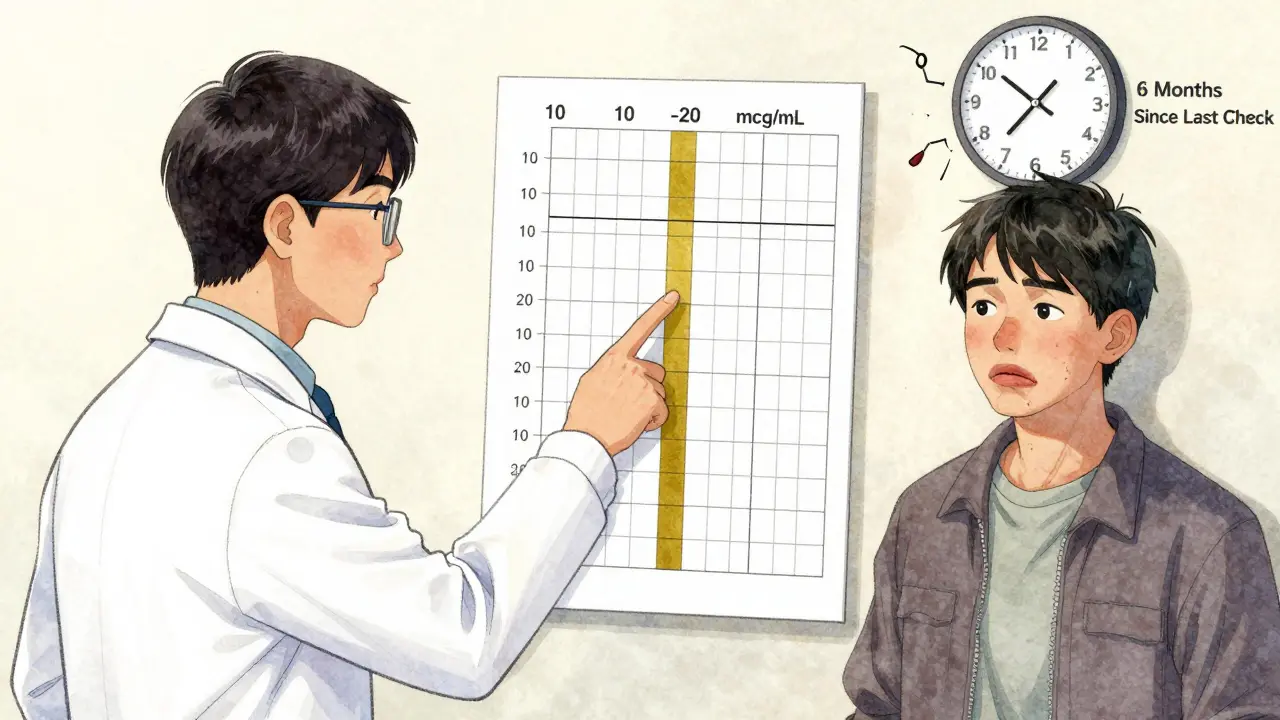
Monitoring isn’t just about drawing blood once. It’s a process.- Take a trough level (just before the next dose) right before switching.
- Wait at least 5 days after the switch before testing again. Phenytoin takes about 24 hours to reach steady state, but full equilibrium can take 5-10 days.
- If the patient got an IV loading dose, wait 12-24 hours before checking levels after an oral dose.
- Don’t check levels too early-results before day 5 are misleading.
Other Factors That Change Phenytoin Levels
Phenytoin doesn’t live in a vacuum. Many drugs interfere with it.- Drugs that raise phenytoin levels: amiodarone, fluconazole, metronidazole, valproate, cimetidine, and sulfa antibiotics.
- Drugs that lower phenytoin levels: carbamazepine, rifampin, phenobarbital, theophylline, and chronic alcohol use.
Long-Term Monitoring Beyond Blood Levels
Phenytoin doesn’t just affect your brain. Long-term use can cause:- Gingival hyperplasia (swollen gums)
- Hirsutism (excess hair growth)
- Vitamin D deficiency
- Low calcium and phosphate
- Bone thinning (osteomalacia)
- Folic acid deficiency
- Peripheral neuropathy
- Complete blood count
- Liver function tests
- Electrolytes and kidney function
- Albumin
- Vitamin D and calcium

What to Do When Switching Formulations
Here’s a simple checklist for clinicians and caregivers:- Document the exact brand and manufacturer of the current phenytoin product.
- Draw a trough level before the switch.
- Switch to the new product on the same time of day.
- Watch for changes in seizure control, coordination, speech, or alertness.
- Check phenytoin level 5-10 days after the switch.
- If levels are abnormal or symptoms change, consider switching back or testing free phenytoin.
- Review all other medications for interactions.
- Schedule follow-up blood work for bone and liver health in 3-6 months.
Bottom Line
Generic phenytoin saves money. But it doesn’t save lives if it causes seizures or toxicity. Therapeutic drug monitoring isn’t just a lab test-it’s a safety net. For phenytoin, it’s the only way to know if the pill you’re taking is working the way it should. Patients on phenytoin need more than a prescription. They need consistent monitoring, clear communication, and awareness that switching pills isn’t like switching brands of aspirin. It’s a medical event. If you or someone you care for is on phenytoin, ask: What brand am I on? When was my last level checked? Have I switched formulations recently? Those questions could prevent a crisis.Do all generic phenytoin products work the same?
No. While all generics must meet FDA bioequivalence standards (80-125% absorption range), phenytoin’s narrow therapeutic index means even small differences in absorption can push levels into the toxic or ineffective range. Patients have reported seizures or toxicity after switching between different generic brands-even when both were labeled as phenytoin sodium.
How often should phenytoin levels be checked?
Once a patient is stable on a specific formulation, levels can be checked every 6-12 months. But levels must be checked after any dose change, illness, or switch in brand or generic. Always check 5-10 days after a switch to confirm steady state. Don’t check too early-results before day 5 are unreliable.
What if my phenytoin level is normal but I still have seizures?
A normal total level doesn’t always mean the drug is working. If you have low albumin (common in older adults or those with liver disease), your free phenytoin level could be too high or too low. Ask your doctor for a free phenytoin test. Also, check for drug interactions or changes in absorption due to GI issues.
Can I switch back to the brand-name drug if generics cause problems?
Yes. If you experience seizures, dizziness, or confusion after switching to a generic, contact your doctor immediately. You may need to return to the original brand or try a different generic. Insurance may require prior authorization, but safety comes first. Document your symptoms and level changes-this helps justify the switch.
Are there any long-term side effects of phenytoin I should watch for?
Yes. Long-term use can cause swollen gums, excess hair growth, bone thinning, vitamin D deficiency, and nerve damage. Get your vitamin D, calcium, and liver enzymes checked every 1-2 years. See a dentist regularly for gum checks. If you’re over 50 or have a history of fractures, ask about bone density scans.
What should I do if I miss a dose of phenytoin?
If you miss one dose, take it as soon as you remember-unless it’s close to your next dose. Never double up. Missing doses can cause breakthrough seizures. If you miss multiple doses, contact your doctor before restarting. Your phenytoin level may have dropped, and restarting without checking could lead to toxicity if you resume your old dose.
Is phenytoin safe during pregnancy?
Phenytoin increases the risk of birth defects, including cleft lip, heart problems, and developmental delays. If you’re pregnant or planning pregnancy, talk to your neurologist. Folic acid supplementation is recommended before and during pregnancy. Levels need close monitoring because pregnancy changes how phenytoin is processed-many women need higher doses.






Been on generic phenytoin for 3 years now and never had an issue but my cousin had a seizure after switching brands last year. Doc said it was the filler. Never thought pills could be that finicky.
Monitoring is non-negotiable. Period.
My dad switched generics and started stumbling around like he was drunk. We thought it was aging. Turned out his levels were at 24. Scary stuff. Always check before you switch.
THIS IS WHY WE NEED TO BAN GENERIC DRUGS IN THE US THEY'RE LITERALLY KILLING PEOPLE AND NO ONE CARES ABOUT THE POOR PEOPLE WHO JUST WANT TO SURVIVE
In India, many patients rely on generics out of necessity. But doctors there often don't have access to free phenytoin tests. It's a systemic gap. We need better infrastructure, not just warnings.
Phenytoin isn’t just a drug-it’s a dance between chemistry, biology, and human vulnerability. One pill, one milligram, one milliliter can tip the scales between safety and catastrophe. And yet we treat it like swapping coffee brands. We owe our patients more than convenience. We owe them vigilance.
So we’re supposed to monitor every time someone switches? What about the people who can’t afford 5 blood draws a year? This system is broken.
I read this whole thing and now I’m convinced that phenytoin is basically a landmine disguised as a pill. One wrong move and boom-you’re in the ER. And the worst part? The system is designed to let this happen. Insurance pushes generics, pharmacies switch without telling you, and patients are left guessing. It’s not negligence-it’s a structural failure. We need a registry. We need mandatory labeling. We need to treat this like we treat insulin or warfarin. Not like aspirin.
My sister’s on phenytoin and she’s been rock solid for 8 years on the same brand. Last month her pharmacy switched her without telling her. She had a minor seizure at work. Now we’re fighting with the insurance company. Don’t let this happen to you. Know your pill. Know your level. Ask questions. Always.
Wow so if I switch from one generic to another I might die? Guess I’ll just pay $500 a month for Dilantin then. Thanks for the reminder that healthcare is just a lottery.