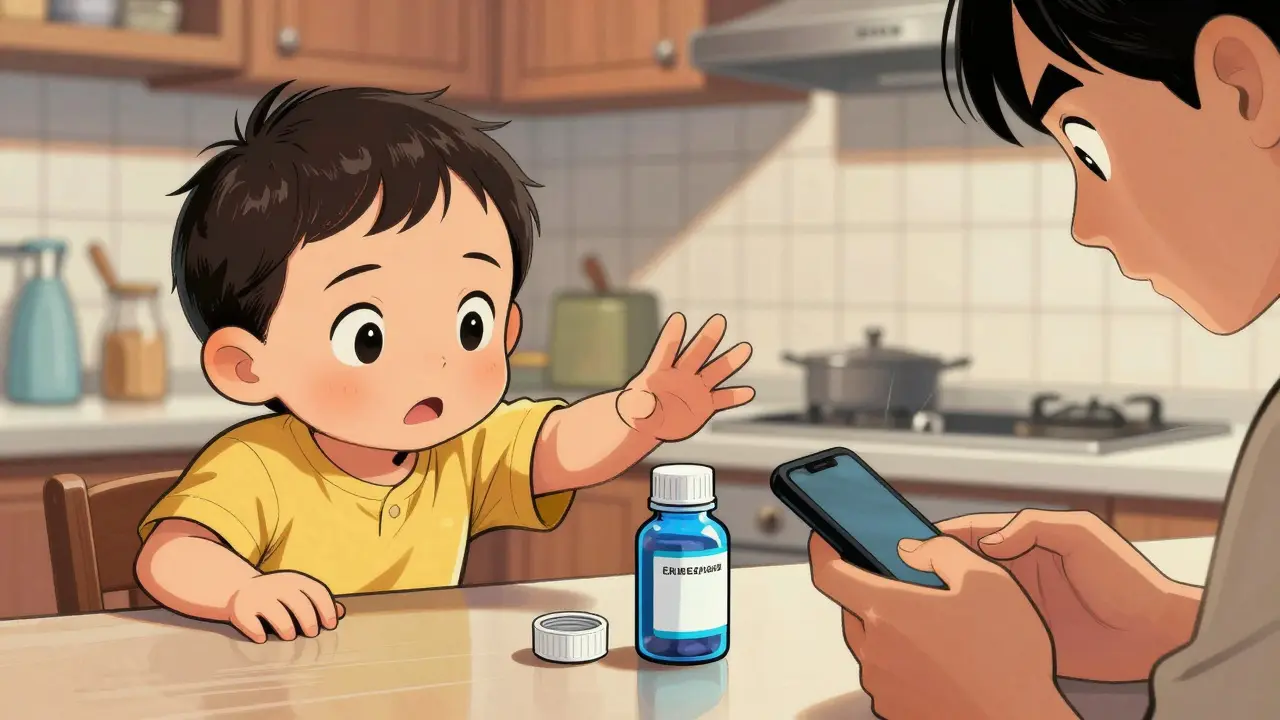
Pediatric Medication Dose Calculator
Correct Measurement:
Critical Safety Warning:
Never use kitchen spoons. 1 teaspoon = 5 mL. Using spoons risks 5x overdose. Always use the dosing syringe or cup provided with your medicine.
Remember: The FDA requires all pediatric medications to use milliliters (mL) only. Always check your medicine's label for mL measurements and use the dosing device that came with your medication.
Every year, 50,000 children under age 5 end up in emergency rooms because they got into medicine they shouldn’t have. Many of these cases aren’t accidents-they’re preventable mistakes. Children aren’t just small adults. Their bodies process drugs differently, they can’t tell you when something feels wrong, and even a tiny dose meant for an adult can be deadly. That’s why pediatric medication safety isn’t just important-it’s life-or-death work that demands special rules, tools, and habits.
Why Kids Are at Higher Risk
Children’s bodies change fast. A newborn weighs maybe 3 kilograms. By age 12, they might weigh 40. That’s more than a 10-fold difference in body size. Medication doses aren’t scaled by age-they’re calculated by weight, in kilograms. Get that number wrong, and you could give 10 times too much-or too little. In adult hospitals, where most patients are grown-ups, staff may not see a pediatric case more than once a week. That lack of experience increases the chance of error. Studies show facilities with fewer than 100 pediatric patients a year have over three times the error rate of dedicated children’s hospitals. Then there’s how kids’ organs work. Their livers and kidneys are still growing. That means drugs stay in their system longer or get cleared too quickly. A medicine that’s safe for a teenager might overload a 6-month-old’s system. And because young kids can’t say, “My stomach hurts” or “I feel dizzy,” side effects often go unnoticed until it’s too late.The Most Common Medication Errors
The biggest danger isn’t always the drug itself-it’s how it’s measured and given. Here are the top mistakes:- Confusing teaspoons and milliliters: 1 teaspoon = 5 milliliters. Giving 1 teaspoon instead of 1 mL means a 5x overdose.
- Using kitchen spoons: A tablespoon is three times bigger than a teaspoon. Many parents use the wrong spoon and don’t realize it.
- Wrong unit conversion: Mixing pounds and kilograms. If a child weighs 20 pounds but the dose is calculated in kg, and someone forgets to convert, the dose can be off by more than 50%.
- Removing pills from child-resistant containers: Adults often take pills out of their original bottles and leave them on counters or in purses. Children can open these containers in under 30 seconds if they’re not fully closed.
Even common items like prenatal vitamins, eye drops, or diaper rash cream can be deadly in small amounts. One pill of an adult opioid or heart medication can kill a toddler. Poison control centers report that 60% of pediatric poisoning cases happen because medicine was left within reach-even in places parents thought were “safe.”
What Hospitals Are Doing Right
Children’s hospitals have learned from years of mistakes. The American Academy of Pediatrics laid out 15 evidence-based safety steps in 2018, and 78% of children’s hospitals now use at least 12 of them. Here’s what works:- Kilograms only: All weight measurements are in kg. No pounds. Electronic systems block dosing if the weight isn’t entered in kg.
- Standardized concentrations: High-risk drugs like morphine or insulin are now made in the same strength across all hospitals. No more guessing if the bottle says 1 mg/mL or 10 mg/mL.
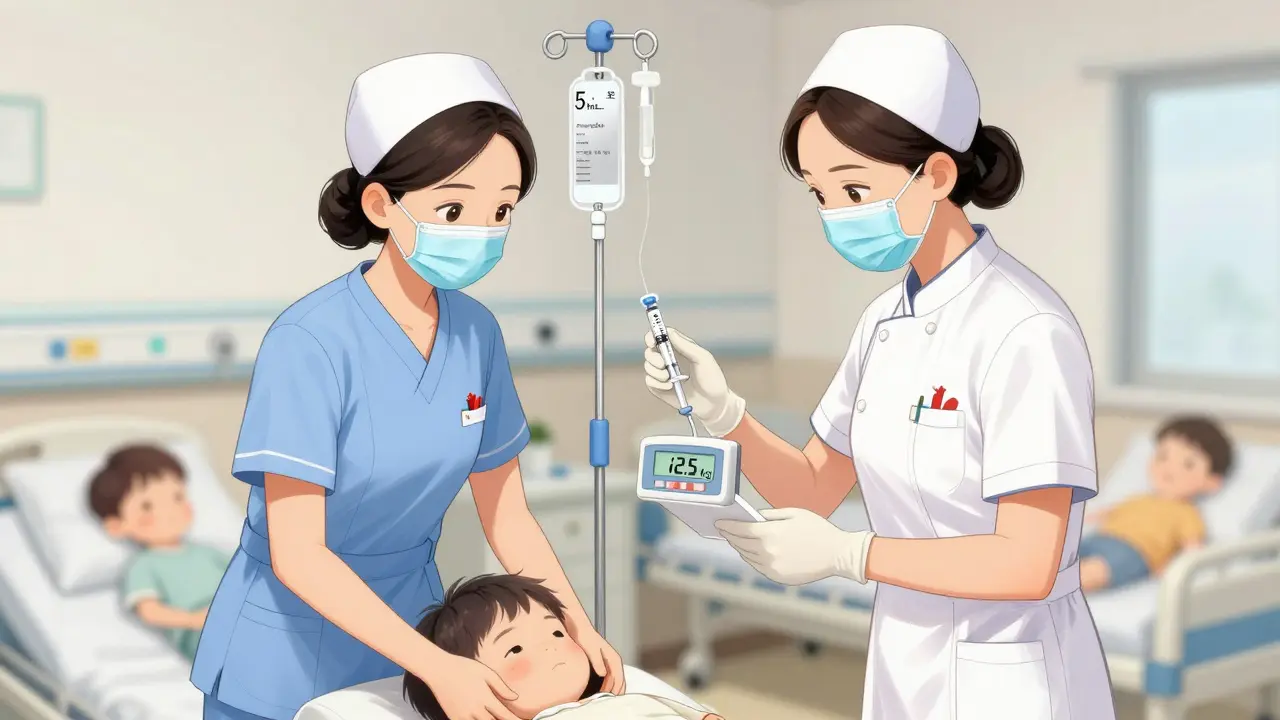
- Two-person checks: Before giving a high-alert drug to a child, two trained staff members verify the dose, the child’s weight, and the route of administration.
- Distraction-free zones: Medication prep happens in quiet areas with no interruptions. Phones are put away. No talking. Just focus.
- Milliliter-only labeling: Liquid medications come with syringes or cups marked in mL only. No teaspoons or tablespoons.
These changes have cut dosing errors by up to 85% in hospitals that fully adopt them. But it’s not just about tech-it’s about culture. Nurses, pharmacists, and doctors are trained specifically in pediatric safety. Competency checks are required, not optional.
What Parents and Caregivers Must Do at Home
Most pediatric medication errors happen at home. Here’s what you need to know:- Never use kitchen spoons. Always use the dosing device that came with the medicine-syringe, cup, or dropper.
- Store all medicine up and away. Not on the counter. Not in a drawer your child can open. Not in your purse. Use high cabinets with locks if needed.
- Keep child-resistant caps fully closed. Even if you think you closed them, check again. A 2013 study found children can open improperly closed bottles in under 30 seconds.
- Never call medicine “candy.” If you say it tastes sweet, kids will try to get it. That’s how 15% of accidental ingestions happen.
- Throw out old or expired medicine. Don’t keep “just in case” bottles. If your child doesn’t need it anymore, dispose of it safely.
- Treat everything like medicine: vitamins, eye drops, cough syrup, even topical creams. They’re all dangerous if swallowed.
And here’s a simple step that saves lives: Program the Poison Help number-800.222.1222-into your phone. Save it as “POISON” so you can find it fast. If your child swallows something they shouldn’t, don’t wait for symptoms. Call immediately.
Labeling and Dosing Tools That Work
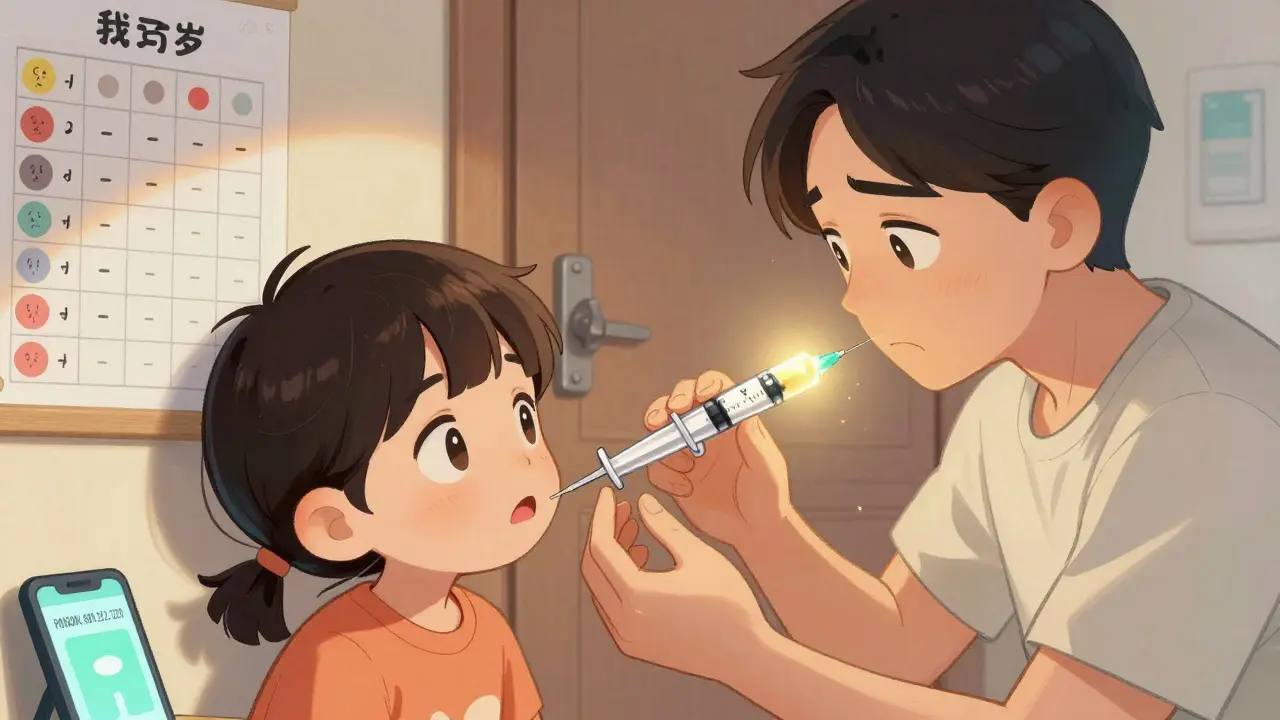
The way medicine is labeled makes a huge difference. The FDA now requires new pediatric drugs to come in standardized concentrations. That’s a big win. But you still need to use the right tools:- Use oral syringes for liquids. They’re accurate to the tenth of a milliliter.
- Ask for pictogram instructions. These are picture-based guides that show when to give the dose, how much, and how. Studies show they improve correct dosing by 47% in families with low health literacy.
- Use the “teach-back” method. After the pharmacist or nurse explains the dose, say back what you heard. “So I give 2 mL twice a day after breakfast, not before?” This cuts errors by 35%.
- Aim the liquid toward the back of the cheek, not the tongue. This helps avoid choking and ensures the full dose is swallowed.
Don’t rely on memory. Write down the dose, time, and route on a sticky note or in your phone. Keep a log if your child is on multiple meds.
What You Should Never Give a Child
Some medicines are just not safe for kids, no matter the dose:- Over-the-counter cough and cold medicines: Not recommended for children under 6. Not safe for kids under 2.
- Adult aspirin: Can cause Reye’s syndrome, a rare but deadly condition in children.
- Any medicine labeled “for adult use only”: Even if it’s a vitamin or supplement.
If you’re unsure, ask. Don’t guess. A pharmacist can tell you what’s safe. A pediatrician can recommend alternatives.
What’s Changing Now
The field of pediatric medication safety is still evolving. The CDC’s PROTECT Initiative updates its guidelines every year. New research shows that teaching kids about medicine safety-like “medicine is not candy, only grown-ups give it”-reduces curiosity-driven ingestions. The FDA is pushing manufacturers to make pediatric-friendly formulations with built-in safety features: easier-to-open caps for adults, harder-to-open ones for kids, and clear labeling that can’t be missed.One big goal: standardizing all pediatric liquid medications to the same concentration. Right now, ibuprofen for kids comes in different strengths. That’s confusing. If every brand used 100 mg per 5 mL, errors would drop by an estimated 60%.
It’s not just about better labels or new rules. It’s about changing how we think. Every pill, every drop, every syringe is a potential risk. But with the right habits, every risk can be prevented.
Why can’t I use a kitchen spoon to give my child medicine?
Kitchen spoons vary in size. A teaspoon at home might hold 4 mL or 7 mL-no two are the same. Medicine dosing requires precision. A 5 mL overdose can be dangerous for a child. Always use the dosing tool that came with the medicine-syringe, cup, or dropper marked in milliliters.
Is it safe to give my child medicine that’s expired?
No. Expired medicine can lose potency or break down into harmful substances. Even if it looks fine, it may not work as intended. Throw it out properly and get a new prescription if needed. Many pharmacies offer take-back programs for old meds.
What should I do if my child swallows medicine they shouldn’t have?
Call Poison Help at 800.222.1222 immediately. Don’t wait for symptoms. Don’t try to make them vomit. Have the medicine container ready when you call-so you can tell them the name, dose, and time ingested. Time matters.
Why are pediatric hospitals safer than general hospitals for kids?
Pediatric hospitals see children every day. Their staff is trained specifically in child dosing, uses kilogram-only systems, has two-person checks for high-risk drugs, and avoids adult-sized equipment. General hospitals with few pediatric patients often lack these systems, leading to 3.2 times more errors.
Can I give my child adult medicine if I cut the dose in half?
Never. Adult medications are not designed for children. Even a half-dose can be toxic. The ingredients, fillers, and release mechanisms are different. Always use a medicine made for children and follow the label or your doctor’s instructions exactly.
Are over-the-counter vitamins safe for kids?
Only if they’re made for children and given in the right dose. Adult vitamins, especially iron or prenatal ones, can be deadly in small amounts. Keep them locked up like any other medicine. Children have died from swallowing just one adult multivitamin.
What’s the best way to store medicine at home?
Store all medicine-prescription, OTC, vitamins, creams-in a locked cabinet, up high and out of sight. Never leave it on counters, nightstands, or in purses. Even if you think your child can’t reach it, they might. Use child-resistant caps correctly every time.
Why is it dangerous to tell a child medicine is candy?
It teaches them that medicine is something to be sought out and eaten. Studies show this practice leads to 15% of accidental ingestions. Instead, say, “This is medicine. It helps you feel better, but only grown-ups can give it to you.”



Per the AAP guidelines, the standardized concentration of pediatric liquid medications remains a critical intervention point. The variance in ibuprofen formulations (20 mg/mL vs. 100 mg/5 mL) introduces unnecessary cognitive load for caregivers and clinicians alike. Kilogram-based dosing protocols, when coupled with electronic health record (EHR) safeguards, reduce error rates by up to 85% in high-adherence settings. The absence of pound-based inputs in pediatric EHRs is non-negotiable.
Of course the hospitals that treat kids every day do better. Shocking. Meanwhile, my cousin gave her 2-year-old a full adult Advil because she "thought it was the same" and now we're paying for her ignorance with ER bills. Maybe stop being a dumbass and read the label?
This is the kind of post that makes me proud to be a parent. Seriously - we’ve all been there, staring at a tiny bottle wondering if we’re giving the right amount. But the fact that we’re talking about this? That we’re pushing for milliliter-only labels and two-person checks? That’s how you build a safer world, one syringe at a time. Keep spreading the word.
Never call it candy. That’s it. That’s the whole post.
The philosophical underpinning of pediatric medication safety lies not merely in clinical protocols, but in the recognition of developmental vulnerability as a moral imperative. Children, as non-autonomous beings, rely entirely on the vigilance and epistemic humility of caregivers. The systemic failures observed in general hospitals reflect not only a lack of specialization, but a broader cultural disregard for the ontological distinctness of childhood physiology. Standardization, therefore, is not merely a technical adjustment - it is an ethical reorientation of healthcare priorities toward the most vulnerable.
Great post! 🙌 Just wanted to add - in India, we’ve seen huge improvements since pharmacies started including pictogram-based instructions with pediatric syrups. Many parents can’t read, but they understand pictures. Also, always use the cap properly - even if it feels stiff. My nephew opened a bottle in 12 seconds last year. Scared us all to death. #SafetyFirst
why do u need all these rules? just give the kid the right amount. its not that hard. also why is everyone so scared of medicine? its not poison unless u give too much.
Let me guess - the CDC’s PROTECT Initiative is just another woke bureaucracy wasting money while real parents are left scrambling. You know what fixes this? PARENTAL RESPONSIBILITY. Not stupid syringes. Not two-person checks. Just stop being lazy and pay attention. My kid’s never gotten a wrong dose because I didn’t trust some ‘standardized concentration’ - I read the damn label. And I don’t leave meds in my purse like a moron.
It is profoundly concerning that the public discourse surrounding pediatric pharmacology remains so regrettably reductive. The normalization of kitchen utensils for dosing, the casual disregard for child-resistant packaging, and the persistent myth of ‘half an adult pill’ reflect a collective epistemic failure. One must question whether the erosion of medical literacy is symptomatic of a broader cultural decay in intellectual rigor.