
Imagine taking a medication that saves your life, but where a tiny difference in dosage could send you to the emergency room. This is the reality for patients on narrow therapeutic index (NTI) drugs, which are medications where the line between helping and harming is razor-thin. For years, we’ve been told that generics are just like brand-name drugs. But when it comes to NTI medications, that assumption can be dangerous. If you or a loved one takes these critical drugs, understanding how they work-and why switching brands matters more than ever-is essential for your safety.
What Makes a Drug “Narrow Therapeutic Index”?
The term sounds technical, but the concept is simple. Most drugs have a wide “therapeutic window.” This means there’s a large range of doses that will work effectively without causing serious side effects. Think of ibuprofen: whether you take slightly too much or slightly too little, you’re likely fine. NTI drugs are different. Their therapeutic window is so narrow that even small changes in blood concentration can lead to treatment failure or severe toxicity.
The U.S. Food and Drug Administration (FDA) defines NTI drugs as those where small differences in dose or blood concentration may lead to serious therapeutic failures or adverse reactions that are life-threatening or result in persistent disability. In practical terms, this means if your body absorbs 10% less of the drug than expected, it might stop working. If it absorbs 10% more, you might suffer organ damage.
Common examples include:
- Anticoagulants: Warfarin (blood thinner)
- Immunosuppressants: Tacrolimus, cyclosporine (prevent organ rejection)
- Antiarrhythmics: Digoxin, flecainide (control heart rhythm)
- Anticonvulsants: Phenytoin, carbamazepine (prevent seizures)
- Hormones: Levothyroxine (treats hypothyroidism)
As of early 2024, the FDA has officially identified 33 specific drug products representing 14 active ingredients as NTI drugs. This list continues to grow as scientists better understand newer medications, including certain targeted cancer therapies like axitinib and nilotinib.
Why Generics Are Different for NTI Drugs
You might wonder: aren’t all generics required to be bioequivalent to their brand-name counterparts? Yes, but the rules are stricter for NTI drugs. Bioequivalence ensures that the generic version gets into your bloodstream at a similar rate and extent as the original drug.
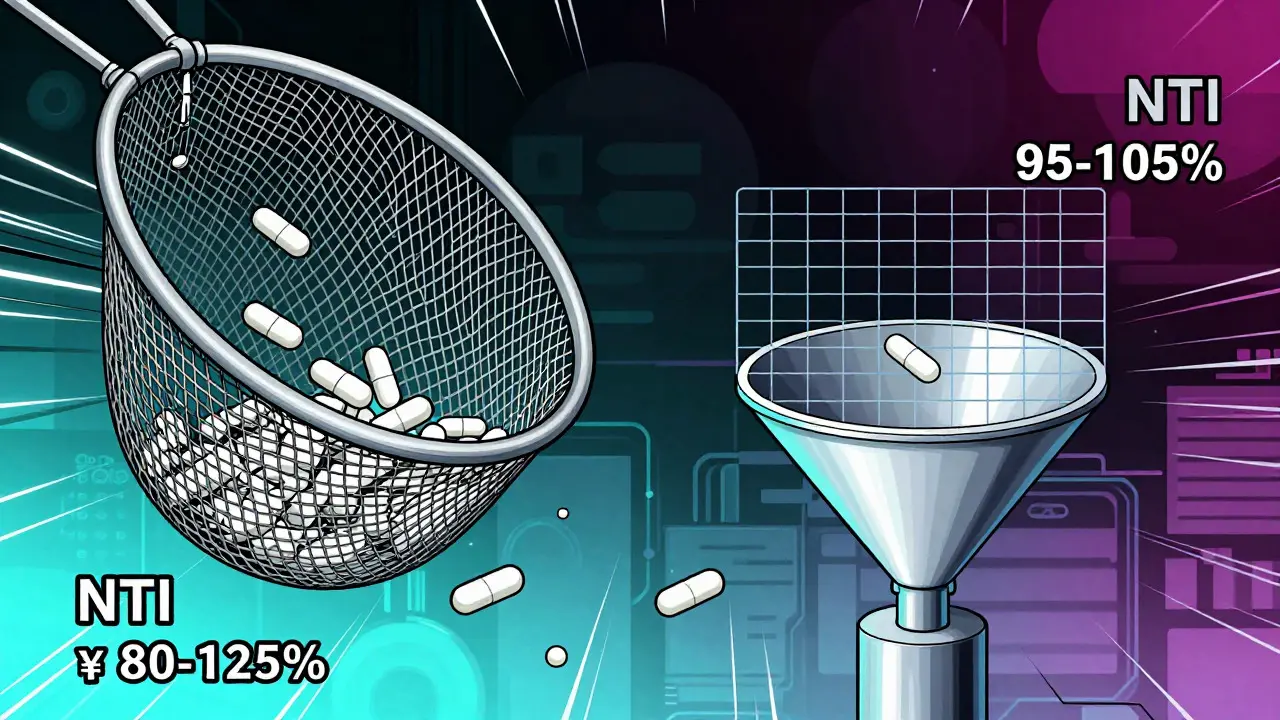
For most non-NTI drugs, the FDA allows a bioequivalence range of 80% to 125%. This means a generic can deliver anywhere from 80% to 125% of the reference product’s exposure, and it’s still considered safe. But for NTI drugs, this margin is too wide. A 25% variation could push a patient out of their therapeutic window.
| Drug Type | Standard Bioequivalence Range | Tightened NTI Range (Low Variability) | Risk of Switching |
|---|---|---|---|
| Non-NTI Drugs | 80-125% | N/A | Low; minor fluctuations usually tolerated |
| NTI Drugs | 90-111% | 95-105% | High; small changes can cause toxicity or failure |
When within-subject variability is low (around 5%), the FDA requires NTI generics to fall within an extremely tight 95-105% range. This reflects the steep dose-response curve of these medications. Even a slight deviation can mean the difference between stability and crisis.
The Real-World Impact of Generic Substitution
Regulations exist on paper, but what happens in practice? Surveys show that pharmacists are far more cautious about substituting NTI drugs. Only 28% of pharmacists feel comfortable swapping a generic for an initial NTI prescription, compared to 78% for non-NTI drugs. Why the hesitation?
Clinical evidence supports their concern. Patients with comorbidities face higher risks. For example, those with diabetes have a 1.20 times higher risk of drug-related problems when using NTI medications, while heart failure patients face a 1.31 times higher risk. These numbers aren’t abstract-they represent real hospitalizations and emergencies.
Consider levothyroxine, a common thyroid medication. Many patients report wildly fluctuating TSH levels after switching from brand to generic or between different generic manufacturers. One pharmacist shared, “I’ve seen patients on levothyroxine have TSH levels swing wildly after generic substitution, requiring multiple dose adjustments.” Similarly, transplant recipients on tacrolimus have reported kidney function deterioration after insurance-mandated switches.
Yet, not all experiences are negative. Some patients thrive on generics, saving hundreds of dollars monthly. The key isn’t avoiding generics entirely-it’s ensuring consistency once a stable regimen is found.
How to Protect Yourself: Practical Steps for Patients
If you take an NTI drug, don’t leave your health to chance. Here’s what you can do:
- Talk to Your Prescriber: Ask if your medication is classified as NTI. If so, request that they mark your prescription “dispense as written” or specify the manufacturer. This prevents automatic substitution by the pharmacy.
- Stick to One Manufacturer: Once you find a generic or brand that works well for you, stay with it. Consistency reduces the risk of unexpected blood level changes.
- Monitor Regularly: NTI drugs often require therapeutic drug monitoring (TDM). Keep up with blood tests to track concentrations. Don’t skip appointments because you “feel fine”-symptoms may lag behind biochemical changes.
- Know Your State Laws: As of 2023, 42 states have laws restricting automatic substitution of NTI drugs, but enforcement varies. Check your local regulations and advocate for yourself if needed.
- Document Everything: Keep records of which manufacturer’s product you’re taking, along with test results. This helps healthcare providers spot trends and adjust care proactively.

The Future of NTI Drug Management
The landscape is evolving. The FDA plans to issue more product-specific guidances by 2025, focusing on newer oncology agents. Meanwhile, pharmacogenomic testing is gaining traction. By 2028, experts predict that 40% of NTI prescriptions will incorporate genetic testing to personalize dosing-a significant jump from just 15% today.
This shift toward precision medicine offers hope. Instead of relying solely on trial-and-error adjustments, doctors could tailor doses based on your unique genetics. Until then, vigilance remains your best defense.
Global market dynamics also play a role. With the NTI drug market projected to reach $185.7 billion by 2027, access and affordability remain concerns. Stricter regulations may limit generic competition, potentially raising prices. Balancing safety with cost-effectiveness is an ongoing challenge for policymakers and providers alike.
Key Takeaways
- NTI drugs have minimal separation between effective and toxic doses, making precise dosing critical.
- FDA bioequivalence standards for NTI generics are much tighter (90-111% or 95-105%) than for regular drugs (80-125%).
- Switching between brands or manufacturers can cause dangerous fluctuations in blood levels.
- Patient advocacy-asking prescribers to specify manufacturers and sticking to one source-is vital for safety.
- Regular monitoring and documentation help catch issues before they become emergencies.
Are all generic versions of NTI drugs unsafe?
Not necessarily. Many patients use generics safely. The risk lies in switching between different manufacturers or from brand to generic without careful monitoring. Once you find a formulation that stabilizes your condition, staying with it minimizes risk.
How do I know if my medication is an NTI drug?
Ask your doctor or pharmacist. Common NTI drugs include warfarin, tacrolimus, phenytoin, digoxin, and levothyroxine. The FDA maintains an official list, but not all potential NTI drugs are formally classified yet.
Can I switch back to the brand name if I’m having issues with a generic?
Yes, discuss this with your prescriber. They can write a new prescription specifying the brand name. Be aware that insurance coverage may vary, and prior authorization might be required.
Do state laws protect me from unwanted generic substitutions?
Many states do. As of 2023, 42 states restrict automatic substitution of NTI drugs. However, definitions and enforcement differ. Check your state’s pharmacy board website or ask your pharmacist about local policies.
What should I do if I miss a dose of an NTI drug?
Follow your provider’s instructions. Generally, take it as soon as you remember unless it’s close to your next dose. Never double up. Missed doses can destabilize blood levels, so inform your healthcare team promptly.
Is pharmacogenomic testing available for NTI drugs?
Increasingly, yes. Genetic testing can reveal how your body metabolizes certain drugs, helping doctors choose optimal starting doses. While not yet standard for all NTI medications, its use is growing rapidly, especially in psychiatry and cardiology.