Your doctor just mentioned your liver enzymes are off. Maybe you’ve been told to watch your weight or cut back on alcohol. The next question is always the scary one: "Is there permanent scarring?" For years, the only way to know for sure was a liver biopsy-a needle through your skin into your liver. It’s invasive, it hurts, and it carries risks. Today, we have better ways to check for liver fibrosis without breaking the skin. These noninvasive tests are changing how we catch liver disease early.
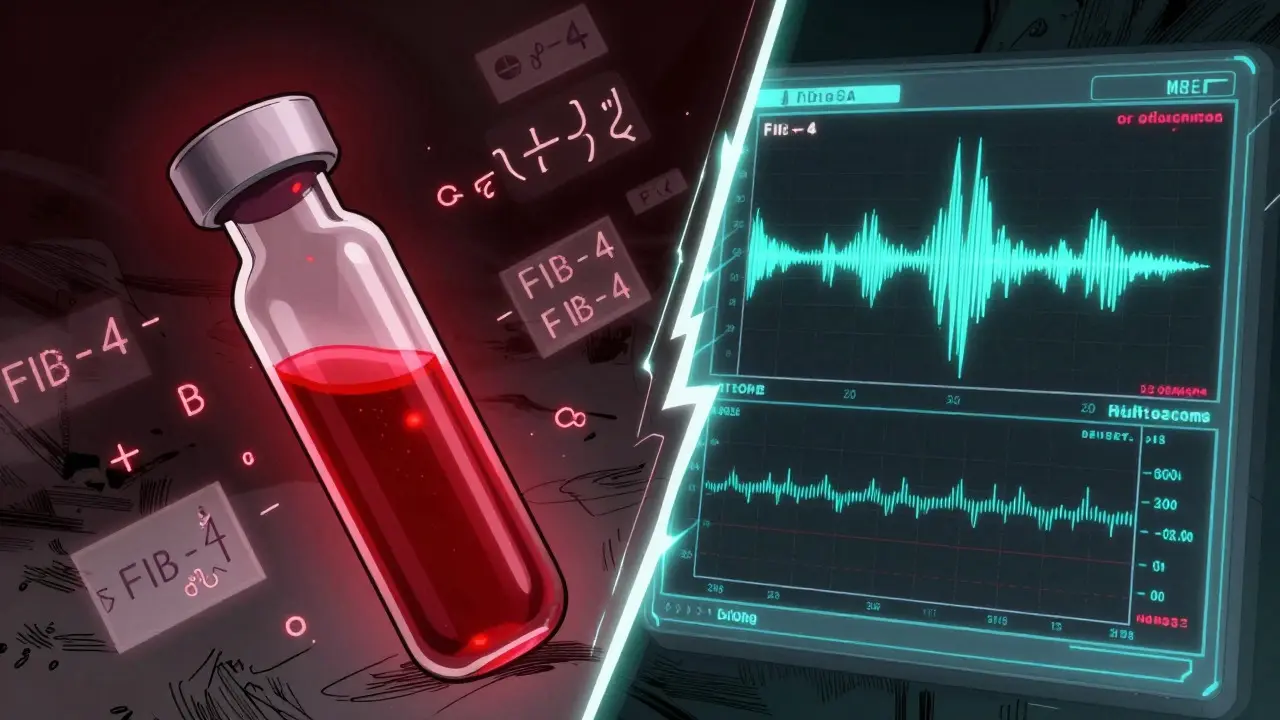
The two main tools in this new arsenal are FibroScan, a machine that uses sound waves to measure stiffness, and serum scores like FIB-4, which use blood test results to calculate risk. Neither is perfect, but together they give a much clearer picture than either could alone. Understanding how these tests work, their limits, and when to use them can save you from unnecessary anxiety-or worse, a missed diagnosis.
Why We Moved Away From Liver Biopsies
For decades, the liver biopsy was the gold standard. If a doctor suspected significant scarring (fibrosis) or cirrhosis, they stuck a needle in you. But biopsies have serious flaws. First, they’re painful and carry a small but real risk of complications, including bleeding, in about 0.1% of cases. Second, and more importantly, they suffer from sampling error. Your liver is large; the biopsy takes a tiny core. You might miss the scarred area entirely. Studies show up to 41% of biopsies can be inaccurate because of this variability.
This gap led researchers at Inserm in France to develop transient elastography in the late 1990s. The result was FibroScan, launched commercially in 2001. The goal was simple: get a reliable, painless measurement of liver health that reflects the whole organ, not just a speck. Today, with non-alcoholic fatty liver disease (NAFLD) affecting roughly 25% of the global population, we need scalable screening methods. Biopsies don’t scale. Noninvasive tests do.
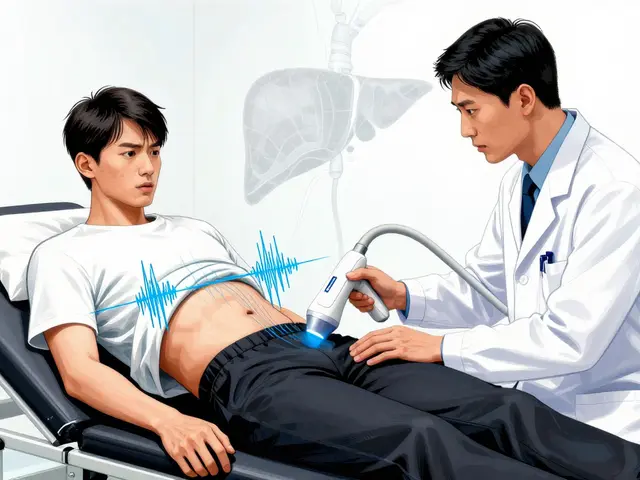
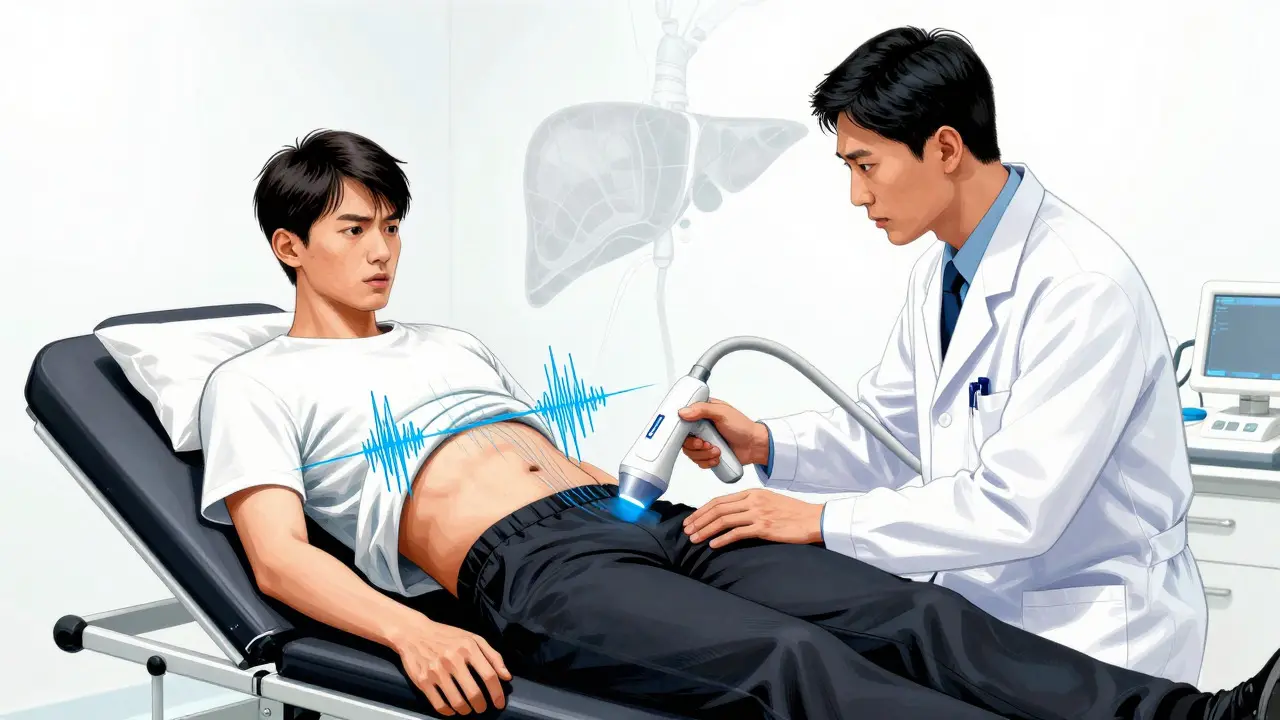
How FibroScan Measures Liver Stiffness
FibroScan is a medical device that assesses liver fibrosis and steatosis using transient elastography technology. It works by sending low-frequency shear waves (50Hz) through your skin into your liver. A stiffer liver-caused by scar tissue-transmits these waves faster. The device measures this speed and converts it into kilopascals (kPa).
- Normal Liver: 2-7 kPa
- Mild Fibrosis: 7-9.5 kPa
- Advanced Fibrosis: 12+ kPa
Modern devices like the FibroScan 630 (released in 2020) also measure fat content using Controlled Attenuation Parameter (CAP). CAP scores range from 100-400 dB/m. A score above 290 dB/m suggests severe fat accumulation (over 67%). This dual capability makes FibroScan powerful for diagnosing both scarring and fatty liver disease simultaneously.
However, FibroScan isn’t magic. It requires skill. You need at least 10 valid measurements with a success rate over 60% and an interquartile range (IQR) under 30% for the result to be trustworthy. If you have a high BMI (over 28 kg/m²), the standard probe might fail. That’s why newer models include XL probes. In clinical practice, technical failure rates hover around 10-15%, often due to obesity or narrow rib spaces.
Serum Scores: Calculating Risk From Blood Work
If FibroScan is hardware, serum scores are software. They take routine blood test values-things you already get checked-and plug them into formulas to estimate fibrosis risk. The most common are FIB-4 and APRI.
FIB-4 (Fibrosis-4 Index) uses four factors: age, AST (aspartate aminotransferase), ALT (alanine aminotransferase), and platelet count. It’s free, instant, and requires no special equipment. According to American Association for the Study of Liver Diseases (AASLD) guidelines:
- Score < 1.3: Low risk of advanced fibrosis (high negative predictive value).
- Score > 2.67: High risk of advanced fibrosis.
- Score 1.3-2.67: Indeterminate; needs further testing.
APRI (Aspartate Aminotransferase-to-Platelet Ratio Index) is simpler, using only AST and platelets. A score ≥2.0 suggests cirrhosis. While easy to calculate, APRI is less sensitive than FIB-4 for detecting earlier stages of fibrosis.
Then there’s the ELF (Enhanced Liver Fibrosis) test. Unlike FIB-4, ELF isn’t calculated from routine labs. It’s a specialized blood test measuring three direct biomarkers of extracellular matrix turnover: hyaluronic acid, PIINP, and TIMP-1. It costs more ($100+) but offers higher accuracy, especially in indeterminate cases where FIB-4 fails.
Head-to-Head: Accuracy and Limitations
| Feature | FibroScan | FIB-4 Score | ELF Test |
|---|---|---|---|
| Method | Ultrasound Elastography | Blood Calculation | Blood Biomarkers |
| Cost | $50-$150 per test | ~$10 (included in labs) | $100+ |
| Accuracy for Advanced Fibrosis | High (AUROC 0.85-0.99) | Moderate (misses ~83% of F3/F4 if used alone) | High (better than FIB-4) |
| Main Limitation | Obesity, inflammation, operator skill | Age bias (poor in patients <35) | Cost, availability |
| Best Use Case | Confirming suspicion, monitoring progression | Initial screening in primary care | Tie-breaker for indeterminate cases |
Data shows clear trade-offs. A 2023 study found FibroScan identified only 45.9% of biopsy-proven advanced fibrosis cases accurately in some cohorts, while FIB-4 missed even more. However, other studies report FibroScan AUROCs near 0.99 for cirrhosis. The discrepancy highlights context matters. FibroScan shines when performed correctly on suitable patients. FIB-4 excels at ruling out disease in large populations cheaply.
Dr. Brent Tetri warns against relying on any single test. "FibroScan's false negative rate underscores why no single non-invasive test should replace clinical judgment," he noted in 2022. Similarly, FIB-4 struggles in younger patients. Its accuracy drops significantly in people under 35, where the AUC falls from 0.85 to 0.67. Age skews the formula.
The Sequential Testing Strategy
Because each test has blind spots, experts recommend a stepwise approach. The European Association for the Study of the Liver (EASL) and AASLD guidelines suggest starting with FIB-4. Why? It’s cheap, fast, and highly effective at ruling out advanced fibrosis. If your FIB-4 is below 1.3, you likely don’t have advanced scarring. No further action needed.
If FIB-4 is indeterminate (1.3-2.67), move to FibroScan. This catches the cases FIB-4 missed. If FibroScan confirms high stiffness, you have advanced fibrosis. If FibroScan is normal but FIB-4 was high, you might have inflammation skewing the blood test, or vice versa.
When results conflict, consider the ELF test as a tiebreaker. A 2020 Lancet Gastroenterology study showed combining FibroScan with ELF increased concordance with biopsy to 85%. Reserve biopsies only for discordant results. This protocol reduces unnecessary biopsies by 70%.

Practical Challenges: Obesity and Inflammation
Real-world use isn’t always smooth. Obesity is FibroScan’s biggest enemy. Sound waves struggle to penetrate thick abdominal walls. Patients with a BMI over 30 often require the XL probe, which isn’t available everywhere. Some users report multiple failed attempts before getting a valid reading, adding cost and frustration.
Inflammation also distorts results. Acute hepatitis raises liver stiffness temporarily, mimicking fibrosis. If your AST levels are more than twice the upper limit of normal, wait until inflammation subsides before scanning. Eating within three hours of the test can also elevate readings. Always fast for at least three hours beforehand.
Conversely, serum scores ignore inflammation entirely. They rely on chronic markers. This makes them stable during acute flares but potentially misleading if platelet counts drop due to other causes like vitamin B12 deficiency or alcohol use.
Future Directions: AI and New Biomarkers
Technology keeps evolving. Echosens announced the FibroScan 730 in April 2024, featuring AI-powered reliability scoring. Early trials show a 22% reduction in technical failures, helping operators get good reads faster. Meanwhile, researchers developed FIB-5, a new serum score incorporating glucose levels. It demonstrated 89% accuracy for advanced fibrosis in diabetic NAFLD patients, addressing a key gap in metabolic liver disease.
MRI-based elastography (MRE) offers even higher accuracy (95% for significant fibrosis) but costs ten times more than FibroScan. It remains a niche tool for complex cases. Smartphone-based apps like HepaTouch show promise but lack robust validation.
The NIH NASH Clinical Research Network is piloting an integrated algorithm combining FibroScan, FIB-4, and ELF. Their 2023 feasibility study reduced unnecessary biopsies by 82% while maintaining 94% sensitivity for cirrhosis. This multi-modal future looks bright.
What Should You Do Next?
If you’re at risk for liver disease-due to obesity, diabetes, alcohol use, or hepatitis-ask your doctor about noninvasive testing. Start with a basic blood panel to calculate FIB-4. It’s inexpensive and widely available. If results are unclear, request a FibroScan. Ensure the technician uses the correct probe for your body type and follows fasting guidelines.
Don’t panic if one test looks bad. Conflicting results are common. Seek a second opinion or advanced testing like ELF or MRE before agreeing to a biopsy. Knowledge is power, but accurate knowledge requires the right tools used correctly.
Is FibroScan painful?
No, FibroScan is generally painless. It feels like a firm tap on your abdomen with an ultrasound probe. There is no needle involved, making it far more comfortable than a liver biopsy.
Can I eat before a FibroScan?
You should fast for at least 3 hours before the test. Eating increases blood flow to the liver, which can temporarily raise stiffness measurements and lead to false-positive results for fibrosis.
What does a FIB-4 score of 2.0 mean?
A FIB-4 score between 1.3 and 2.67 is considered indeterminate. It means you are at intermediate risk for advanced fibrosis. You will likely need further testing, such as a FibroScan or ELF test, to clarify your status.
Why might FibroScan fail?
FibroScan can fail due to obesity (BMI >30), narrow rib spaces, ascites (fluid in the abdomen), or poor technique. Technical failure rates are around 10-15%. Using an XL probe or switching to serum tests may help.
Is the ELF test covered by insurance?
Coverage varies by insurer and region. Because ELF is more expensive than FIB-4, some plans require prior authorization or proof that cheaper tests were inconclusive. Check with your provider before ordering.