Imagine you’ve spent a decade and billions of dollars developing a life-saving medication. Just as you start seeing returns, the clock strikes midnight on your core patent. Generics rush in, prices plummet, and your revenue stream dries up almost overnight. This is the nightmare scenario for every pharmaceutical company. But what if there was a way to hit pause? What if you could keep competitors at bay for years after your main patent expires?
This isn’t science fiction. It’s the reality of formulation patents on drug combinations that allow brands to extend market exclusivity beyond the expiration of core composition-of-matter patents. By tweaking how a drug is delivered, combined, or dosed, companies build a "picket fence" of intellectual property that can delay generic entry by an average of 4.7 years. While critics call it "evergreening," industry leaders argue it’s essential for recouping massive R&D investments. Let’s break down exactly how this strategy works, why it’s so effective, and where the legal lines are being drawn.
The Anatomy of a Combination Patent Strategy
To understand how brands extend exclusivity, you first need to separate the "what" from the "how." The core patent protects the chemical structure of the active pharmaceutical ingredient (API). Once that expires, anyone can make that molecule. But formulation patents protect something different: the specific combination of APIs, their precise ratios, the dosage form, or the delivery mechanism.
Consider the difference between buying ingredients and buying a recipe. Anyone can buy flour and sugar (the API), but only one brand might own the patent for the exact ratio and baking method that creates a specific cake texture (the formulation). In pharma, this means securing protection for a pill that combines Drug A and Drug B in a 10mg/50mg ratio, or a subcutaneous injection that delivers two antibodies simultaneously.
| Feature | Primary (Composition) Patent | Secondary (Formulation/Combination) Patent |
|---|---|---|
| What it Protects | Chemical structure of the API | Specific combinations, ratios, delivery methods, or dosage forms |
| Average Lifespan Post-Approval | 12-14 years | 3-8 additional years |
| Invalidation Rate | 22% | 38% |
| Key Legal Hurdle | Novelty and non-obviousness of molecule | Demonstrating "unexpected results" per KSR v. Teleflex |
| Strategic Goal | Initial market monopoly | Extending revenue streams via "picket fencing" |
According to the USPTO's 2024 Drug Patent and Exclusivity Study Report, companies like Roche and Genentech use these secondary patents to maintain market control for an average of 3 to 16 years beyond their initial patent expiration. This isn't just about protecting a single product; it's about creating a layered defense system.
Overcoming the Obviousness Hurdle
You might think combining two known drugs is easy to patent. After all, if Drug X treats hypertension and Drug Y lowers cholesterol, isn't it obvious to combine them? Legally, yes-unless you can prove otherwise. This is where the 2007 Supreme Court decision in KSR International Co. v. Teleflex Inc. changed everything.
Before KSR, examiners often used a rigid test for obviousness. Now, they apply a "common-sense" approach. There is a presumption that combining known elements for a known purpose is obvious. To get a formulation patent granted, innovators must provide compelling evidence of unexpected results. This means showing that the combination does more than the sum of its parts.
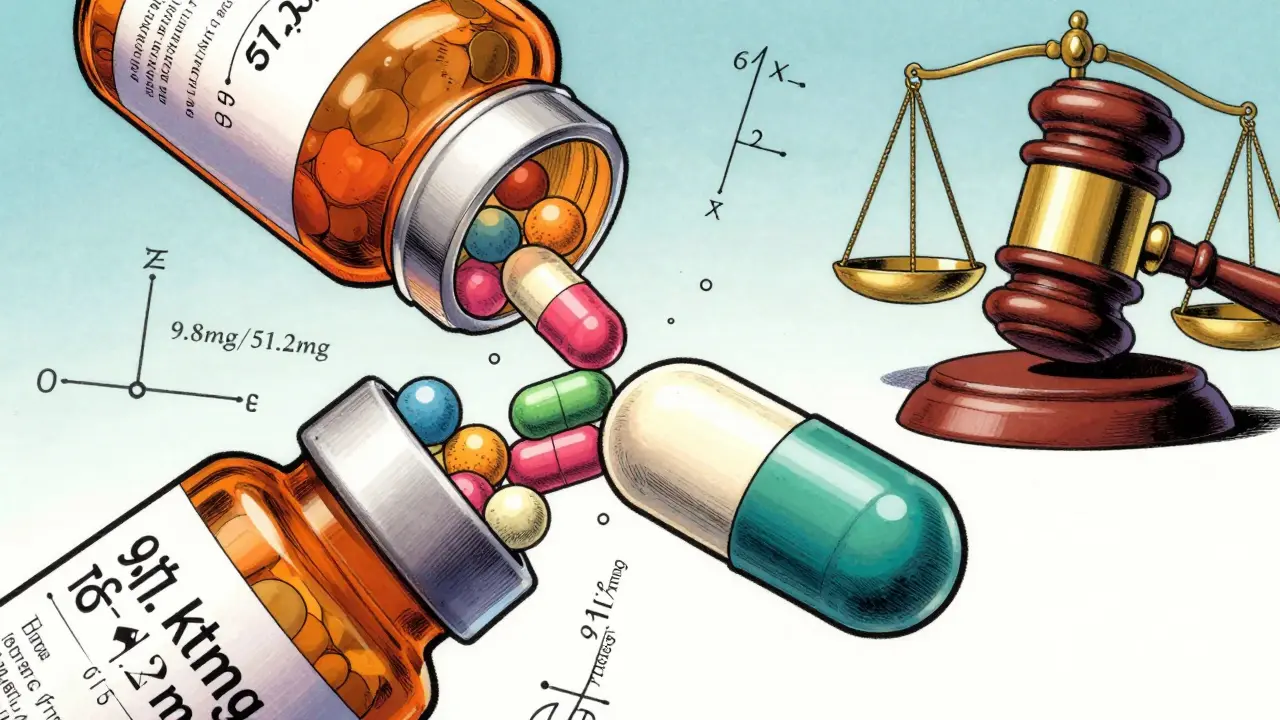
For example, a patent might specify that a 9.8mg/51.2mg ratio of two antibiotics reduces side effects by 40% compared to taking them separately, whereas other ratios do not. As one pharmaceutical patent attorney noted on Reddit (r/patentlaw, March 2024), "I've seen 10mg/50mg ratio claims get rejected while 9.8mg/51.2mg gets granted-precision matters." You need statistically significant data, typically with a p-value of less than 0.01 in head-to-head trials, to satisfy the USPTO.
This high bar explains why combination patents have a higher invalidation rate (38%) compared to primary patents (22%). If you can't prove the combination offers a surprising clinical benefit, the patent will likely be challenged successfully by generic manufacturers using Paragraph IV certifications under the Hatch-Waxman Act.
The Role of Regulatory Exclusivities
Patents aren't the only tool in the box. Pharmaceutical companies also leverage regulatory exclusivities granted by the FDA. These are distinct from patents but work in tandem to block generic entry. Under the Hatch-Waxman framework, several types of exclusivity exist:
- New Chemical Entity (NCE): 5 years of exclusivity for new molecules.
- New Clinical Investigation: 3 years for new formulations, indications, or dosage forms.
- Orphan Drug: 7 years for treatments of rare diseases.
Here’s the kicker: these exclusivities stack. The FDA documented that 42% of drugs approved between 2010 and 2020 received multiple overlapping exclusivity periods. When you combine a 3-year regulatory exclusivity for a new formulation with a 5-year patent term extension (PTE) allowed under Hatch-Waxman, you create a formidable barrier. Remember, PTE can add up to 5 years to patent life, but the total post-approval patent term cannot exceed 14 years (21 C.F.R. § 314.52).
This "patent thicket" strategy forces generic competitors to wait until both the regulatory exclusivity and the relevant patents expire. For complex therapies in oncology or immunology, this can mean delaying competition by nearly a decade.
Real-World Examples of Success and Failure
Not every attempt to extend exclusivity succeeds. The line between innovation and anticompetitive behavior is thin, and courts are watching closely.
Success Story: Roche’s Phesgo®
Roche developed Phesgo®, a fixed-dose combination of trastuzumab and pertuzumab in a subcutaneous format. Previously, patients had to receive these as separate intravenous infusions. Phesgo reduced administration time significantly. Even though the core patents for the individual antibodies were expiring, the formulation patent for the subcutaneous combination created a new barrier. Biosimilars couldn't simply copy the old IV versions without infringing on the new delivery mechanism's convenience and safety profile, allowing Roche to maintain market share well into the post-patent era.
Failure Case: Amgen’s Enbrel Injector
Amgen attempted to extend exclusivity for Enbrel (etanercept) by patenting a subcutaneous auto-injector device. Generic challengers argued this was merely the "obvious automation of manual injection." The court agreed, invalidating the patent. This failure cost Amgen $147 million in legal fees and opened the door for biosimilar competition much sooner than planned. It serves as a stark reminder: if the improvement is just convenience without unexpected technical benefits, the patent won't hold.
The Economic Impact and Criticism
The stakes are enormous. The global pharmaceutical patent market was valued at $1.43 trillion in 2023, with formulation and combination patents accounting for $312 billion (22%) of that value. Industry analysts at Evaluate Pharma project these strategies will protect $312 billion in annual revenue through 2028.
However, this practice faces intense scrutiny. FTC Chair Lina Khan testified in June 2023 that secondary patents on trivial changes represent "anticompetitive evergreening" that increases U.S. drug prices by 17-23%. Dr. Aaron Kesselheim from Harvard Medical School criticized this as "patent privateering," noting that 31% of combination patents filed between 2015 and 2022 covered minor modifications like salt forms with no demonstrated clinical improvement.
The debate centers on balance. On one side, Dr. Robert Kreisman of DrugPatentWatch argues that the "picket fence" approach is essential because the average development cost per new drug is $2.6 billion over 10-15 years. Without extended exclusivity, companies would lack the incentive to invest in costly follow-on innovations. On the other side, policymakers worry that consumers pay for decades of monopoly pricing for marginal improvements.
Future Outlook: Tightening the Net
The landscape is shifting. Regulators are getting tougher. The USPTO’s June 2024 report recommended narrowing the scope of obviousness exceptions for combination therapies. Meanwhile, the FDA proposed rulemaking in May 2024 to require "clinical superiority evidence" for new formulation approvals seeking 3-year exclusivity.
Generic manufacturers are also becoming more aggressive. They filed 842 Paragraph IV challenges against formulation patents in 2023, up from 517 in 2020. Their success rate has climbed to 45% as courts apply stricter standards. Congress is considering the Preserve Access to Affordable Generics Act, which would limit secondary patents to those demonstrating "meaningful clinical benefit." If passed, this could invalidate 28% of current formulation patents.
Despite these headwinds, strategic formulation patenting remains vital. IQVIA projects it will continue protecting 65-70% of top-selling drugs' revenue through 2030. However, the average exclusivity extension is expected to drop from 5.3 years (2020-2023) to 3.8 years (2025-2030). Companies must now focus on genuine innovation-like pH-sensitive release technologies or novel biologics combinations-rather than minor tweaks, to survive the coming regulatory storm.
What is the difference between a composition patent and a formulation patent?
A composition patent protects the chemical structure of the active ingredient itself. A formulation patent protects how that ingredient is prepared, such as its combination with other drugs, specific dosage ratios, delivery mechanisms (like patches or injections), or release rates. Composition patents are broader and harder to challenge, while formulation patents are narrower but can extend exclusivity after the core patent expires.
How do drug companies overcome the "obviousness" rejection for combination patents?
Following the KSR v. Teleflex decision, companies must prove "unexpected results." This involves rigorous clinical trials showing that the specific combination offers statistically significant benefits in efficacy or safety that are not predictable from the individual components alone. Precision in claim drafting, such as specifying exact milligram ratios, is also critical.
What is "evergreening" in pharmaceuticals?
Evergreening is the strategy of extending the market exclusivity of a drug by obtaining secondary patents on minor modifications, such as new formulations, dosages, or combinations, rather than developing entirely new molecules. Critics argue this delays generic competition and keeps drug prices high without adding significant therapeutic value.
How long can formulation patents extend market exclusivity?
On average, formulation patents extend exclusivity by 3 to 8 years beyond the core patent expiration. In highly strategic cases with strong patent thickets, this extension can reach up to 16 years. However, the trend is moving toward shorter extensions due to increased regulatory scrutiny and successful generic challenges.
What is a Paragraph IV challenge?
A Paragraph IV challenge is a legal certification filed by a generic manufacturer stating that a listed patent in the FDA's Orange Book is invalid, unenforceable, or will not be infringed by their generic product. This allows generics to seek approval before the patent expires, triggering a 30-day stay and potentially leading to litigation.