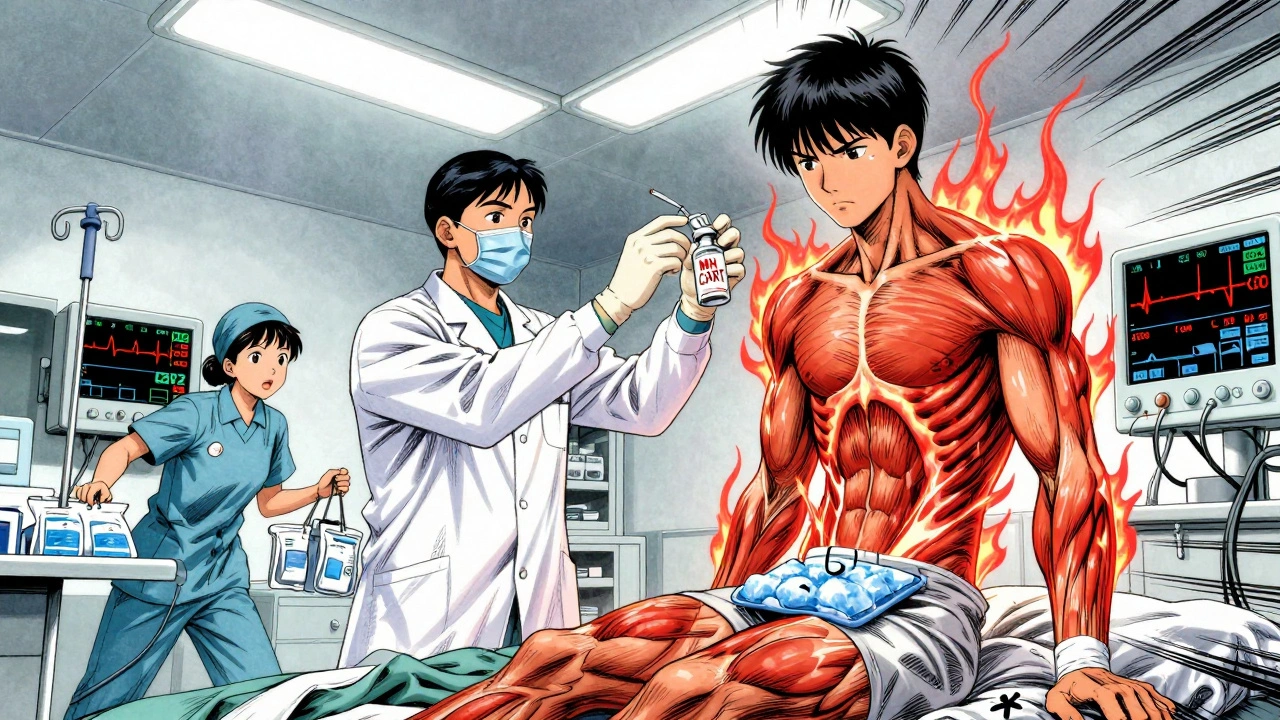
Malignant Hyperthermia Dantrolene Dose Calculator
Critical Dosing Information
2.5 mg/kg initial dose - start immediately
Maximum dose: 10 mg/kg - may require multiple doses
Time is critical - administer within 20 minutes of first sign
1 vial Ryanodex = 50 mg (faster than Dantrium)
Dantrolene Dose Calculation
What Is Malignant Hyperthermia?
Malignant hyperthermia is a rare but deadly genetic reaction to certain anesthesia drugs that causes muscles to lock up and overheat, often killing patients if not treated within minutes. It doesn’t happen to everyone - only people with specific gene mutations, mostly in the RYR1 gene, are at risk. But when it strikes, it strikes fast. The body’s temperature can spike from normal to over 109°F in under an hour. Heart rates explode. Muscles stiffen like stone. And without immediate action, the patient can die.
Most cases happen during surgery. The trigger? Common anesthetics like sevoflurane, desflurane, isoflurane, or the muscle relaxant succinylcholine. These drugs are used in thousands of surgeries every day. But for someone with the mutation, they’re like lighting a fuse. The muscle cells start releasing calcium uncontrollably, forcing muscles to contract nonstop. That’s what burns through oxygen, generates massive heat, and crashes the body’s chemistry.
How Do You Know It’s Happening?
There’s no time to wait for symptoms to get worse. Early signs are subtle but unmistakable to trained staff:
- Heart rate jumps above 120 beats per minute - without reason
- End-tidal CO2 rises above 55 mmHg - a sign muscles are burning oxygen too fast
- Masseter muscle rigidity - the jaw locks tight after succinylcholine is given
- Body temperature climbs rapidly - often past 104°F within 30 minutes
- Urine turns dark brown - a red flag for muscle breakdown
One anesthesiologist on Reddit described catching it at 32 minutes into a procedure when a 28-year-old man’s CO2 hit 78 mmHg and his heart rate hit 142. He’d been stable before. No warning. No family history. That’s the scary part - nearly 30% of cases happen in people who never knew they were at risk.
What Happens If You Wait?
Before 1970, 80% of patients with malignant hyperthermia died. Now, thanks to one drug, that number is down to 5%. But that drop only happened because doctors learned to act fast. Every minute counts.
If dantrolene isn’t given within 20 minutes of the first sign, survival chances drop to 50%. At 40 minutes? The odds are slim. Why? Because the longer muscles stay locked, the more acid builds up in the blood, the more potassium leaks out, and the more kidney damage occurs from muscle proteins clogging the filters. The body doesn’t just overheat - it starts shutting down.
One hospital in Ohio reported a case where a teenager died because the team waited 45 minutes to give dantrolene. They thought it was just a fever. They didn’t recognize the CO2 spike. That mistake cost a life.
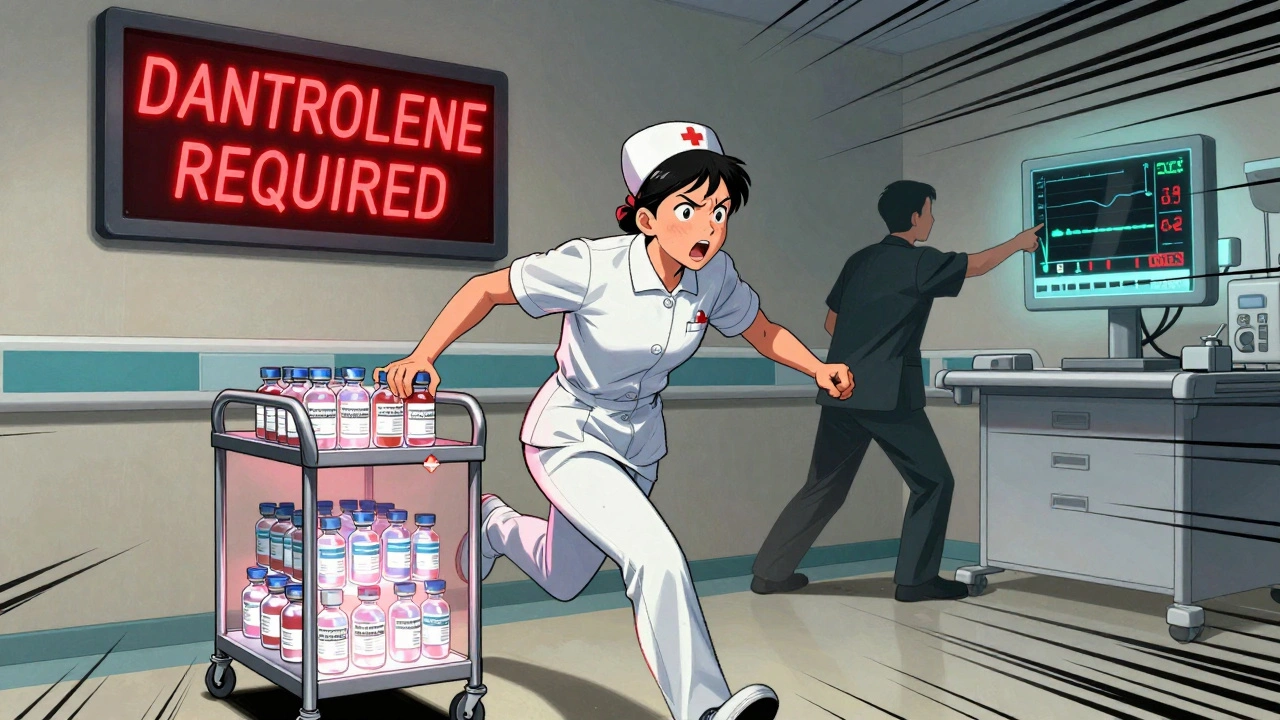
The Only Drug That Saves You: Dantrolene
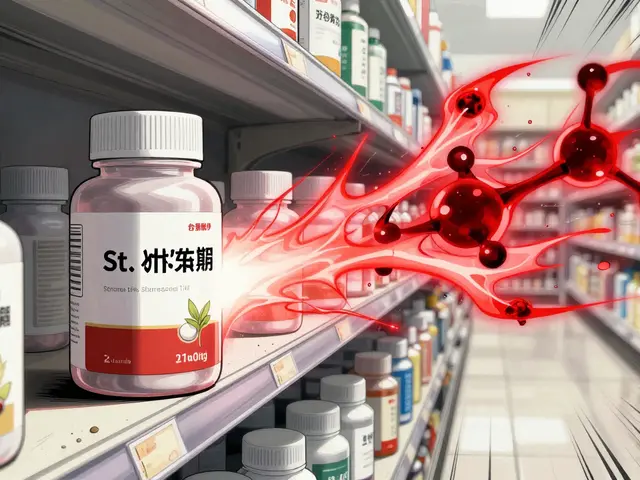
Dantrolene is the only medication that stops malignant hyperthermia. It works by blocking calcium release in muscle cells - literally stopping the chain reaction. There are two versions: Dantrium and Ryanodex. Ryanodex, approved in 2014, is now the standard because it mixes in just one minute. Dantrium takes 22 minutes to dissolve - too long when every second matters.
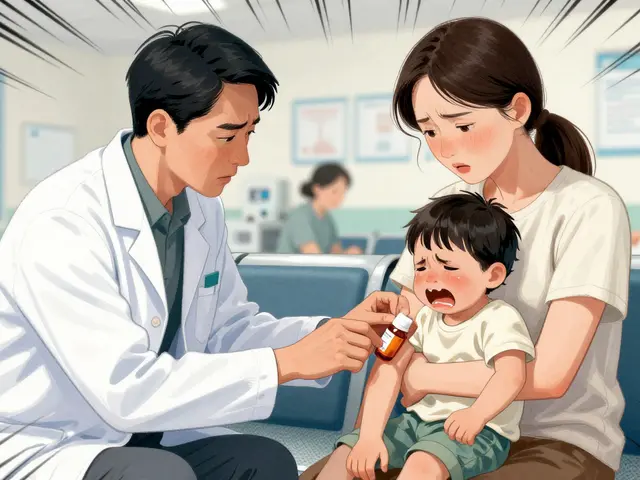
The dose? Start with 2.5 mg per kilogram of body weight. If symptoms don’t improve in 5 to 10 minutes, give another dose. Repeat until the patient stabilizes. Most adults need 10 mg/kg - that’s 700 mg for a 70 kg person. That’s 14 vials of Ryanodex. But hospitals are required to keep 36 vials on hand - enough for a large adult or multiple patients. Each vial costs $4,000. A full cart runs $144,000.
It’s expensive. But not as expensive as a funeral.
What Else Must Happen - Right Now
Dantrolene alone isn’t enough. You need a full emergency response:
- Stop all triggering anesthetics immediately - no more sevoflurane, no more succinylcholine
- Give 100% oxygen at 10 liters per minute - flush out CO2 and boost oxygen
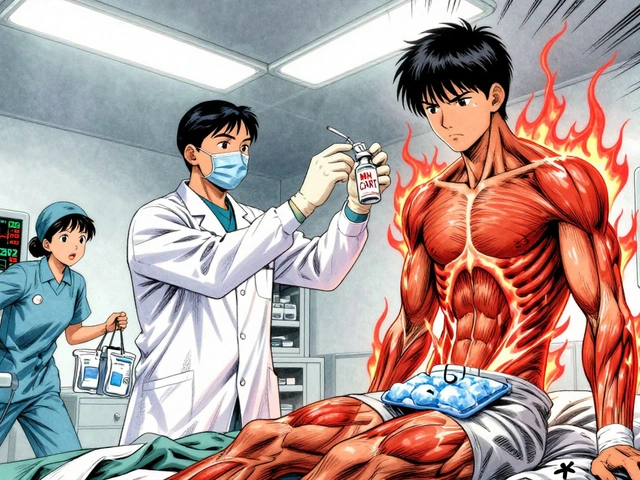
- Start active cooling - ice packs on neck, armpits, groin, and cold IV fluids
- Give sodium bicarbonate - to fix the acid buildup in the blood
- Use insulin and glucose - to drive potassium back into cells and prevent heart failure
- Give mannitol and furosemide - to protect the kidneys from muscle breakdown products
At Mayo Clinic, they keep MH carts with all this equipment pre-stocked and within 30 seconds of any operating room. Result? Treatment starts in under 5 minutes. In rural hospitals? Sometimes it takes 20. That’s the difference between life and death.
Who’s at Risk? (Spoiler: It’s Not Who You Think)
People assume if no one in the family had it, they’re safe. That’s wrong. About 29% of MH cases happen in people with no family history. The mutation can skip generations or appear as a new change. That’s why the American Society of Anesthesiologists now says: assume everyone is at risk until proven otherwise.
Children are more vulnerable. Kids having tonsillectomies have a 1 in 3,000 chance - 3 times higher than adults. That’s why some anesthesiologists avoid succinylcholine in kids unless absolutely necessary.
Genetic testing for RYR1 mutations exists and is 95% accurate. But it costs $1,200 to $2,500. Most insurance won’t cover it unless there’s a family history. So unless you’ve had a prior reaction, you’ll never know you’re at risk - until you’re in the OR.
What Hospitals Are Doing Right - And Wrong
Academic hospitals? Nearly 100% follow the MHAUS protocol. They train staff yearly. They run simulations. They keep dantrolene ready. Rural centers? Only 63% do. Some don’t even have dantrolene on-site. In 2022, 22% of rural hospitals reported running out of it.
There’s a new FDA rule: every facility doing general anesthesia must have an MH emergency kit. That’s 6,200 hospitals and 9,400 surgery centers. But rules don’t fix culture. If the anesthesiologist doesn’t know the signs, or the nurse doesn’t know where the cart is, the rule means nothing.
One big win? The MHAUS hotline. Since 1997, it’s been a 24/7 lifeline for doctors who aren’t sure. Call 1-800-644-9737. A specialist answers. They walk you through the steps. That hotline cut mortality by 37%.
What’s Coming Next?
The future is coming fast. In 2024, an intranasal form of dantrolene will be available - no IV needed. Paramedics could give it before the patient even reaches the hospital. That could save lives in ambulances or remote locations.
Researchers are testing new drugs like S107 that stabilize the RYR1 channel - potentially preventing the reaction before it starts. And down the road, CRISPR gene editing might one day fix the mutation in embryos. Phase I trials are expected by 2027.
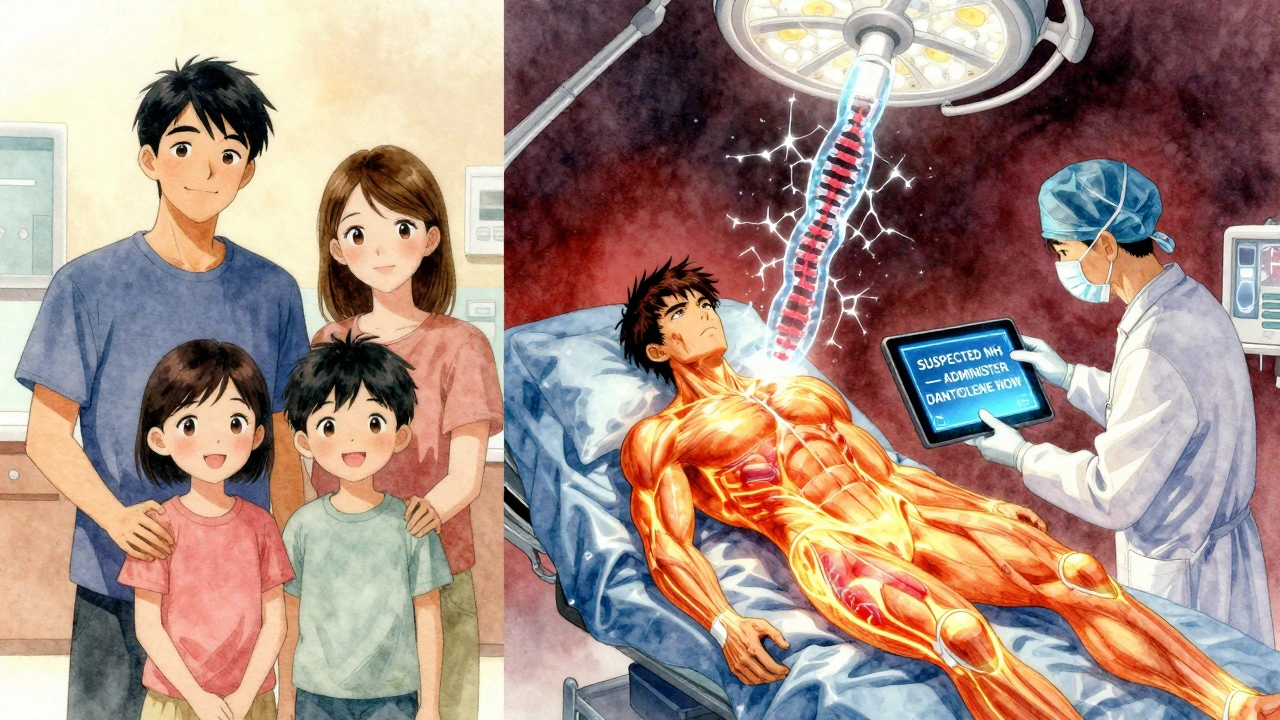
Right now, the biggest advancement isn’t a drug - it’s software. Epic Systems just rolled out an AI alert in their anesthesia system. If CO2, heart rate, and temperature hit critical levels at the same time, the system flashes a warning: “Suspected MH. Administer dantrolene.” That’s not science fiction. It’s happening in hospitals today.
What You Should Know - Even If You’re Not a Doctor
If you’re scheduled for surgery, ask:
- Do you have dantrolene on site?
- Have your staff trained for MH in the last year?
- Do you use Ryanodex or Dantrium?
If you’ve had a bad reaction to anesthesia before - especially muscle stiffness or unexplained fever - tell your anesthesiologist. Write it down. Bring it with you.
And if you’re a family member of someone who died unexpectedly during surgery? Ask for an autopsy. Malignant hyperthermia is often missed. If it’s confirmed, your family can be tested. And you can help prevent another death.
One survivor told MHAUS: “I never heard of this until I almost died.” That’s the tragedy. It’s not rare. It’s just hidden. And now, we know how to stop it.



It's staggering how a single genetic glitch can turn a routine procedure into a death sentence. The RYR1 mutation isn't just a variant-it's a silent landmine in the neuromuscular junction. What's more unsettling is that we're still operating under the assumption that absence of family history equals safety. That's not just outdated-it's dangerously naive. The calcium dysregulation cascade is so rapid, so thermodynamically violent, that even a 15-second delay in dantrolene administration can tip the scales toward multiorgan failure. We're not talking about protocol tweaks here; we're talking about neurophysiological dominoes collapsing in real time.
I remember reading about a case in Manchester where a 19-year-old went in for a wisdom tooth extraction and didn't come out. No prior signs, no family history, just a sudden spike in end-tidal CO2 and a jaw that wouldn't unlock. The team thought it was a seizure at first. Took them 22 minutes to realize what was happening. By then, the potassium was through the roof. It's terrifying how much of this still comes down to instinct and experience rather than hard-and-fast rules. And yeah, the cost of the cart is insane-$144k-but if you're not prepared, you're just gambling with someone's life. I've seen hospitals cut corners on this stuff because 'it's rare.' Rare doesn't mean impossible. And when it hits, it hits hard.
Man, this is one of those posts that makes you want to stand up and clap. Dantrolene is basically the superhero drug we didn't know we needed until we almost lost everything. And Ryanodex? That’s the real MVP-mixes in a minute, no drama. I’ve seen rural hospitals still using Dantrium because it’s ‘cheaper,’ but bro, you’re not saving money-you’re saving pennies while risking a whole damn life. And that AI alert from Epic? That’s next-level shit. Imagine an algorithm yelling ‘DANTROLENE NOW’ right when your brain is stuck on ‘is this just a fever?’ That’s not tech, that’s a lifesaver with a siren. Also, kids getting tonsillectomies? Yeah, they’re basically ticking time bombs if you give them succinylcholine. Just say no.
so i work in a small hospital and we have the cart but no one really knows where it is. the nurse who trained us left 3 years ago and we never replaced her. i think the cart is in the basement near the old autoclave? last time we checked it was still sealed. the anesthesiologist says he 'knows what to do' but he's never actually given dantrolene. we have 1 vial. expired 2021. i dont know what to do anymore
It's amusing how the medical community has turned a biochemical catastrophe into a compliance checklist. The real issue isn't the lack of dantrolene-it's the institutionalized complacency that treats this as a 'protocol' rather than a physiological emergency. The MHAUS hotline? A bandage on a hemorrhage. AI alerts? Glorified noise generators for overworked staff who don't understand the pathophysiology. The only thing that matters is whether the provider can recognize the triad: hypercapnia, tachycardia, and rigidity-and act without hesitation. Everything else is theater. And don't get me started on the $4,000 vial pricing. This isn't medicine; it's corporate extortion wrapped in white coats.
I had a cousin die during a hernia repair. They said it was a heart attack. We never knew about MH until years later. I wish someone had told us to ask for an autopsy. Now I tell everyone I know to ask about dantrolene before any surgery. Just one question could save someone.
so this is wild 🤯 i never knew this could happen. in india we dont even have dantrolene in most hospitals. i had a friend who had a fever after surgery and they just gave him paracetamol. he died 2 days later. no one knew. now i tell everyone to ask. even if they think its crazy. better safe than sorry 🙏
They’re hiding this from us. Why? Because if people knew, they’d stop surgeries. Big Pharma makes billions off these drugs. Dantrolene is old and cheap. They don’t want you to know it exists. They want you scared enough to sign the consent forms but not smart enough to ask the right questions. This isn’t medicine. It’s control.
There’s something deeply poetic about how a single protein channel-RYR1-can hold the difference between life and death. It’s not just a mutation; it’s a whisper in the genome that screams when triggered. We treat anesthesia like a routine, but it’s more like stepping into a minefield blindfolded. And yet, we’ve got this one drug, this one molecule, that can flip the switch. It’s almost beautiful in its simplicity. The tragedy isn’t the rarity-it’s that we still don’t treat it like the emergency it is. We wait for signs. We wait for confirmation. We wait for permission. But the body doesn’t wait. It just burns.
As a medical professional from India, I find this article both enlightening and sobering. In many parts of our country, access to dantrolene remains a luxury. Training is inconsistent, and awareness is low. However, the principles outlined here-early recognition, immediate cessation of triggers, rapid cooling, and dantrolene administration-are universal. We need grassroots education campaigns, not just hospital protocols. And yes, the cost is prohibitive-but lives are priceless. Perhaps international partnerships could help distribute stockpiles to underserved regions. This is not just an American issue. It is a global one.
my brother had a bad reaction to anesthesia back in 2010. they thought it was an allergic reaction. turns out it was MH. he survived but had kidney damage for years. we never got tested. now i’m terrified for my kids. i’m gonna push for genetic testing. no more guessing.
This is the most important thing I’ve read all year. If you’re reading this and you’re scheduled for surgery, don’t wait for someone else to ask the questions. Ask them yourself. Do you have dantrolene? Is it current? Has your team trained this year? If they hesitate, walk out. Your life is worth more than their convenience. And if you’re a provider? Stop treating this like a footnote. It’s the difference between a patient going home-or going into a body bag. Be the one who acts. Not the one who waits.