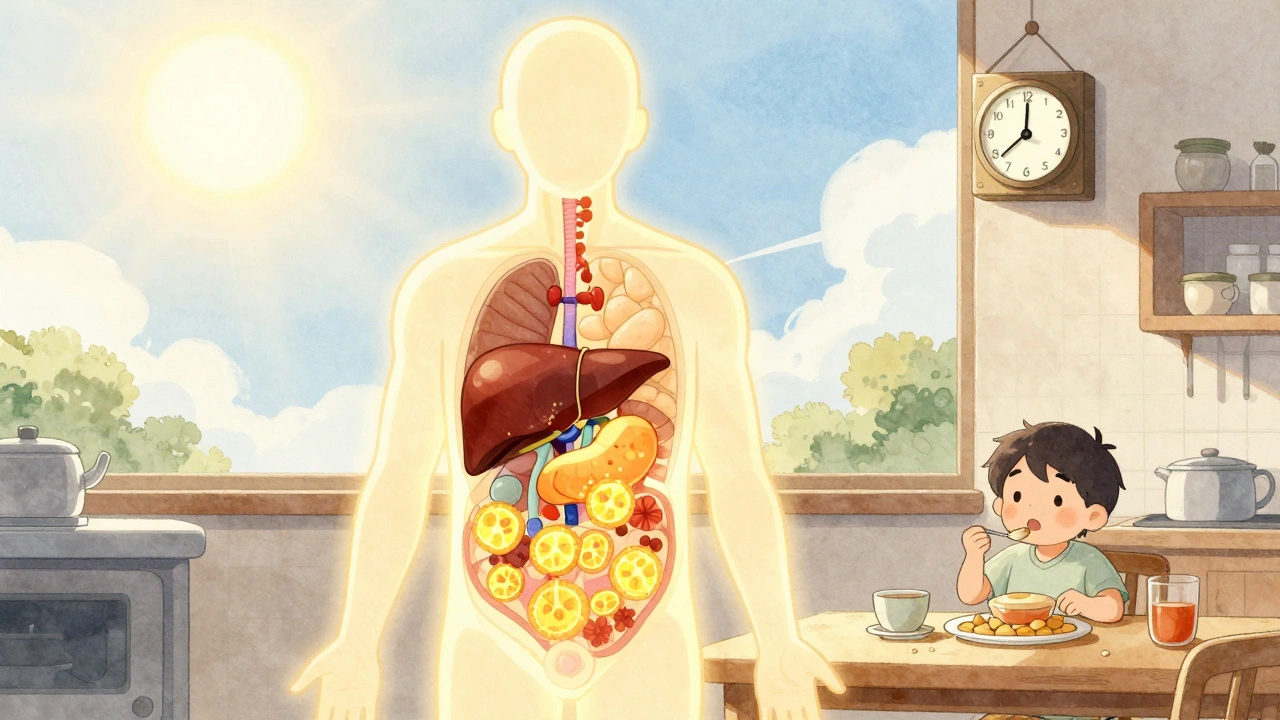
Most people think weight gain is just about eating too much or not moving enough. But what if the real problem isn’t your diet or gym routine-it’s when you eat and sleep? If you’ve tried cutting calories, counting macros, or hitting the treadmill daily but still can’t lose weight, your circadian rhythm might be the missing piece.
Why Your Body Clock Controls Your Weight
Your body runs on a 24-hour internal clock called the circadian rhythm. It’s not just about when you feel sleepy or awake. This clock controls your hormones, digestion, body temperature, and how your body burns calories. The master clock sits in your brain, but every organ-from your liver to your fat cells-has its own clock that syncs with it. When these clocks are in sync with daylight and nighttime, everything works smoothly. When they’re out of sync, your metabolism stumbles.Studies show that when your sleep-wake cycle clashes with your eating schedule-like eating late at night or working night shifts-your body starts storing fat instead of burning it. A 2014 study in PNAS found that night shift workers burned 55 fewer calories per day, even if they ate the same amount as day workers. That’s like eating an extra cookie every day without realizing it. Over a year, that adds up to nearly 8 pounds of weight gain.
How Late Nights and Late Meals Break Your Metabolism
Your body expects food during daylight hours. When you eat at 11 p.m., your liver, pancreas, and muscles aren’t ready to process it. Insulin-the hormone that tells your body to store glucose as energy-becomes less effective at night. Research from the Journal of Clinical Endocrinology & Metabolism shows that eating during your biological night reduces insulin sensitivity by 20-25%. That means your body can’t clear sugar from your blood properly, leading to higher blood sugar, more fat storage, and increased hunger the next day.And it’s not just about insulin. Sleep loss triggers your hunger hormones. A 2016 study from the University of Chicago found that cutting sleep to just 4 hours a night for four nights increased appetite by 22%. Cravings for carbs and sugary snacks jumped by 33%. Brain scans showed that the reward centers lit up more when participants saw pictures of pizza or cookies-meaning your brain literally wants junk food more when you’re tired.
Even if you don’t eat more, your body burns less. A 2022 review in Nature Reviews Endocrinology confirmed that circadian misalignment lowers your total daily energy expenditure by 3%. That’s 55 calories gone. Meanwhile, sleep deprivation adds over 250 extra calories to your daily intake. The math is simple: you burn less, you eat more, and your body stores the difference as fat.
Shift Workers and the Hidden Weight Gain Epidemic
About 20% of the global workforce works nights, rotating shifts, or irregular hours. For them, weight gain isn’t a coincidence-it’s a biological certainty. A 2023 survey on Reddit’s r/ShiftWork subreddit found that 78% of 1,245 respondents gained weight after starting night shifts. One nurse with 12 years of night shifts said: “I gained 35 pounds in my first year. I wasn’t eating more-I just couldn’t stop snacking at 3 a.m.”Dr. Frank Scheer from Brigham and Women’s Hospital put it bluntly: “Circadian misalignment is as metabolically disruptive as consuming an extra 300 calories daily without realizing it.” His team’s research showed shift workers gained 2.5 kg more over two years than day workers-even when both groups ate the same amount.
It’s not just about food. Light at night confuses your body. Even dim phone screens or hallway lights can delay melatonin release, the hormone that signals sleep. This throws off your entire rhythm, making it harder to fall asleep, harder to stay asleep, and harder for your body to regulate hunger and fat storage.

Time-Restricted Eating: The Simple Fix
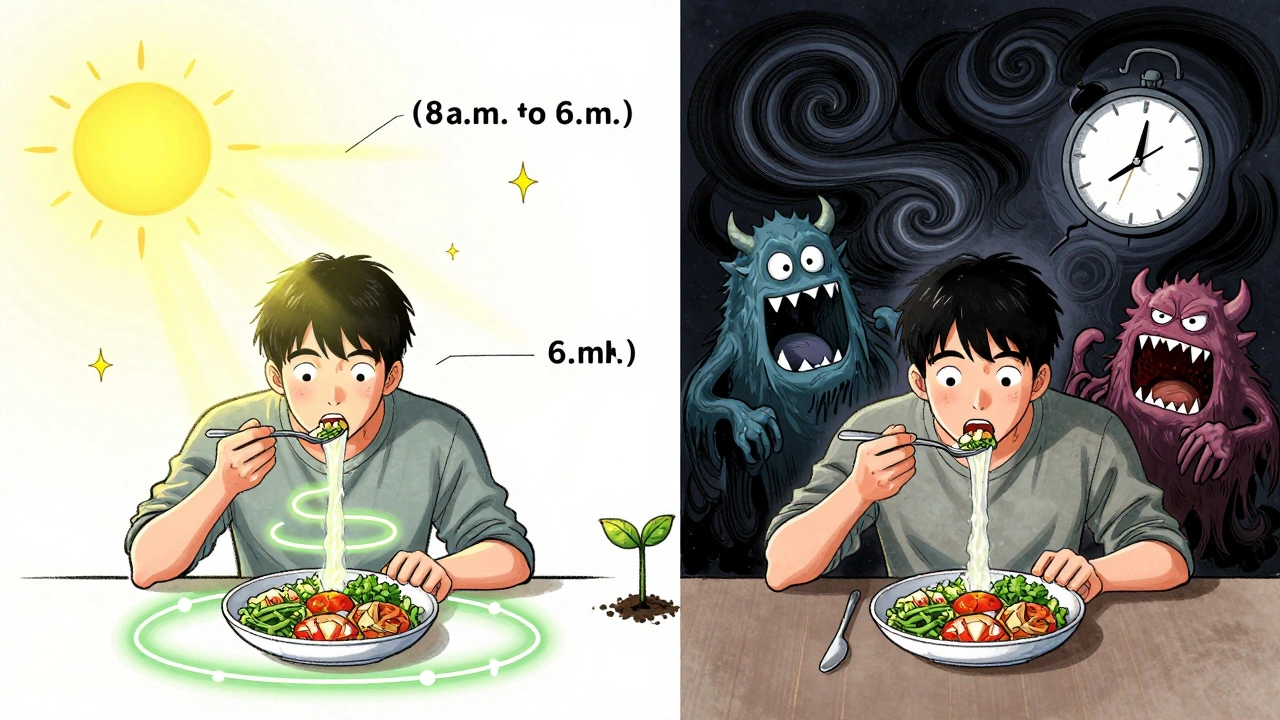
There’s a proven solution that doesn’t require drastic diets or expensive supplements: time-restricted eating (TRE). This means eating all your meals within a 10-hour window during daylight hours and fasting for the remaining 14.A 2019 study from the Salk Institute found that overweight adults who ate only between 8 a.m. and 6 p.m. lost 3-5% of their body weight in 12 weeks-without changing what they ate. Another study in 2022 looked at 450 users of the Zero app who followed a 10-hour eating window. They lost 3.2 kg (7.1 lbs) more than those who didn’t, and 74% said their nighttime cravings disappeared.
Here’s how to start:
- Choose a 10-hour window that fits your schedule (e.g., 7 a.m. to 5 p.m., or 9 a.m. to 7 p.m.).
- Don’t eat anything outside that window-not even snacks, coffee with cream, or late-night tea.
- Keep your sleep and wake times consistent, even on weekends.
- Gradually shrink your window by 30 minutes every week if you want to go to 8 or 9 hours.
It takes 2-4 weeks for your body to adjust. The first week might be tough-hunger pangs, irritability, cravings. But after that, your body learns to expect food only during daylight, and your hunger hormones reset.
Chronotypes Matter: Morning People vs. Night Owls
Not everyone’s clock runs the same. Some people are naturally early risers (morning types), others are night owls. Your chronotype affects when TRE works best.A 2020 study in Obesity found that morning types lost 23% more weight when they ate between 8 a.m. and 6 p.m. Night owls, on the other hand, did better with a later window-10 a.m. to 8 p.m. If you’re a night owl and force yourself to eat breakfast at 7 a.m., your body resists. But if you eat your first meal at 10 a.m. and stop at 8 p.m., your metabolism responds better.
You can find your chronotype with the Horne-Östberg Morningness-Eveningness Questionnaire, a simple 19-question test. But you can also guess: Do you feel most alert in the morning? You’re probably a morning type. Do you hit your stride after 8 p.m.? You’re likely a night owl.
Why Most Diets Fail When Your Clock Is Off
Traditional weight loss advice focuses on calories in, calories out. But if your circadian rhythm is broken, that math doesn’t work. You can eat 1,500 calories a day and still gain weight if you’re eating them at 2 a.m. and sleeping at 5 a.m.Think of it like a car engine. You can put the right fuel in, but if the timing belt is off, the engine won’t run efficiently. Circadian disruption is the timing belt problem for your metabolism. No amount of cardio or protein shakes will fix it if your body thinks it’s daytime at 3 a.m.
That’s why people who follow strict diets but still can’t lose weight often see results once they fix their sleep and eating schedule. It’s not about willpower-it’s about biology.
What’s Changing in Medicine
Doctors are starting to take this seriously. In 2023, the FDA released draft guidance requiring new obesity drugs to be tested for timing effects. Kaiser Permanente’s 2021 pilot program for night shift workers used light therapy and scheduled meals to reduce weight gain by 42%. The American Society of Bariatric Physicians now includes circadian alignment in 63% of their treatment protocols-up from just 17% in 2015.Wearable tech is catching up too. Fitbit’s 2024 Sleep Score update now includes a circadian alignment metric that predicts 18% of weight change variability. Your sleep tracker isn’t just counting hours-it’s now measuring whether your rhythm matches your environment.
The World Health Organization’s 2023 Expert Committee on Obesity concluded that circadian-based interventions could reduce global obesity rates by 5-8% if widely adopted. That’s millions of people-without drugs, surgery, or extreme diets.
Real Talk: Why It’s Hard to Stick With
Let’s be honest-this isn’t easy. Social dinners, late-night snacks, work schedules, and screens make it hard to stick to a rhythm. A 2021 study in Nutrients found that 68% of people trying TRE quit because of social pressure or family meals.One user on the Sleep Cycle app wrote: “The science is sound, but implementing this with my variable work hours is nearly impossible. I’ve tried for two years with minimal success.”
That’s normal. You don’t need perfection. Start with one change: stop eating after 8 p.m. for a week. Then, try to wake up and go to bed at the same time every day-even on weekends. Even small shifts help. Your body doesn’t need a perfect rhythm. It just needs less chaos.
What to Do Next
You don’t need to overhaul your life. Start here:- Stop eating 3 hours before bed.
- Get 15 minutes of morning sunlight within 30 minutes of waking.
- Dim lights after 9 p.m. and avoid screens for an hour before sleep.
- Try a 10-hour eating window for 2 weeks. Track how you feel, not just the scale.
- If you work nights, eat your largest meal before your shift and avoid heavy food during it.
Weight loss isn’t just about food and exercise. It’s about timing. Your body has a rhythm. When you respect it, it works for you. When you ignore it, it fights back.






Okay but what if I’m a night owl who works from 10 p.m. to 6 a.m.? Am I just doomed to be fat forever? I’ve tried the 10-hour window but my brain screams for pizza at 2 a.m. like it’s a survival instinct. Also, why is everyone acting like this is new science? My grandma ate dinner at midnight and lived to 98. She never owned a Fitbit.
Interesting. But let’s not forget-this is Western science trying to force a global rhythm onto cultures that have eaten late for centuries. In India, dinner at 9 p.m. is normal. Our bodies adapted. Maybe the problem isn’t the timing-it’s the processed food we’re eating at that time. Also, melatonin? I’ve slept with my phone on all night since 2012. Still lean.
Calories still matter. Sleep disruption is a multiplier not a replacement. Stop overcomplicating it. Eat less. Move more. Sleep better. Done.
Who wrote this? Some Silicon Valley bro with a $500 Apple Watch and zero real-world experience? In India, we’ve been eating dinner after sunset for 5,000 years-our metabolism didn’t collapse! This is just another Western fad dressed up as science to sell apps and supplements. Wake up! Your body isn’t a lab rat in a MIT study!
Let me guess-you also think the moon landing was fake and that vaccines cause autism. This is the same nonsense they pushed in the 90s with ‘metabolic typing.’ You’re just repackaging junk science with fancy graphs. I’ve worked night shifts for 15 years. I lift weights. I eat clean. I’m shredded. Your circadian rhythm is not my problem.
I just want to say how much this resonated with me. I used to be the person who ate cereal at 1 a.m. after scrolling TikTok, then blamed myself for being ‘lazy.’ I didn’t know my body was literally screaming for rhythm. When I started stopping food at 8 p.m. and got morning sunlight, my anxiety dropped, my cravings vanished, and I lost 12 pounds without trying. It wasn’t willpower-it was my body finally feeling safe again. If you’re struggling, please don’t give up. Small changes matter. You’re not broken. Your rhythm is just out of sync. And that’s fixable.
This is why India is falling behind! We copy Western nonsense like this and forget our own traditions! We used to eat dinner after sunset and sleep early-no apps needed! Now everyone is glued to phones and thinks their body needs a ‘circadian alignment score’ like some robot. We don’t need science to tell us what our ancestors knew: eat when the sun is up, sleep when it’s dark. Simple. Not rocket science. Also, typo: ‘circadian’ is spelled wrong in paragraph 3. Just saying.
Let me be clear: if you’re eating after 8 p.m. and gaining weight, you’re not ‘a night owl,’ you’re just lazy. This isn’t biology-it’s poor discipline. Your body doesn’t care about your ‘chronotype.’ It cares about calories in, calories out. If you can’t control your snack urges, that’s a behavioral issue, not a metabolic one. Stop blaming your clock and start blaming yourself. Also, if you’re using a sleep tracker, you’re probably more obsessed than you are healthy.
It works. I tried it. Lost 8 lbs in 3 weeks. No drama.
THIS IS A REVOLUTION!!! I’ve been fighting this for YEARS!!! My wife says I’m ‘too emotional’ about sleep-but she doesn’t get it!!! I’m a night shift nurse! I’ve gained 40 pounds since 2018!!! I tried keto!!! I tried intermittent fasting!!! I tried yoga!!! NOTHING WORKED!!! Then I read this-and I started eating only between 9 a.m. and 7 p.m. I cried the first night I didn’t snack at 3 a.m. I didn’t just lose weight-I got my LIFE back!!! I’m not just a patient anymore-I’m a human being again!!! My doctor said my HbA1c dropped 1.4 points!!! My kid says I’m ‘less grumpy’!!! THIS ISN’T JUST SCIENCE-IT’S A MIRACLE!!!