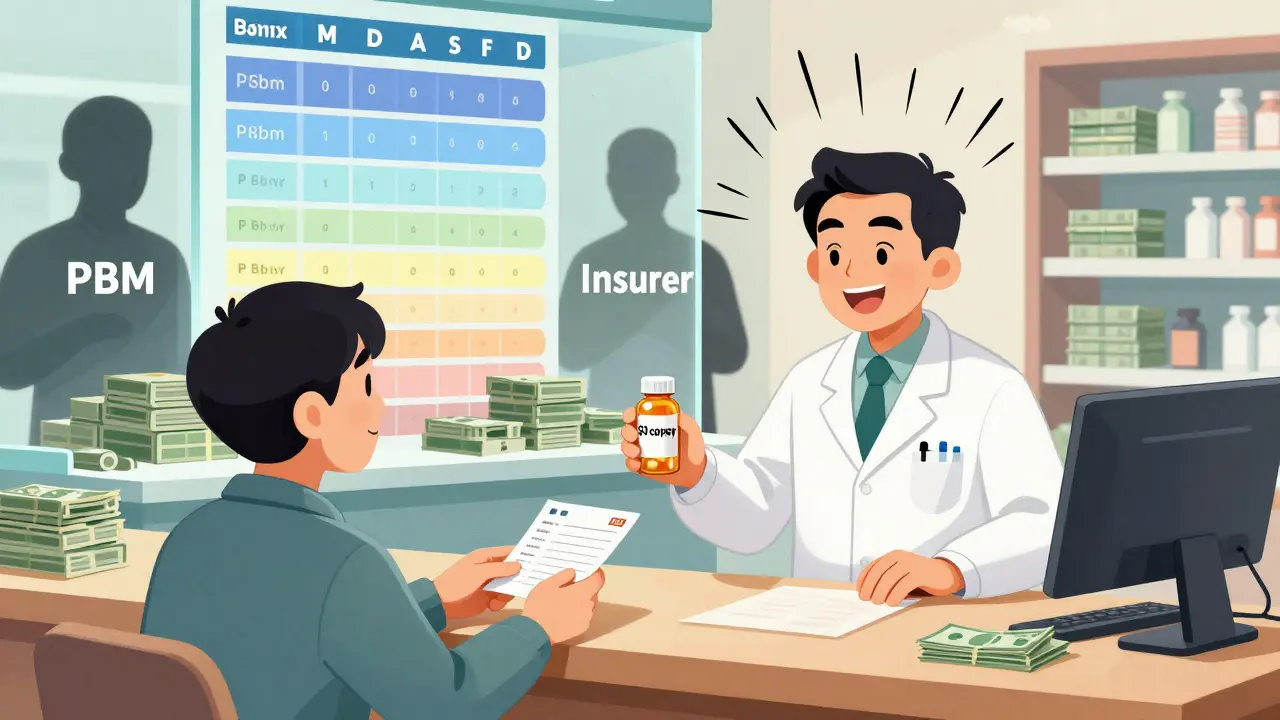
Health insurance plans don’t just pay for your prescriptions-they actively shape which ones you get. The key tool they use? generic drugs. By designing benefits that push patients toward generics, insurers save billions each year. But the system isn’t always as simple as it sounds. For many people, a $5 generic copay feels like a win. For others, it’s a hidden maze of clawbacks, prior authorizations, and surprise bills.
How generics became the backbone of insurance cost control
The modern use of generic drugs in insurance plans didn’t start with a patient’s request. It began with law. The Hatch-Waxman Act of 1984 created a legal pathway for generic versions of brand-name drugs to enter the market. These generics had to prove they were bioequivalent-same active ingredient, same dose, same effect. But they cost far less. Today, 91.5% of all prescriptions filled in the U.S. are generics. Yet they make up only 22% of total drug spending. That’s the math insurers love: 9 out of 10 pills are cheap, but they pay for just 1 in 5 dollars of the total bill.
Over the last decade, this strategy saved the U.S. healthcare system $3.7 trillion. In 2022 alone, generic drugs saved more than $370 billion. That’s not just corporate profit-it’s lower premiums, smaller deductibles, and more coverage for other services. But who actually gets to keep that money? That’s where things get messy.
The tiered formulary: Your drug plan’s hidden roadmap
Every health plan has a formulary-a list of covered drugs. But it’s not just a list. It’s a hierarchy. Tier 1 is for generics. Tier 2 is for preferred brand-name drugs. Tier 3 and above are for non-preferred brands and specialty drugs. Your copay changes with each tier.
In 2024, the average copay for a 30-day supply of a generic drug in a commercial plan was $0 to $10. For a preferred brand? $25 to $50. For a non-preferred brand? $60 or more. That’s not a coincidence. Plans engineer these gaps to make the cheap option look like the obvious choice. If your plan has a $0 generic copay, you’re being nudged-politely-to pick the generic, even if your doctor originally wrote for the brand.
Medicare Part D plans use the same system. In 2024, generic copays ranged from $0 to $15 across different plans. Medicaid programs, which cover 89.3% of generic prescriptions, use federal price caps to keep costs low. Self-insured employers? They’re even more aggressive. One Johns Hopkins study found two large employers saved 9% to 15% on drug costs just by switching patients to generics-without any drop in health outcomes.
Step therapy and mandatory substitution: When your doctor’s choice gets overridden
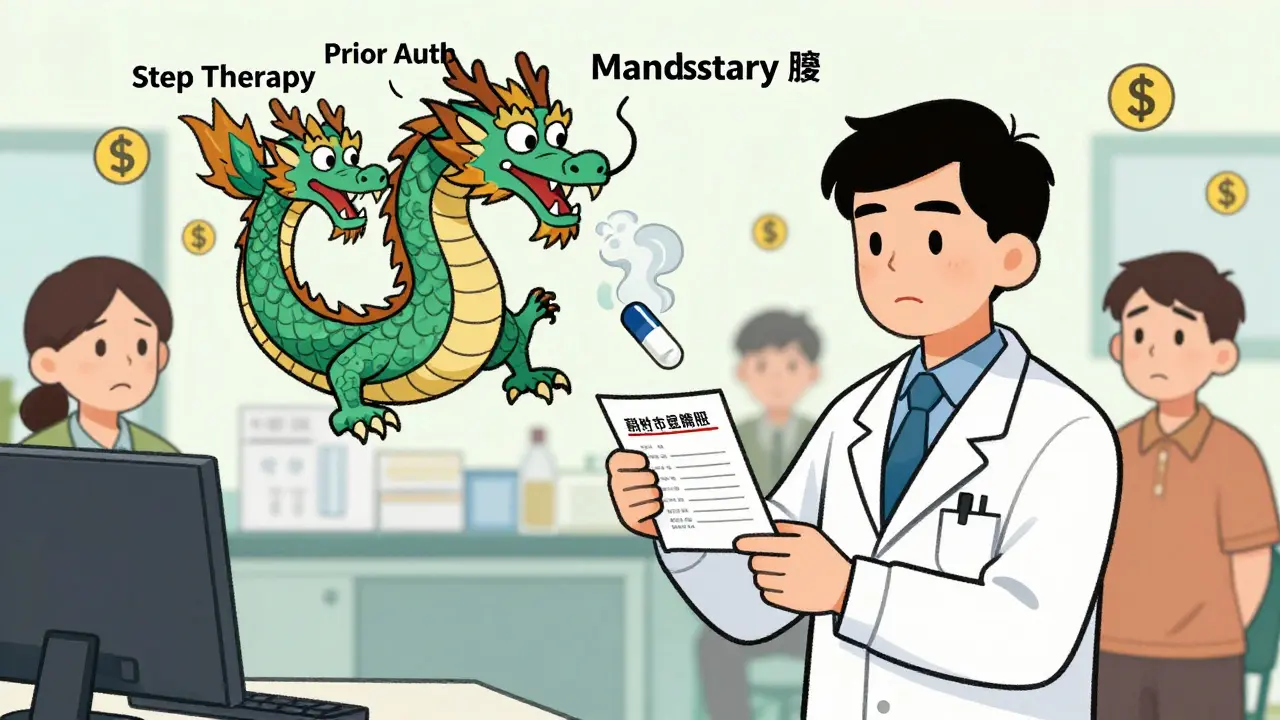
It’s not enough to just make generics cheaper. Plans also make it harder to get the brand. Step therapy means you have to try the generic first. Only if it fails do you get approval for the brand. By 2023, 92% of Medicare Part D plans required this. In some cases, your pharmacist can swap the brand for a generic without even asking your doctor-thanks to mandatory substitution laws in all 50 states.
But here’s the catch: not all generics are created equal. Some patients report side effects after switching. A 2023 Medscape poll found 31% of doctors had patients who experienced problems after being forced to switch. It’s not common, but it happens. And when it does, patients are stuck in a bureaucracy. One Kaiser survey found 22% of Medicare beneficiaries had to get prior authorization for a brand drug when a generic was available. Of those, 14% said their doctor had to appeal multiple times.
Who really saves money? The patient-or the middleman?
The big promise of generics is lower out-of-pocket costs. But in practice, many patients don’t see the full savings. Why? Because of how pharmacy benefit managers (PBMs) work.
PBMs-like CVS Caremark, OptumRx, and Express Scripts-are the middlemen between insurers, pharmacies, and drugmakers. They negotiate discounts, manage formularies, and process claims. In 2022, they secured $195 billion in rebates and discounts for health plans. But here’s the twist: they often don’t pass all of that savings to you.
Take spread pricing. A PBM might tell your insurer they paid $5 for a generic drug. But they actually paid $2 to the pharmacy. You pay a $10 copay. The PBM pockets the $5 difference. That’s not fraud. It’s legal. But it means you’re paying more than the drug actually costs. A 2022 USC Schaeffer Center study found patients were overpaying by $10 to $15 per generic prescription because of this practice.
Then there’s copay clawbacks. You pay your $10 copay for a generic. Later, your plan realizes the drug only cost $3. So they claw back $7 from the pharmacy-and sometimes, that cost gets passed to you. You end up paying more than the drug’s real price. The Department of Labor’s 2024 report confirmed this happens more often than people realize.
The new players: Direct-to-consumer and Medicaid’s next move
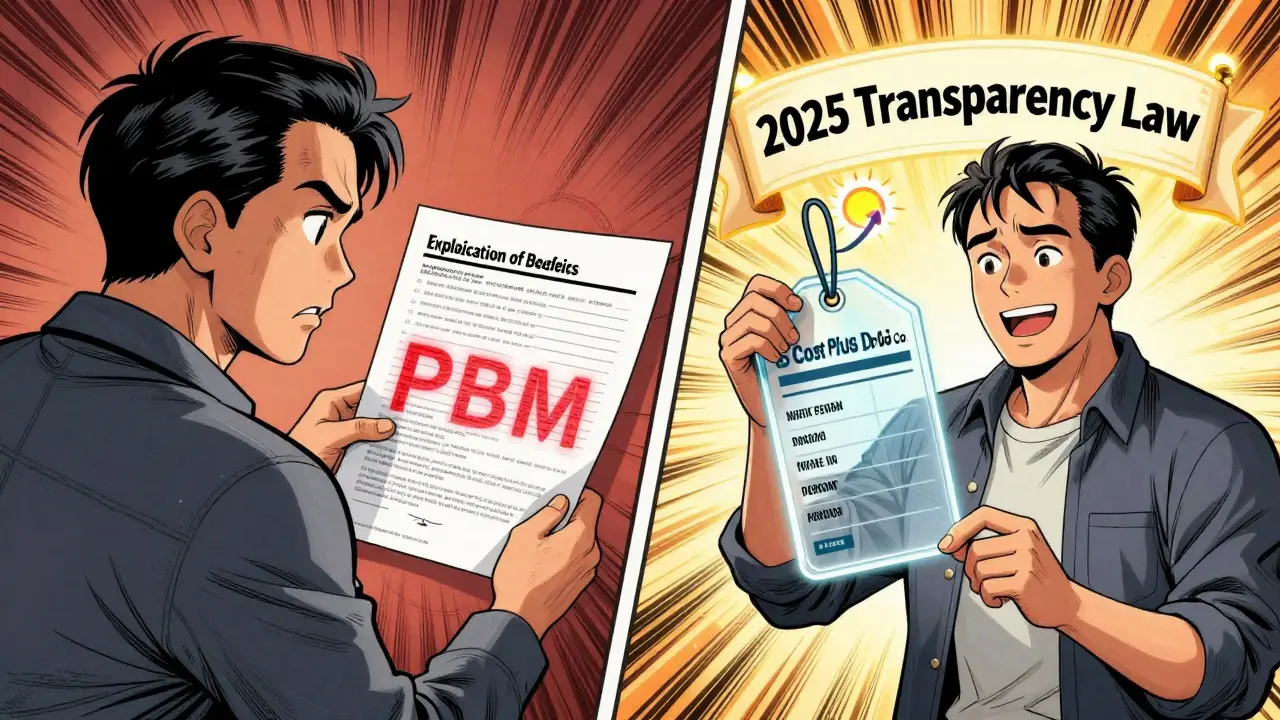
Some people are tired of playing the insurance game. Enter Mark Cuban Cost Plus Drug Company. Launched in 2022, it sells generics at transparent cost-plus prices. No PBMs. No rebates. Just the price of the drug plus a $3 pharmacy fee. In 2023, patients saved a median of $4.96 per prescription. For the uninsured, it’s a game-changer. But if you’re on Medicaid, you don’t save a cent-because Medicaid already pays the lowest price.
Meanwhile, the federal government is stepping in. In 2026, CMS will launch the GENEROUS Model-a new program designed to cut Medicaid drug spending by $40 billion over ten years. It will let CMS negotiate directly with drugmakers and require states to use uniform coverage rules. It’s a direct challenge to the PBM model.
And then there’s the Inflation Reduction Act. Starting in 2025, Medicare Part D beneficiaries won’t pay more than $2,000 a year for drugs. That cap changes the game. Suddenly, plans have less incentive to push generics just to keep costs low. They’ll need to find smarter ways to balance savings and access.
What patients really think-and what they want
On Reddit, a thread asking if anyone else had their generic copay drop to $0 got 142 comments. Eighty-seven percent said yes-and they were thrilled. But 13% complained they couldn’t get certain generics because their plan didn’t cover them. A Kaiser survey found 68% of Medicare beneficiaries were satisfied with their generic coverage. But 22% struggled with prior authorization. And 78% of commercially insured people said they’d switch plans for better generic coverage.
What do patients want? Lower copays. Transparency. Fewer hoops. A 2023 National Center for Policy Analysis survey found people would rather pay a slightly higher monthly premium than face unpredictable drug costs. They’re not against generics. They’re against being tricked.
What’s next? More rules, more transparency
The system is changing. Starting January 1, 2025, insurers must show you exactly how much your drug costs on your Explanation of Benefits (EOB). No more hidden spreads. No more mystery copays. You’ll see what the PBM paid, what you paid, and what the pharmacy received.
Medicare will start negotiating prices for 10 high-cost drugs in 2026. That could push down prices for generics too, since manufacturers may lower prices to stay competitive.
And the big PBMs? They’re still dominant. CVS, OptumRx, and Express Scripts process 83% of all prescriptions. But they’re under fire. Lawmakers, patients, and even some insurers are asking: If generics save so much money, why are patients still overpaying?
The answer isn’t simple. Generics work. They save money. But the system that delivers them is built on opacity. The real challenge isn’t getting patients to take generics. It’s making sure they get to keep the savings.


Generics work. They save money. But the system that delivers them is built on opacity.
The real challenge isn’t getting patients to take generics. It’s making sure they get to keep the savings.
That’s the quiet truth no one talks about.
We’ve optimized for cost, not care.
And now we’re surprised when people feel exploited.
It’s not the drugs. It’s the middlemen.
And the laws that let them get away with it.
It’s not capitalism. It’s rent-seeking with a stethoscope.
I’ve been on a plan with $0 generics for three years. Never had an issue.
But I know people who switched and got migraines.
It’s not the drug.
It’s the body.
And nobody listens until it’s too late.
It is imperative to acknowledge, with a high degree of analytical rigor, that the structural architecture of pharmaceutical benefit management, as currently constituted, constitutes a systemic inefficiency that disproportionately externalizes financial burden onto the patient-consumer.
Moreover, the practice of spread pricing-while legally permissible under现行 regulatory frameworks-demonstrates a clear misalignment between fiduciary duty and consumer welfare.
Furthermore, the absence of mandatory rebate pass-through mandates exacerbates this disparity.
It is not merely a market failure; it is a governance failure.
Policy reform must prioritize transparency, accountability, and equitable cost distribution-not merely cost containment.
Without these, the promise of generic accessibility remains a hollow rhetorical construct.
Of course the PBMs are stealing from you.
They’re owned by the same banks that own the drug companies.
And the FDA? They’re in the pocket of Big Pharma.
They approve generics that aren’t bioequivalent.
They know.
They all know.
You think $0 copay is a win?
It’s a trap.
They want you dependent.
They want you numb.
Wake up.
It’s all connected.
Mark Cuban? He’s the only one not lying.
Let’s be honest-most people don’t even read their EOBs.
They just pay the copay and move on.
And that’s why this system survives.
It thrives on apathy.
It’s not about generics.
It’s about how little we expect from our own healthcare.
Stop being grateful for $5 pills.
Start demanding to know what they actually cost.
And then, maybe, we’ll get real reform.
I used to think generics were fine.
Until I got switched to one and felt like my brain was dissolving.
My doctor didn’t care.
Insurance didn’t care.
Pharmacist didn’t care.
So I paid out of pocket for the brand.
It cost me $120.
And I still feel like a criminal for it.
That’s the real cost.
Not the dollar amount.
The shame.
In India, generics are the only option-and we don’t have PBMs, we don’t have spread pricing, we don’t have prior authorizations.
Why? Because we don’t let corporations turn medicine into a casino.
You think this is innovation?
No.
This is American greed dressed in white coats.
And you call it progress?
Pathetic.
While the economic rationale underpinning the widespread adoption of generic pharmaceuticals is undeniably sound, the ethical implications of patient coercion through tiered formularies and mandatory substitution protocols warrant serious reconsideration.
Moreover, the lack of standardized patient education regarding potential bioequivalence variability undermines informed consent.
Furthermore, the opacity of PBM financial arrangements-particularly regarding rebates and clawbacks-constitutes a violation of fiduciary transparency principles.
It is not sufficient to reduce cost; we must also preserve autonomy, dignity, and trust in the provider-patient relationship.
Policy must evolve to reflect these non-financial values as primary, not secondary, considerations.
wait so if i pay $10 for a generic and it only cost $3... they take the $7 back from the pharmacy??
but then i still paid $10??
so the pharmacy gets nothing??
and i paid more than the drug cost??
is that even legal??
why does no one talk about this??
i just thought i was getting a deal lol
so i’m the one getting scammed??
bruh
They’re not just stealing from you-they’re laughing.
They’ve turned your health into a spreadsheet.
And you’re still thanking them for the $0 copay.
Wake up.
It’s not a discount.
It’s a trap.
And the worst part?
You’re complicit.
You didn’t fight it.
You didn’t ask questions.
You just took the pill.
And now you’re mad when it doesn’t work?
Surprise.
You let them do this.
There’s something beautiful about a $5 generic that saves someone’s life.
But there’s something ugly about the machine that hides the real price.
It’s like giving someone a loaf of bread… then charging them for the flour, the oven, the delivery truck, and the guy who smiled at them while stealing the change.
We need to fix the system.
Not just the price tag.
The whole damn thing.
Generics aren’t the problem.
The problem is we treat medicine like a commodity.
It’s not.
It’s life.
And if we keep letting corporations decide who gets what-and how much they pay-we’re not saving money.
We’re sacrificing humanity.
Let’s fix that.
They lied.
They said it was for YOU.
They said it was to save you money.
They said generics were just as good.
But then they stole the difference.
And when you got sick?
They made you jump through hoops.
And now they want a medal?
NO.
NO.
NO.
They need to burn.
And someone needs to tell them the truth.
They’re not heroes.
They’re thieves.
Bro in India we got generics for 10 rupees and no one cares who made it.
But here you got people arguing about who gets the rebate?
Madness.
Medicine should be simple.
Not a corporate chess game.
Just give people the pill.
And let them live.
That’s it.
Why is that so hard?