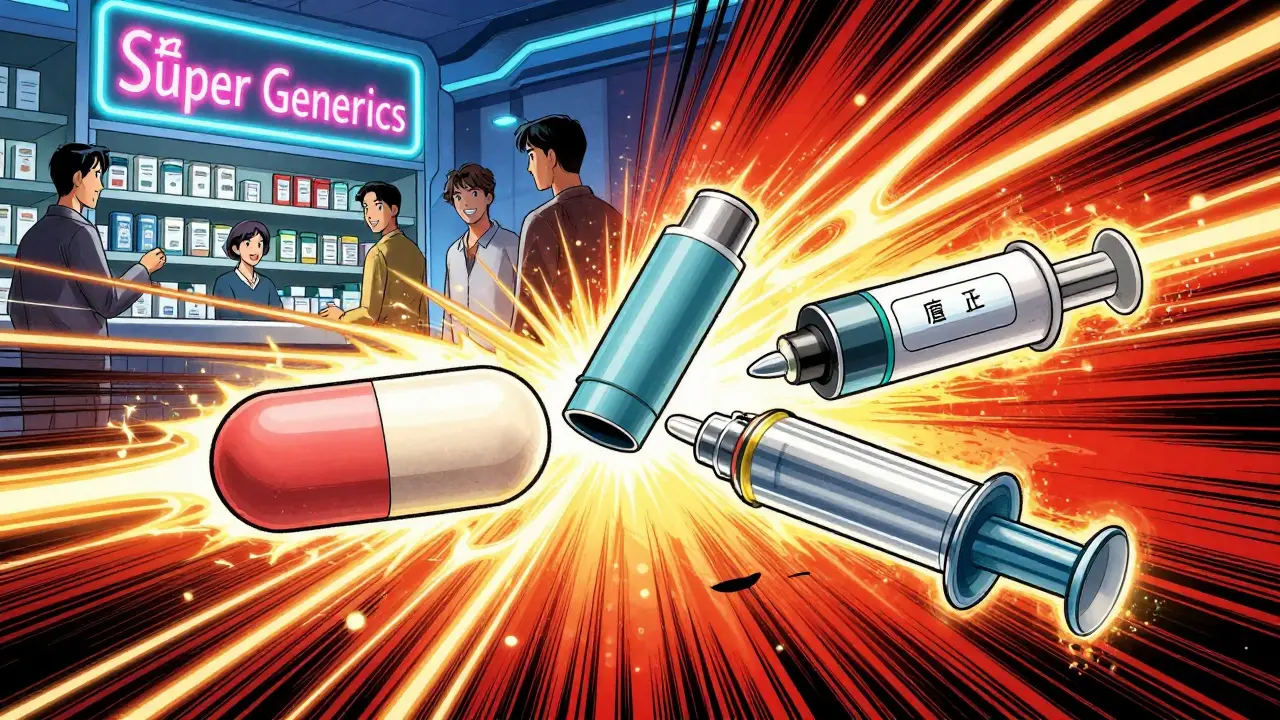
Generic drugs used to be simple: copy the brand, prove bioequivalence, and sell for pennies. But that era is over. Today, the most exciting players in the generics space aren’t just copying pills-they’re redesigning how drugs work. These aren’t your grandfather’s generics. We’re talking about generic combinations-products that merge multiple active ingredients, embed drugs in smart devices, or stretch release profiles to make treatment safer, simpler, and more effective. And they’re not just changing the game-they’re rewriting the rules.
What Exactly Are Generic Combinations?
Generic combinations go beyond simple copies. They’re advanced versions of existing drugs that add real therapeutic value. Think of them as upgraded generics. The most common type is the fixed-dose combination (FDC) a single pill containing two or more active ingredients, designed to improve adherence and clinical outcomes. For example, instead of taking separate pills for blood pressure and cholesterol, a patient might take one pill that does both. Other types include drug-device combinations such as inhalers or auto-injectors that deliver medication with precision, and modified-release formulations like extended-release tablets that maintain steady drug levels over 12-24 hours.
These aren’t just minor tweaks. They’re engineered to solve real problems: patients forgetting pills, side effects from fluctuating drug levels, or difficulty using complex delivery systems. The goal? Keep the cost of generics but boost the outcome. And it’s working. In 2025, the global market for these advanced generics-called super generics high-value generic combinations with enhanced delivery or multi-component formulations-hit $235.6 billion. By 2035, it’s projected to more than double to $474.6 billion.
Why Now? The Perfect Storm of Patent Expirations
There’s a reason this is exploding right now. Between 2025 and 2030, branded drugs worth $217-$236 billion in annual sales will lose patent protection. These aren’t small-time drugs. We’re talking about blockbusters like Trelegy Ellipta a three-in-one inhaler for COPD and asthma with $2.8 billion in 2024 U.S. sales, and Austedo a complex CNS drug for Huntington’s disease movement disorders with $1.2 billion in 2024 sales.
Brands can’t hold onto these markets forever. But if generics just copy them, margins vanish. So companies are building smarter versions-ones that can’t be easily replaced. A generic version of Trelegy that improves dose accuracy, reduces side effects, or allows once-daily dosing? That’s not just another generic. That’s a product with staying power.
Regulatory Hurdles: The Bigger Challenge Than Science
Developing a generic combination isn’t harder because of chemistry. It’s harder because of regulation.
Traditional generics follow the ANDA (Abbreviated New Drug Application) path. Prove you’re the same as the brand. Done. But for combinations? The FDA demands more. For FDCs, you need to show the combination offers a clinical advantage over taking the drugs separately. For drug-device combos, like an auto-injector with a built-in sensor, you need approval from the Office of Combination Products the FDA unit that determines whether the product is primarily a drug, device, or biologic. That adds months-sometimes years-to approval.
According to FDA internal data from 2024, complex combinations take 18-24 months longer to approve than simple generics. And 78% of failures? Not because the drug doesn’t work. It’s because the delivery system doesn’t meet equivalence standards. A tablet might release the right amount of drug-but if the coating doesn’t dissolve the same way as the brand, it gets rejected.
And it’s not just the U.S. The European Medicines Agency (EMA) the regulatory body overseeing drug approval in the European Union is far more cautious. Through Q1 2025, the EU approved only 12 complex generic combinations. The U.S. approved 37. That gap means companies can’t treat global markets the same. A product approved in the U.S. might still be stuck in regulatory limbo in Europe.

Market Advantage: Why Companies Are Betting Big
Here’s the kicker: even though these products cost 10-20 times more to develop, they hold their price like branded drugs.
Traditional generics? They lose 80-90% of their price within two years. One company launches, then five more jump in. Prices crash. But super generics? They keep 40-60% of their launch price for five years. Why? Because there’s no easy copycat.
Take Budeprion XL Teva’s extended-release version of bupropion, an antidepressant and smoking cessation aid. Before generic competition, it brought in $187 million a year. Once simple generics hit the market, total sales for bupropion dropped to $42 million. But Budeprion XL held on because it was harder to replicate. That’s the power of complexity.
Market share tells the same story. Simple generics dominate high-volume areas like statins, holding 90%+ of prescriptions. But they make less than 5% margin. Super generics? They capture only 25-35% of prescriptions in areas like CNS disorders or complex cardiovascular conditions-but they earn 20-35% margins. That’s where the money is.
The Technology Behind the Scenes
You can’t make these products without serious tech. Simple tablets? You can make them on old machines. But advanced combinations? They need precision.
- Hot-melt extrusion a manufacturing process that blends drugs with polymers to create uniform extended-release cores for modified-release tablets
- Lipid-based delivery systems fat-based carriers that improve absorption of poorly soluble drugs for oncology combinations
- Manufacturing equipment that maintains ±2% tolerance in drug ratios-any more, and you risk safety or efficacy
- Dissolution testing that matches the reference product within 10% f2 similarity factor
And it’s not just about making the pill. Device combos require collaboration with engineering firms. Catalent, for example, is teaming up with Hikma to build auto-injectors that can track dosing and send alerts to patients’ phones. This isn’t pharmaceuticals anymore. It’s pharma + tech.
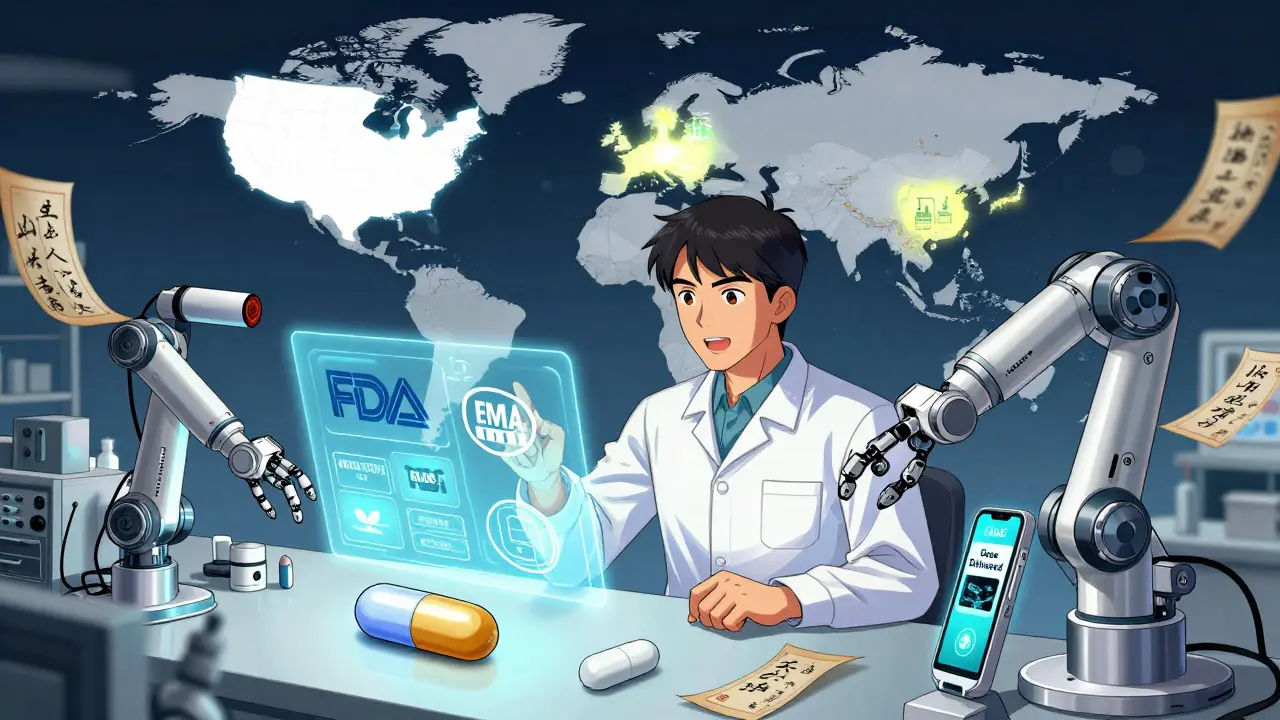
Regional Battles: Who’s Winning?
The U.S. leads in both innovation and approval. It accounts for 42% of the global super generics market. Why? Favorable reimbursement, strong payer willingness to pay for better outcomes, and a regulatory system that’s adapting. The October 2025 FDA pilot program accelerates review for U.S.-manufactured generic combinations is a game-changer-cutting approval time by 3-6 months.
Meanwhile, India is becoming the manufacturing engine. It now produces 35% of the world’s complex generics. But here’s the twist: most of those are made for U.S. and EU companies. India has the capacity, but not the regulatory flexibility to approve them locally.
Europe? Still playing catch-up. The EMA’s conservative stance means many products that launch in the U.S. take years to reach European patients. That’s creating a two-tier market-and giving U.S.-based companies a major advantage.
What’s Next? Three Big Trends
Looking ahead, three forces will define the future of generic combinations:
- The complexity premium-Products with multiple innovations (like a drug-device combo with a smart sensor) will command 2-3x the price of traditional generics. Companies aren’t just competing on cost anymore. They’re competing on capability.
- Regulatory divergence-The U.S. will keep pushing boundaries. The EU and other regions will lag. This means companies will need separate development paths for each market, increasing costs but also creating strategic opportunities.
- Device-pharma partnerships-You won’t see just pharma companies anymore. Look for alliances between drugmakers and device firms like Medtronic, Abbott, or even tech startups. The future of combination products is interdisciplinary.
And the big prize? Generic semaglutide combinations fixed-dose versions of GLP-1 agonists like semaglutide combined with other diabetes drugs. The original semaglutide market is worth over $100 billion. If a generic version can combine it with a second drug (like SGLT2 inhibitors) in a single daily pill, it could reshape diabetes care. Aspen Pharmacare and others are already in trials.
The Risk: Margin Erosion Is Still Looming
It’s not all sunshine. IQVIA projects the U.S. generics market will grow 11.4% in 2025-but Morningstar warns that pricing pressure could slash margins by 30% over the next decade. Why? Because if one company cracks a complex combination, others will follow. And when there are five competitors instead of one, prices drop.
The key to survival? Don’t just make a better generic. Make one that’s hard to copy. That means investing in proprietary tech, securing patents on delivery systems, and building regulatory expertise. The days of just copying pills are gone. The winners will be those who engineer smarter treatments-and outmaneuver regulators.
Are generic combinations the same as branded combination drugs?
No. Branded combination drugs are original products developed by pharmaceutical companies with full clinical trials and patent protection. Generic combinations are versions of those drugs that enter the market after patents expire, but they often include improvements-like better release profiles, device integration, or new dosing forms-that aren’t in the original brand. They’re not copies; they’re upgrades.
Why do generic combinations cost more to develop than regular generics?
Regular generics only need to prove they’re bioequivalent to the brand. Generic combinations must prove they’re not just equivalent-but improved. That means extra clinical trials, complex manufacturing validation, device testing, and regulatory submissions. Development costs jump from $1-5 million for a simple generic to $15-50 million for a complex combination.
Can generic combinations be patented?
The active drug ingredients can’t be patented again if they’re off-patent. But the delivery system-like a novel coating, a smart injector, or a unique release mechanism-can be. Companies file patents on these non-drug components to protect their investment. That’s why some generic combinations have 5-7 years of market exclusivity even after the original brand’s patent expires.
Which therapeutic areas are seeing the most growth in generic combinations?
Oncology is growing fastest at 11.3% CAGR, driven by combinations of kinase inhibitors and targeted therapies. Respiratory comes second at 9.89% CAGR, thanks to multi-drug inhalers. CNS disorders like Parkinson’s and Huntington’s are growing at 8.7% CAGR, as companies develop better delivery systems for drugs that cross the blood-brain barrier. These are high-value areas with limited competition and high patient need.
Is the FDA making it easier to approve generic combinations?
Yes. In October 2025, the FDA launched a pilot program that prioritizes review of generic combinations manufactured entirely in the U.S. This reduces approval time by 3-6 months. They’re also adopting ICH Q14 guidelines, which standardize how companies test complex formulations. These changes signal the FDA is adapting to the reality that modern generics are no longer simple pills.
Are generic combinations safe?
They must meet the same safety standards as branded drugs. But because they’re more complex, regulators have to evaluate more variables: dissolution profiles, device performance, patient handling, and long-term stability. The FDA and EMA both require rigorous testing. While rare, some failures have occurred due to differences in delivery systems-highlighting why regulatory oversight must evolve alongside the technology.





The evolution of generic combinations is a quiet revolution in public health. What used to be a race to the bottom on price is now a race to the top on precision. The real win isn't just cost savings-it's adherence, safety, and outcomes. A single pill that combines antihypertensives and statins doesn't just make life easier for patients-it reduces hospitalizations. That's not pharmaceutical innovation; that's healthcare engineering.
I’ve seen this in my family-my uncle used to take five pills a day for diabetes and hypertension. Then he switched to a combo FDC. He said it felt like someone finally listened. It’s not just science. It’s dignity. And yet, so many of us still think generics are ‘cheap.’ We’re missing the point. These aren’t knockoffs-they’re upgrades built for real people.
Let’s be real-this whole super generic thing is just Big Pharma’s way of extending monopolies under a different name. They’re not making better drugs-they’re making harder-to-copy drugs so they can charge brand prices forever. FDA’s ‘pilot program’? Sounds like a backdoor patent extension. Wake up people, this isn’t innovation-it’s exploitation dressed up in lab coats.
They say these combo drugs are safer? Yeah right. I read somewhere that 78% of rejections are because of coating differences. Coating. Like, the outer shell. So now we’re trusting that a pill made in India with a slightly different polymer coating won’t kill someone? What’s next-generic insulin with a QR code? This is a disaster waiting to happen. And don’t even get me started on the device integrations. Who’s liable when the app fails and someone overdoses?
The notion that these ‘super generics’ command 40-60% margins is laughable. It’s not innovation-it’s regulatory arbitrage. The FDA’s willingness to entertain these complex submissions is a symptom of capture by industry consultants. Meanwhile, the EMA’s caution isn’t bureaucracy-it’s prudence. The U.S. is racing toward a cliff of fragmented standards, and the rest of the world is being left with the debris. This isn’t progress. It’s fragmentation masquerading as advancement.
Look, I get it. Everyone’s excited about these fancy pills with sensors and extended release. But let’s cut through the jargon. You’re telling me that a company spent $40 million to develop a pill that’s slightly better than the original, and now they’re going to charge $80 a month for it? And we’re supposed to be thrilled because it’s ‘not a simple generic’? Where’s the ethics here? Patients aren’t guinea pigs. If the original drug works, why do we need a $50 million upgrade? This isn’t healthcare. It’s venture capital disguised as medicine. And someone’s going to get hurt when the first device fails silently in someone’s pocket.
And don’t even get me started on the ‘smart injector’ nonsense. You think a diabetic in rural Alabama is going to trust an app to tell them when to inject? Or worse-what if the app updates and suddenly stops working? Who’s responsible? The manufacturer? The app developer? The FDA? No one. That’s who. This isn’t innovation. It’s liability laundering.
And the real kicker? The whole thing is being driven by Wall Street analysts who think ‘complexity = value.’ But complexity doesn’t equal safety. It equals failure points. One more coating, one more sensor, one more variable-and you’ve got a thousand more ways for something to go wrong. We’re not building better medicine. We’re building Rube Goldberg machines for the human body.
India makes 35% of the world’s complex generics but can’t approve them? That’s because they’re being used as the world’s pharmacy slave. The U.S. and EU outsource the manufacturing, then act like they’re doing the world a favor by approving it. Meanwhile, Indian workers are exposed to chemical dust and regulatory neglect while the West cashes in. This isn’t global collaboration-it’s colonial economics with a patent lawyer. And don’t tell me about ‘quality control’-if the coating’s off by 2%, it gets rejected in the U.S. but shipped to Africa anyway. That’s not healthcare. That’s exploitation with a white coat.
Super generics are basically the pharma version of a Tesla upgrade-same engine, better UI. And honestly? I’m here for it. If I can take one pill instead of three, with a device that reminds me and tracks my adherence? Sign me up. The cost to develop is high, sure, but so is the cost of non-adherence. ER visits. Hospitalizations. Lost wages. This isn’t luxury-it’s efficiency. And the fact that it’s still cheaper than the brand? That’s the win. No need to overcomplicate it.
It’s fascinating how regulatory divergence is creating a two-tier system-U.S. gets the smart combos, Europe waits, and the rest of the world gets the leftovers. But what happens when a patient in Ireland gets a version approved in the U.S. but not the EMA? Are they getting a substandard product? Or is the EMA just too slow? Either way, patients are caught in the middle. This isn’t just policy-it’s a health equity issue.
As someone who works in manufacturing in India, I see this every day. We build these complex combos with precision tools, trained engineers, and quality checks that rival any U.S. lab. But because we can’t get approval here, our products sit in warehouses waiting for a U.S. or EU order. The real story isn’t about regulation-it’s about trust. Why does the world assume a pill made in India is inferior? We’re not making cheap versions. We’re making the backbone of global access. And yet, we’re treated like the factory, not the innovator.
Just heard my cousin’s doctor switched her from three pills to one combo for her Parkinson’s. She cried. Said she hadn’t slept through the night in years-now she’s sleeping 7 hours. That’s not science. That’s life. Don’t overthink it. Sometimes better medicine is just… simpler. And cheaper. And real.