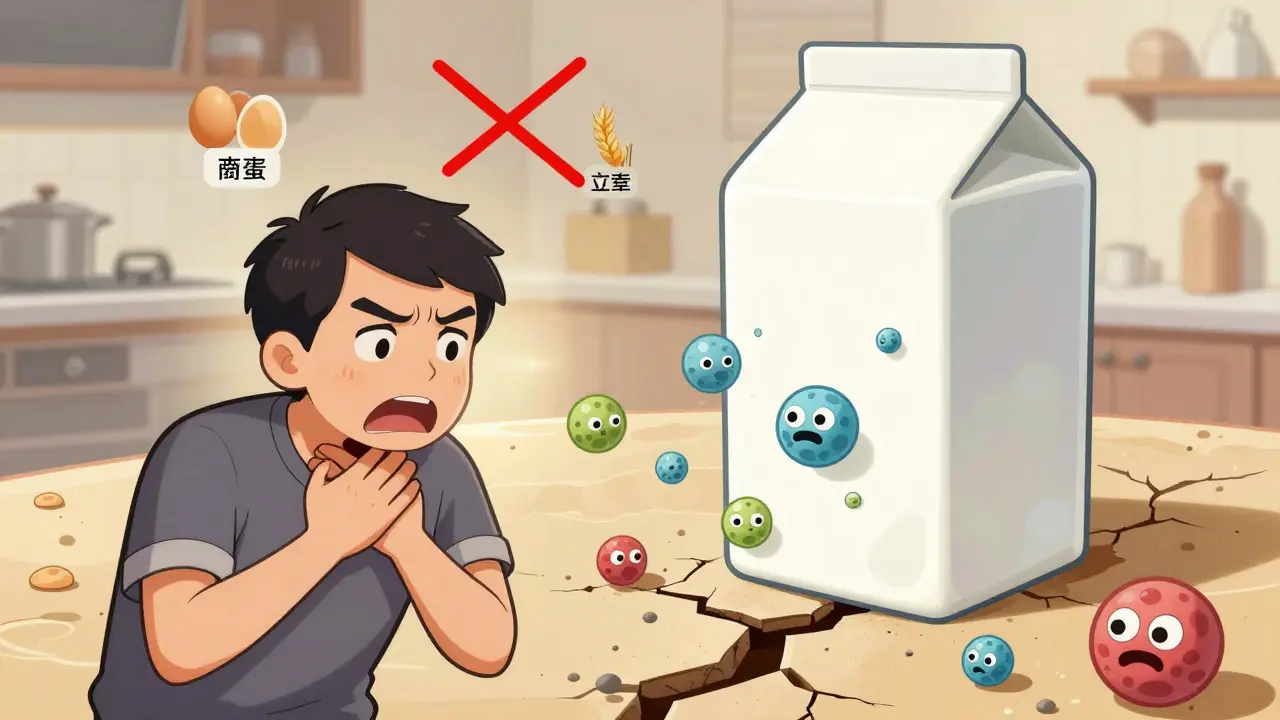
Swallowing a bite of bread used to feel like sandpaper scraping your throat. For people with eosinophilic esophagitis (EoE), that’s not just discomfort-it’s a daily reality. EoE is a chronic allergic condition where the esophagus becomes inflamed by too many eosinophils, a type of white blood cell that normally fights parasites but turns against food in this disease. It’s not heartburn. It’s not acid reflux. It’s an immune system misfire triggered by everyday foods, and it affects around 56.7 cases per 100,000 people in North America. The good news? We now know exactly what causes it and how to stop it.
What Foods Trigger Eosinophilic Esophagitis?
The biggest surprise in EoE research? Milk is the main villain. A landmark 2022 NIH-funded study showed that removing just dairy from the diet worked just as well as cutting out six major food groups. In adults, eliminating milk alone led to remission in 64% of cases-almost identical to the 65% success rate of the six-food elimination diet. That’s a game-changer. The six-food elimination diet traditionally removes milk, eggs, wheat, soy, fish/shellfish, and nuts. But now, doctors are starting with milk first.
Why milk? Because it’s the most common trigger across populations. Studies from Cincinnati Children’s Hospital and Northwestern University found that over 60% of EoE patients react to dairy proteins, even if allergy skin tests come back negative. That’s because EoE isn’t IgE-mediated like peanut allergies-it’s a delayed, T-cell-driven reaction. Skin prick tests only catch about 20-30% of triggers. Blood tests? Even worse. The only reliable way to find your trigger is to eliminate and then reintroduce foods one by one under medical supervision.
But geography matters. In Spain, soy and legumes show up as triggers in 35% of cases. In the U.S., they’re only responsible for 15%. That’s why blanket diets don’t always work. A 2023 study from Children’s Hospital Colorado found that children in different regions react to different foods. This isn’t one-size-fits-all. Your trigger might be eggs. Or wheat. Or maybe even apples. That’s why a personalized elimination plan, guided by a dietitian, is critical.
How Steroid Slurries Work
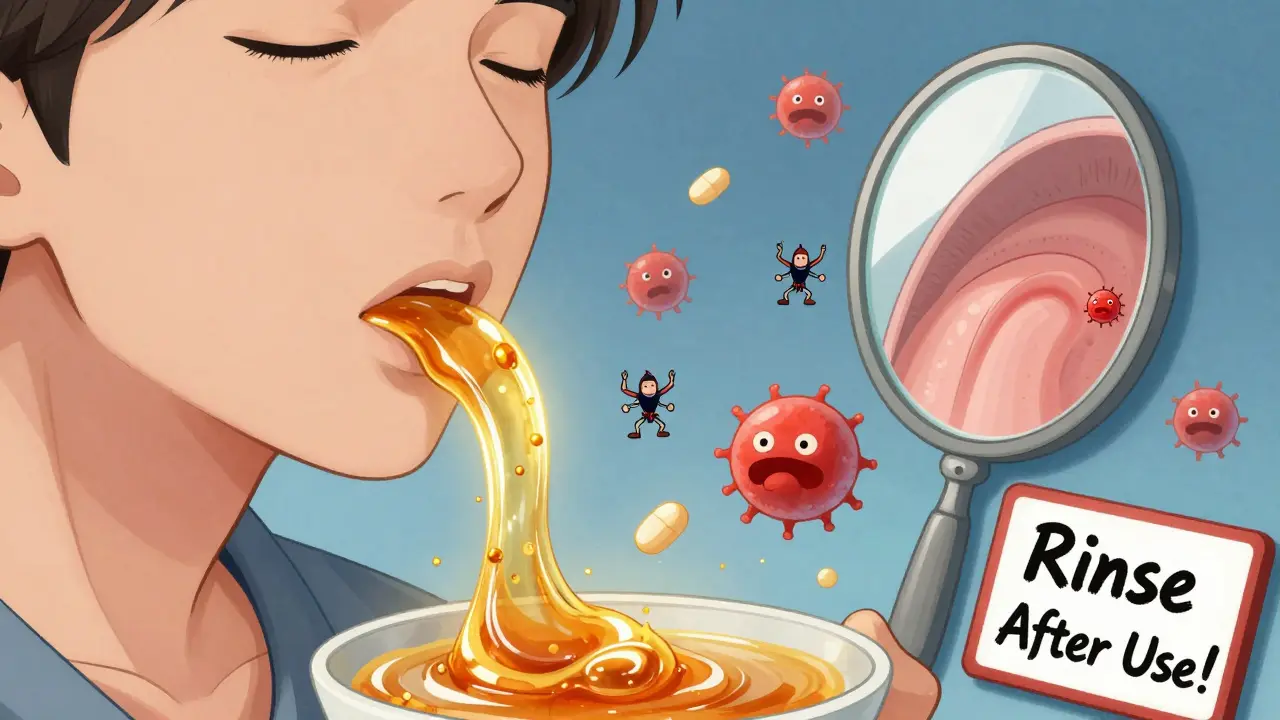
If diet feels overwhelming, steroid slurries offer a faster, more direct solution. These aren’t inhalers. They’re not swallowed like pills. A steroid slurry is a thick mixture of fluticasone or budesonide-two corticosteroids-mixed with honey, applesauce, or water, then swallowed slowly. The goal? Coat the esophagus, not the lungs. When you inhale these drugs for asthma, they land in your airways. But for EoE, you need them to stick to your esophagus.
Here’s how to do it right: Mix 220 mcg of fluticasone with 2-3 mL of water or honey. Swish it in your mouth for 30 seconds. Then swallow. Don’t drink water right after. Let it sit. Do this twice a day for 8-12 weeks. Budesonide oral suspension (Jorveza), approved by the FDA in January 2023, is now the first drug specifically made for EoE. In clinical trials, 64% of patients reached histological remission-meaning fewer than 15 eosinophils per high-power field under the microscope-with no systemic side effects.
Fluticasone is cheaper and widely available, but budesonide works faster. A 2022 patient survey found 73% of users saw symptom improvement within two weeks on budesonide, compared to 58% on fluticasone. But here’s the catch: 78% of patients say the slurry tastes awful. Honey helps, but it’s still not pleasant. And 15% develop oral thrush-a yeast infection in the mouth. That’s why rinsing your mouth after each dose is non-negotiable. Skip it, and you risk infection.
Diet vs. Steroids: What Works Better?
There’s no clear winner. It depends on your life, your body, and your goals.
Dietary elimination has no drug side effects. It can lead to lasting remission if you keep the trigger out. But it’s brutal. One Reddit user, SwallowWithCare, said eliminating dairy kept her from needing esophageal dilation for 14 months. Another, FoodFight2023, said the six-food diet ruined his social life-he tracked every meal for eight weeks, only to find soy was the problem. He almost quit.
Steroid slurries work faster. Most people feel better in 2-4 weeks. But they’re temporary. Stop the slurry, and symptoms often return. Plus, you’re still eating the trigger foods. That means inflammation can creep back. A 2022 survey showed 40% of patients relapse within six months of reintroducing foods-even if they felt fine.
Here’s the reality: For kids, diet is still the gold standard. Six-food elimination works in 75-80% of pediatric cases. For adults, many choose steroids first because they’re easier. But the most successful long-term outcomes come from combining both: use steroids to calm the inflammation quickly, then switch to diet to maintain it.
What No One Tells You About Treatment
Most people don’t realize EoE needs monitoring. You can’t just feel better and call it done. Remission is measured by a biopsy-fewer than 15 eosinophils per high-power field. If you skip this, you might think you’re fine, but damage is still happening. That’s why endoscopies are recommended every 3-6 months during treatment.
Nutrition is another silent risk. If you cut out dairy, you’re losing calcium and vitamin D. A 2022 study found 28% of dairy-free EoE patients had deficiencies. A dietitian isn’t optional-she’s essential. The American Partnership for Eosinophilic Disorders (APFED) offers consultations, and the Cincinnati Center’s Food Pantry gives free hypoallergenic meals to qualifying patients.
And then there’s the cost. An elemental diet-made of amino acids-works in over 90% of cases. But it costs $1,200-$1,800 a month. Most insurance won’t cover it. That’s why most people start with milk elimination or steroid slurries.
What’s Next for EoE Treatment?
The future is getting personal. Regeneron’s dupilumab (Dupixent), approved in May 2023, is a biologic that blocks the immune signals causing inflammation. In trials, 60% of adults reached remission after 24 weeks. It’s a shot, not a pill or a diet. And it’s changing the game for adults who can’t stick to elimination diets.
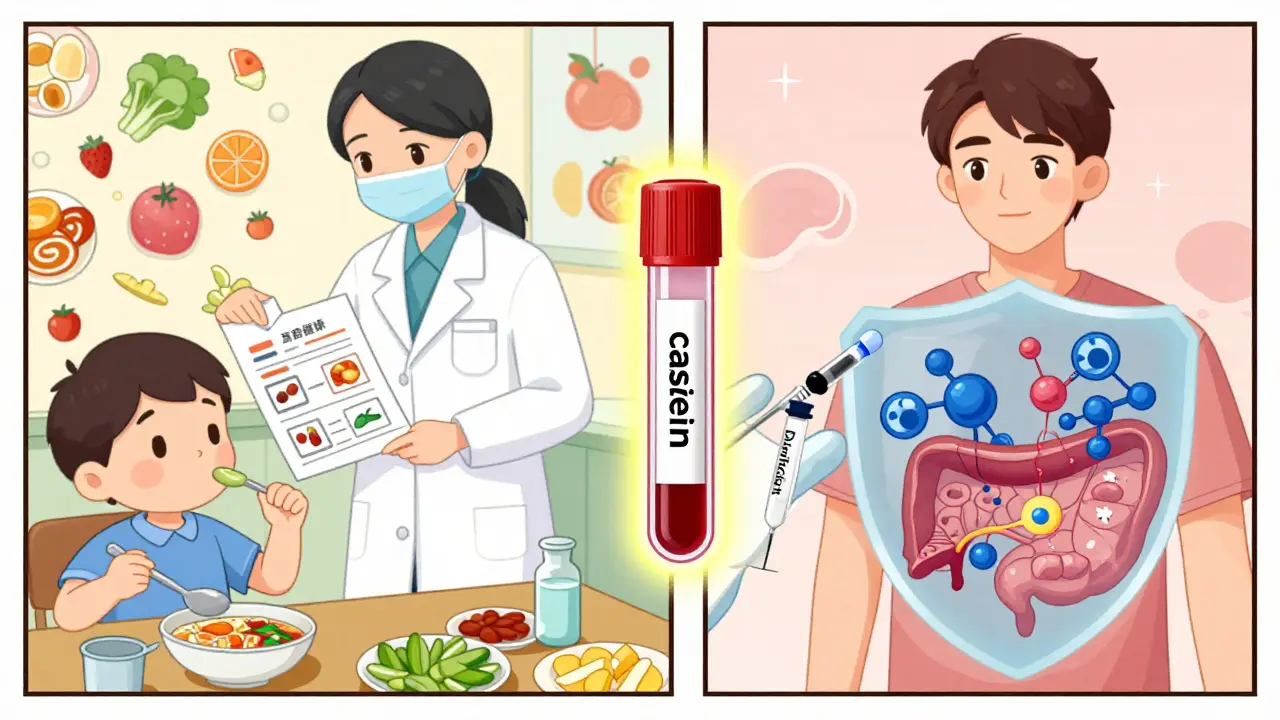
Researchers are now trying to predict triggers without elimination. The NIH’s CEGIR study is testing blood biomarkers to find exactly which food proteins trigger reactions. Imagine a simple blood test that says, “You react to casein in milk,” instead of cutting out everything for months.
Component-resolved diagnostics are also emerging. Instead of avoiding all nuts, you might only need to avoid almonds because of a specific protein. That’s huge. It means less fear, less restriction, and better quality of life.
But here’s the bottom line: You’re not alone. Over 160,000 people in the U.S. have EoE. And for every person who says, “I can’t do this,” there’s another who found freedom-by cutting out dairy, by using a slurry, by finding their trigger. It’s not easy. But it’s manageable. And it’s getting better every year.
Can EoE be cured?
EoE can’t be cured yet, but it can be controlled. With dietary changes or steroid treatment, most people achieve remission-meaning no symptoms and normal esophageal tissue. But if you stop treatment, symptoms usually return. Long-term management is key.
Do allergy tests help find EoE triggers?
Not reliably. Skin prick and blood tests for IgE allergies miss most EoE triggers because the reaction is T-cell-based, not IgE-based. Only 20-30% of triggers show up on these tests. The only proven method is elimination and reintroduction under medical supervision.
Is the steroid slurry safe for long-term use?
Topical steroids like fluticasone and budesonide are designed to act locally and have minimal absorption into the bloodstream. When used correctly-with proper rinsing after each dose-they’re safe for months. The biggest risk is oral thrush, which can be prevented with good hygiene. Long-term use beyond a year should be monitored by a specialist.
Can children outgrow EoE?
Some children do, but not most. Studies show that about 20-30% of pediatric patients may outgrow EoE by adolescence. For others, it becomes a lifelong condition. Early diagnosis and treatment improve outcomes. Diet and steroids are both effective in kids, but diet is preferred due to fewer side effects.
Why is milk the most common trigger?
Milk contains several proteins-casein, whey, alpha-lactalbumin-that are highly resistant to digestion. These proteins survive stomach acid and reach the esophagus intact, triggering an immune response in genetically prone individuals. It’s not the lactose-it’s the protein. That’s why lactose-free milk still causes reactions in many EoE patients.
What happens if I don’t treat EoE?
Untreated EoE leads to scarring, narrowing, and strictures in the esophagus. Over time, food can get stuck, requiring emergency dilation. Some patients develop food impaction, which is a medical emergency. Chronic inflammation can also increase the risk of esophageal dysfunction and reduced quality of life. Early treatment prevents these complications.




Just read this after my third endoscopy this year and honestly? I cried. Not because it hurt, but because someone finally explained why my throat feels like it’s full of ground glass after eating pizza. Milk was my trigger too. Took me 3 years to figure it out. Now I drink oat milk and feel like a human again. 🥹
My kid got diagnosed last year and we went full six-food elimination. It was brutal. We had to label every snack, avoid birthday cakes, and I swear I gained 10 pounds from stress-eating rice cakes. But seeing him eat a cheese stick without gagging? Worth every second. 🙌
Slurries taste like regret mixed with chalk. But hey, at least they don’t require me to give up my Sunday brunch. I do the fluticasone thing twice a day and rinse like my life depends on it. Thrush is no joke. Learned that the hard way.
LMAO at people still doing elimination diets like it's 2015. Dupilumab exists now. It's a shot. Once every two weeks. You don't have to become a food detective or swallow chalky sludge. If you're still eating applesauce with steroid paste, you're doing it wrong 😴
For anyone scared of steroids - they’re local. They don’t wreck your adrenals. I’ve been on budesonide for 18 months. My bone density is fine. My teeth are fine. I just rinse. It’s not magic, it’s medicine. Stop fearing the spray.
Oh so now milk’s the villain? Funny. In my house, it’s soy sauce. And gluten. And eggs. And honestly? I’m just done. I eat plain rice and boiled chicken. I don’t go out. I don’t date. I just survive. Congrats on your 64% remission rate. I’m in the 36%. 😑
My dietitian told me to try eliminating dairy first, like the article said. I thought she was crazy. But after two weeks? My throat stopped feeling like I’d swallowed a cactus. I didn’t even realize how much I was swallowing every bite until it stopped hurting. Small wins, folks.
It’s wild how we treat EoE like it’s a diet problem when it’s really a failure of our immune system to recognize food as harmless. We’re trying to outsmart evolution with elimination diets and slurry cocktails. Maybe one day we’ll just edit the T-cells. Until then… honey and fluticasone it is. 🤷♂️
If you’re still using fluticasone instead of Jorveza, you’re basically using a horse blanket to stop a hurricane. And if you think soy isn’t a trigger just because you’re American - geography doesn’t care about your assumptions. Educate yourself.
so i tried the slurry thing and it tasted like death and i forgot to rinse and got thrush and now im scared to even look at my inhaler
Of course milk is the trigger. Because everything is milk in America. In Japan, it’s rice. In India, it’s lentils. But no, let’s just blame dairy because it’s convenient. Also, Dupilumab costs $40k a year. Good luck with that, middle class.
Wait so if I eat dairy and don't have symptoms does that mean I'm not allergic? Or is it just that my esophagus is numb now? I'm confused. Also, can I eat yogurt? Is that different? What about butter? I need answers. I can't sleep.
I used to think this was just a fancy word for acid reflux. Then I had my first food impaction. ER. Scared the crap out of me. Now I carry a liquid diet in my bag. I’m 32. I shouldn’t have to do this. But I’m glad we’re finally talking about it.
My daughter’s EoE was diagnosed after she stopped eating solids at age 3. We did the six-food elimination. She cried every meal for months. But now she’s 8, eats chicken and rice like a champ, and doesn’t need steroids. I’m so proud of her. And so grateful for this community.
Just wanted to say thank you for writing this. I’ve been lurking on EoE forums for years. This is the first time I felt like someone actually understood. No jargon. No fear-mongering. Just facts. And honey. I’m gonna try the slurry tomorrow.