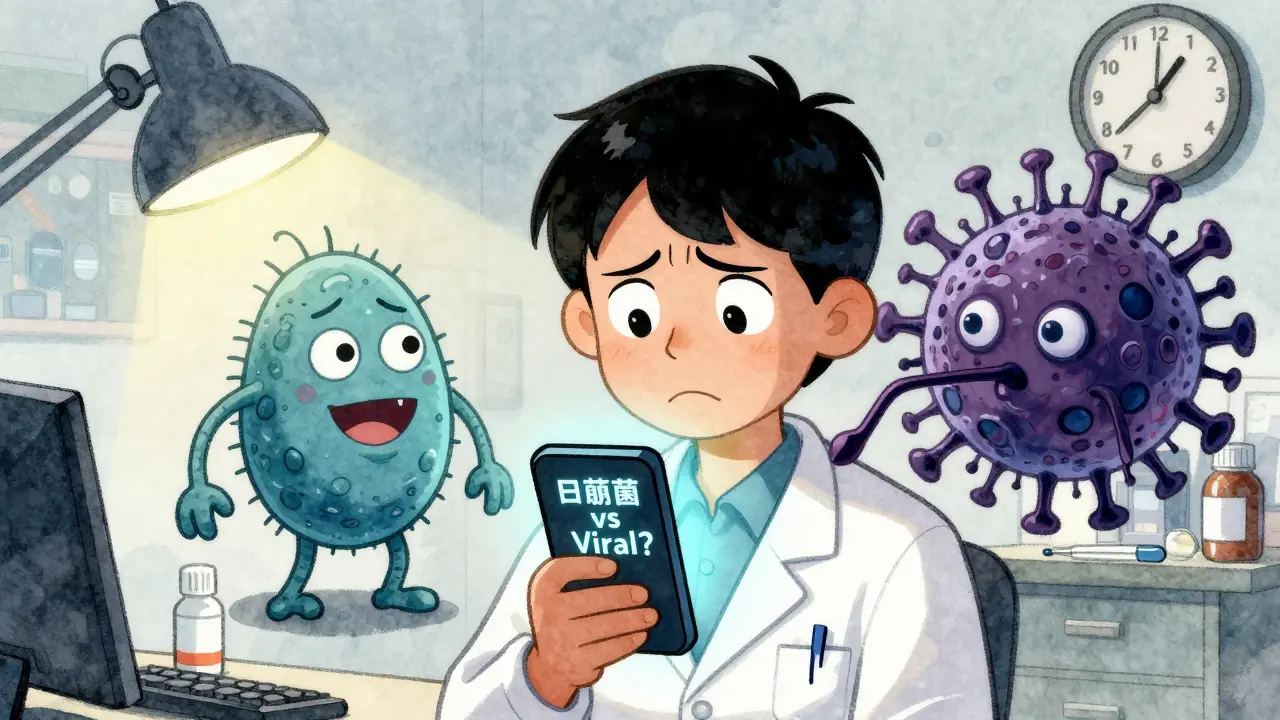
Why It Matters If Your Infection Is Bacterial or Viral
You wake up with a sore throat, fever, and body aches. You grab your phone and start searching: bacterial vs. viral infections. You’re not alone. Millions of people face this confusion every year. The problem? Treating them the wrong way doesn’t just waste time-it makes things worse.
Bacteria and viruses might both make you sick, but they’re completely different. One is a living cell that can survive on its own. The other is just genetic material wrapped in protein, and it can’t do anything without hijacking your body’s cells. This difference changes everything-how you get sick, how long you’re sick, and most importantly, how you get better.
Here’s the hard truth: if you take an antibiotic for a virus, you’re not helping yourself. You’re helping drug-resistant bacteria grow. The CDC says 47 million unnecessary antibiotic prescriptions are given each year in the U.S. alone-mostly for viral infections like colds and flu. That’s not just a mistake. It’s a public health crisis.
What Bacteria and Viruses Actually Are
Bacteria are single-celled organisms. They’re alive. They eat, they grow, they reproduce-often every 20 minutes. You carry trillions of them on your skin and inside your gut. Most are harmless. Some are helpful. A few, like the ones causing strep throat or tuberculosis, turn dangerous when they invade the wrong place.
Viruses aren’t alive in the way we think of life. They’re like tiny robots made of DNA or RNA, stuck inside a protein shell. They can’t do anything on their own. They need to break into your cells and force them to make copies of the virus. That’s how they spread. Once they’ve taken over, your immune system has to fight back-and sometimes, it overreacts, giving you fever, cough, and fatigue.
Size matters too. The smallest bacteria are about 200 nanometers wide. The biggest viruses are around 300 nanometers. That sounds tiny, but under a regular microscope, you can see bacteria. Viruses? You need an electron microscope to even spot them. That’s why doctors can’t just look at a sample and tell what’s causing your illness.
Common Infections: Bacterial vs. Viral
Not all infections are created equal. Here’s what you’re likely to run into:
- Bacterial: Strep throat (caused by group A streptococcus), urinary tract infections (UTIs), tuberculosis, whooping cough, and some types of pneumonia and sinus infections.
- Viral: Common cold (usually rhinovirus), flu (influenza), COVID-19 (SARS-CoV-2), chickenpox, measles, and most cases of bronchitis and ear infections.
Worldwide, strep throat affects over 600 million people each year. Tuberculosis still kills 1.3 million people annually. Meanwhile, seasonal flu hits 9 to 41 million Americans every year. And COVID-19 has claimed over 7 million lives since 2020.
Here’s the twist: viral infections often lead to bacterial ones. About half of hospitalized COVID-19 patients develop a secondary bacterial pneumonia. That’s why antibiotics are sometimes needed-even when the original illness was viral.
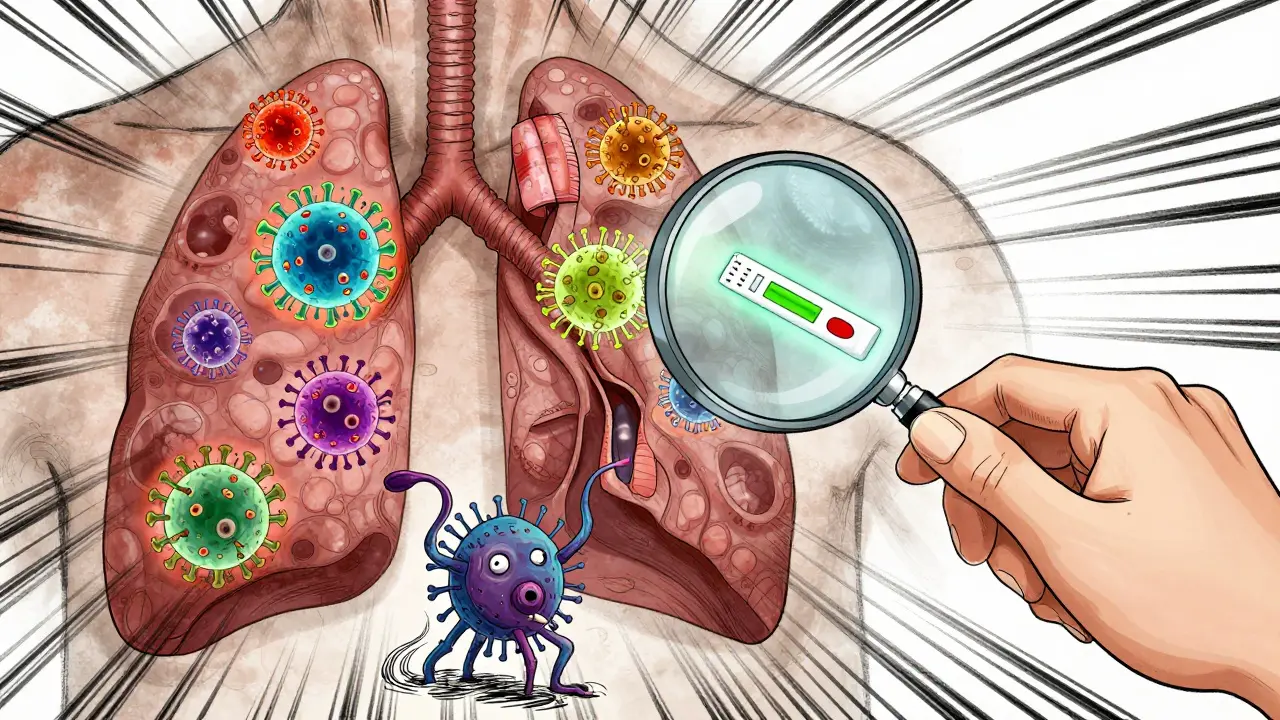
How Symptoms Differ (And How They Don’t)
Both can give you fever, cough, sore throat, and fatigue. That’s why so many people get confused. But there are patterns.
Bacterial infections often come with:
- Fever higher than 101°F (38.3°C)
- Symptoms that last more than 10-14 days
- A sudden worsening after initial improvement (like feeling better for a few days, then crashing again)
- Pus or thick, colored mucus (yellow or green) that doesn’t clear up
Viral infections usually mean:
- Fever under 100.4°F (38°C)
- Runny nose, sneezing, watery eyes
- Generalized body aches and tiredness
- Symptoms peak around day 3-5 and start fading by day 7
But here’s the catch: these aren’t foolproof. Some viral infections cause high fevers. Some bacterial ones start mild. That’s why doctors don’t guess. They test.
How Doctors Tell the Difference
There’s no magic sign. But there are tools.
For strep throat, a rapid antigen test gives results in 10 minutes with 95% accuracy. If it’s negative but the doctor still suspects strep, they’ll send a throat culture. That’s the gold standard-it’s 98% accurate but takes 24-48 hours.
For respiratory infections, a new test called FebriDx (approved by the FDA in 2020) checks two biomarkers: CRP (a sign of inflammation) and MxA (a protein your body makes only when fighting a virus). It’s 94% sensitive and 92% specific. That means it can tell if your infection is likely bacterial or viral in under 10 minutes.
PCR tests-used for flu and COVID-19-are highly accurate too. They detect viral genetic material. But they only work well if taken within the first 72 hours of symptoms.
Doctors also use tools like the Centor Criteria for sore throats: fever, swollen lymph nodes, tonsil exudate, no cough. Score 3 or higher? You’re 50-55% likely to have strep. That’s when testing makes sense.
Treatment: Antibiotics vs. Antivirals vs. Rest
This is where most people get it wrong.
Antibiotics kill bacteria. They work by attacking things bacteria have but your cells don’t-like their cell walls or protein-making machines. Penicillin, amoxicillin, azithromycin-they’re lifesavers for bacterial infections. But they do nothing to viruses. Taking them when you don’t need them? That’s how superbugs like MRSA and drug-resistant TB spread.
Antivirals are different. They don’t kill viruses. They slow them down. Oseltamivir (Tamiflu) for flu, acyclovir for chickenpox, remdesivir for severe COVID-19-they work best if taken within 48 hours of symptoms. After that, your immune system is already in full swing, and the virus has done most of its damage.
For most viral infections? There’s no magic pill. You need rest, fluids, and over-the-counter meds like acetaminophen or ibuprofen to manage fever and pain. That’s it. Your body does the rest.
And here’s the kicker: treating a viral infection with antibiotics doesn’t make you feel better faster. In fact, it might make you feel worse. Antibiotics can cause diarrhea, rashes, and even life-threatening infections like C. diff, which kills over 12,000 Americans every year.
Why Misuse of Antibiotics Is a Global Crisis
Every time you take an antibiotic you don’t need, you’re helping bacteria evolve. They learn to survive. They become resistant. And those superbugs don’t care if you’re a child, an elderly person, or someone in a hospital after surgery.
The WHO calls antimicrobial resistance one of the top 10 global health threats. In 2019, drug-resistant infections killed 1.27 million people worldwide. By 2050, that number could hit 10 million-more than cancer.
In the U.S., antibiotic-resistant bacteria cause 35,900 deaths each year. The economic cost? Over $1 billion just from unnecessary prescriptions. And that’s not even counting the lost workdays, ER visits, and long-term health damage.
It’s not just about you. It’s about your neighbor, your child’s teacher, the nurse treating you in the ER. When antibiotics stop working, routine surgeries become dangerous. A simple cut can turn deadly.
What You Can Do
You can’t always avoid getting sick. But you can avoid making it worse.
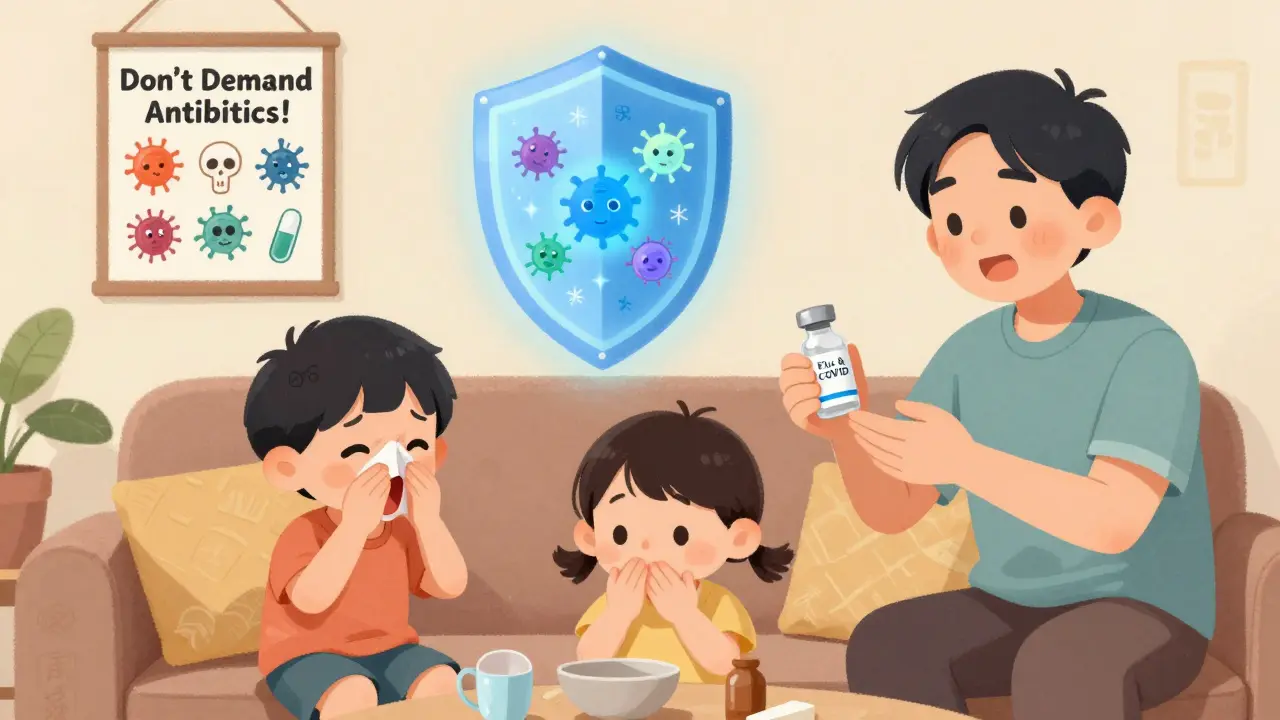
- Don’t demand antibiotics. Ask: “Is this bacterial or viral?”
- Get tested if symptoms last more than 10 days or get worse after improving.
- Get vaccinated. Flu shots, COVID boosters, pneumococcal vaccines-they prevent infections before they start.
- Wash your hands. Viruses spread through touch. Bacteria too.
- Stay home when you’re sick. You’re not just protecting yourself-you’re protecting others.
- Finish your antibiotics if they’re prescribed. Stopping early lets the toughest bacteria survive and multiply.
And if your child gets sick six times a year? That’s normal. Most are viral. They’re building immunity. Don’t rush to the doctor for every sniffle.
The Future: Better Tests, Better Treatments
Science is catching up. Researchers at the University of Queensland are testing new compounds (IMB-001 and IMB-002) that target bacterial surface proteins-ways to kill resistant strains without wiping out good bacteria.
Phage therapy-using viruses that infect only bacteria-is showing 85% success in European trials for hard-to-treat infections. It’s not mainstream yet, but it’s coming.
And scientists are working on universal coronavirus vaccines that could protect against future variants. That’s the real win: preventing pandemics before they start.
The bottom line? We have the tools. We just need to use them right. Knowing the difference between bacterial and viral infections isn’t just medical knowledge. It’s a public health responsibility.
Can a viral infection turn into a bacterial one?
Yes. Viral infections like the flu or COVID-19 can weaken your airways and immune defenses, making it easier for bacteria to move in. This is called a secondary bacterial infection. About half of hospitalized COVID-19 patients develop bacterial pneumonia. That’s why doctors sometimes add antibiotics after a few days-even if the original illness was viral.
Do I need antibiotics for a sinus infection?
Probably not. About 70% of sinus infections are viral and clear up on their own in 7-10 days. Antibiotics are only needed if symptoms last longer than 10 days, get worse after improving, or involve high fever and thick, colored mucus. Most cases respond to saline rinses, decongestants, and rest.
Why do doctors sometimes prescribe antibiotics for viral infections?
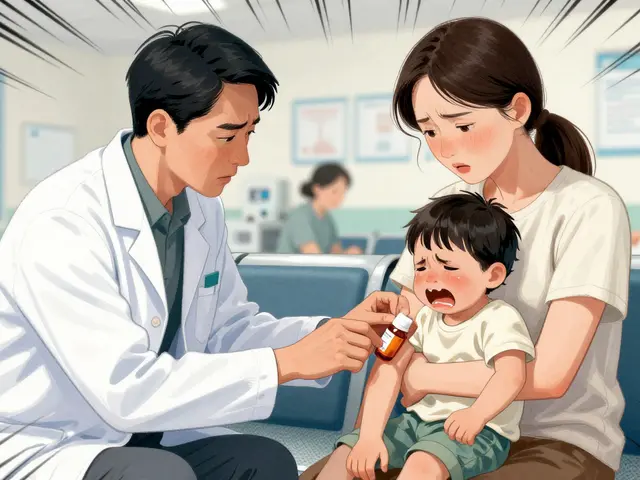
Sometimes, it’s pressure. Patients ask for them. Doctors want to please. But it’s not standard practice. The CDC and WHO strongly advise against it. Some doctors may prescribe them if they’re unsure and the patient is at high risk-like someone with a weakened immune system. But it’s not the norm, and guidelines are shifting toward testing before prescribing.
Can I take antiviral meds for any virus?
No. Antivirals are specific. Tamiflu works for influenza. Acyclovir helps with herpes and chickenpox. Remdesivir is for severe COVID-19. For the common cold, RSV, or most other viruses, there are no effective antivirals. Supportive care is the only option.
How long should I wait before seeing a doctor?
For most viral infections, wait 7-10 days. If symptoms are getting worse after day 5, or you have trouble breathing, high fever that won’t break, chest pain, or confusion, see a doctor right away. For children, infants under 3 months with fever, or anyone with chronic illness, don’t wait-get checked sooner.




Antibiotics for a cold? Bro, that's like using a chainsaw to cut a piece of paper. You're not helping, you're just making the next infection harder to kill.
so like... viruses are just like... ghost hackers right? they dont even exist as real things, just code that hacks your cells. kinda wild when you think about it.
In India we dont waste time with tests. If fever above 101 its bacteria. Take azithromycin. Done. Your western overtesting is just a scam to sell more labs
So let me get this straight... you're telling me the only thing that works for a cold is... sleeping? And not buying some magic pill? Mind blown.
My kid gets sick every 3 weeks and I used to panic. Now I just give him soup and let his body do the work. He's stronger now. No antibiotics needed.
I love how people act like antibiotics are candy. Meanwhile the superbugs are throwing a rave in your gut and you're the DJ. Nice job.
The whole bacterial vs viral thing is a capitalist construct. Nature doesn't care about your diagnostic categories. Your immune system knows better than any test
Please remember: if you're feeling sick, it's okay to rest. You don't have to power through. Your body is doing its best. Drink water. Sleep. Be kind to yourself. Seriously.
I work in a hospital. Saw a guy get C. diff from an antibiotic for a sinus infection that was clearly viral. He was in ICU for 3 weeks. This isn't theory. This is real life. Stop it.
i just want to say thank you for explaining this so clearly. my mom used to always demand antibiotics for every sniffle and now she gets confused when i say 'just rest'. it's hard to change habits but this helps
Oh wow. So the CDC is right? And the WHO? And science? What's next? Maybe the moon landing wasn't fake? This is too much to process. I need to sit down.
what about the ones where you dont know if its viral or bacterial like when you have a cough that lasts 3 weeks? do you just wait or go get tested
I used to think green snot meant bacteria but turns out its just your immune system throwing everything at the wall. Viral infections can do that too. Learned the hard way.
I used to be that guy who demanded antibiotics. Then I got sick after taking them for a virus and ended up with a 6-month stomach nightmare. Never again. Sometimes the best medicine is doing nothing.