Antihistamine Comparison Tool
Find the Right Antihistamine for Your Hives
Compare effectiveness, drowsiness risk, and onset time for common antihistamines to help you choose the best option for your needs.
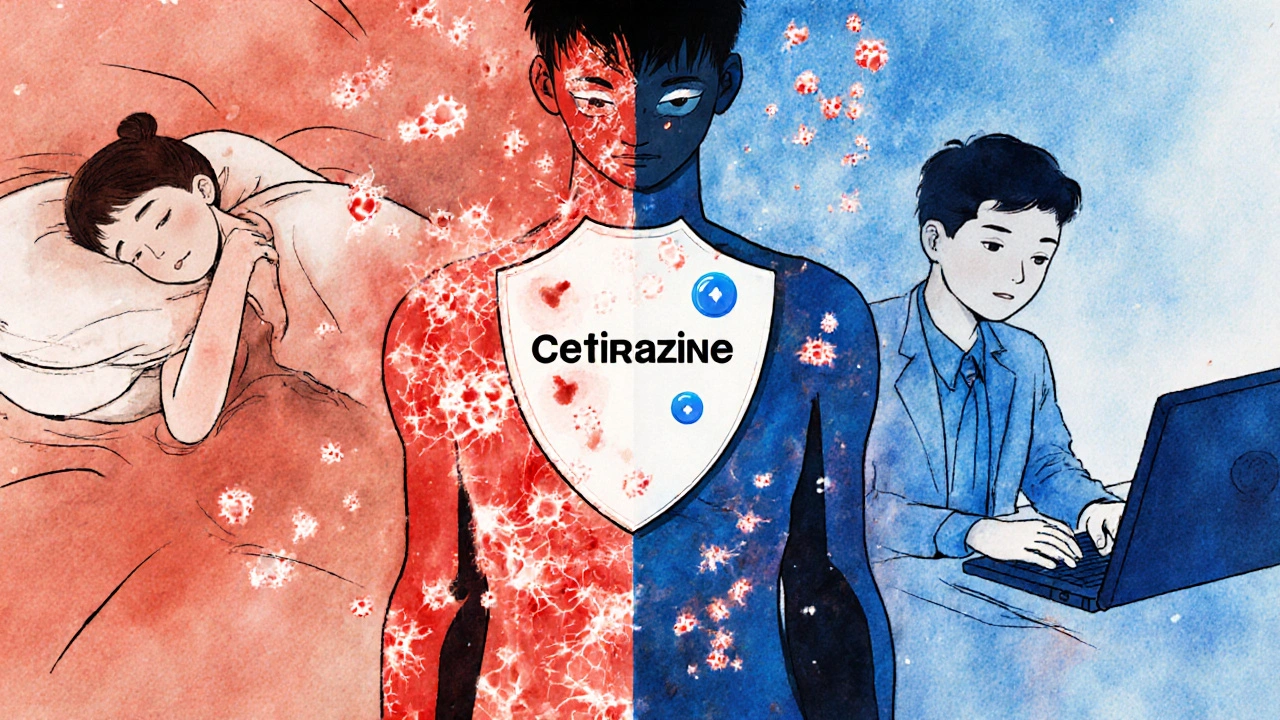
Cetirizine (Zyrtec)
Starts working quickly but has highest drowsiness risk among second-generation options.
Loratadine (Claritin)
Mild drowsiness risk, but less effective for severe itching than other options.
Fexofenadine (Allegra)
Best for cognitive clarity with lowest drowsiness risk of the three.
Key Differences Summary
| Cetirizine | Loratadine | Fexofenadine | |
|---|---|---|---|
| Effectiveness | 78% | 65% | 72% |
| Drowsiness Risk | 38% | 10% | 8% |
| Onset Time | 1 hour | 1.3 hours | 2.6 hours |
| Best For | Rapid relief | Cost-effectiveness | Cognitive clarity |
When to Talk to Your Doctor
If antihistamines aren't working
If standard dose doesn't control symptoms after 2 weeks, discuss increasing to 2-4x the dose under medical supervision.
If you experience drowsiness
Consider switching to fexofenadine or discussing alternative options with your doctor.
For chronic hives
If you've tried high-dose antihistamines without relief, ask about specialist referrals and next steps.
Remember:
Always consult your doctor before changing your medication. This tool provides general information based on clinical studies.
Why antihistamines are the first line of defense for hives
Hives-those red, itchy, raised welts on your skin-don’t just appear out of nowhere. They’re your body’s reaction to histamine, a chemical released by mast cells when it thinks it’s under attack. This could be from food, stress, heat, medications, or even nothing obvious at all. The goal isn’t to find the trigger every time. It’s to stop the itching and swelling fast. That’s where antihistamines come in.
They work by blocking H1 receptors, the spots on your cells where histamine locks in to cause the reaction. First-generation antihistamines like diphenhydramine (Benadryl) were the go-to for decades. But they cross into your brain, making you sleepy, foggy, or unsteady. That’s why doctors now start with second-generation options: cetirizine (Zyrtec), loratadine (Claritin), and fexofenadine (Allegra). These were designed to stay out of your brain, so they work without knocking you out.
How drowsiness really works with antihistamines
Not all antihistamines are equal when it comes to sleepiness. A 2021 review in the Journal of Allergy and Clinical Immunology found that about half of people taking diphenhydramine feel drowsy. That’s why you see warnings on the bottle: "May cause drowsiness. Do not operate machinery."
Second-generation drugs are better, but not perfect. Cetirizine still causes drowsiness in 10-15% of users. Fexofenadine? Only about 8%. Why? It’s all about molecular design. Fexofenadine is bulkier and can’t slip through the blood-brain barrier as easily. Cetirizine is smaller and slips through a bit more-hence why some people feel tired even on "non-drowsy" labels.
One study using driving simulators showed that 15% of people on cetirizine had impaired reaction times. That’s less than half the rate of diphenhydramine users, but still enough to matter if you drive for a living or operate heavy equipment. If you notice yourself zoning out after your morning pill, switch to fexofenadine. It’s not magic, but it’s often the least sedating option.
Which antihistamine works best for hives?
There’s no single "best" antihistamine for everyone. But science gives us clear winners based on effectiveness and side effects.
- Cetirizine (Zyrtec): Starts working in about an hour. In a 2021 trial with 342 chronic hives patients, it reduced itching by 78%-better than loratadine’s 65%. But 38% of users report drowsiness.
- Loratadine (Claritin): Takes a little longer to kick in-around 1.3 hours. Less effective than cetirizine for severe itching, but cheaper and widely available as a generic. Drowsiness rate: 10%.
- Fexofenadine (Allegra): Slowest to absorb (2.6 hours), but best for cognitive clarity. Only 22% of users report drowsiness. Ideal for people who need to stay sharp-students, drivers, office workers.
Most guidelines, including those from the European Academy of Allergy and Clinical Immunology, say start with one of these three. Don’t rotate them randomly. Pick one and stick with it for at least two weeks before deciding if it’s working.

What if your antihistamine stops working?
Here’s the hard truth: for about 57% of people with chronic hives, standard doses don’t fully control symptoms. That’s not your fault. It’s biology.
When that happens, the next step isn’t switching brands. It’s increasing the dose. The 2023 International Consensus Guidelines say it’s safe to go up to four times the standard dose. That means 40mg of cetirizine a day, or 60mg of loratadine. Studies show this boosts control rates from 43% to 70%.
Many patients don’t know this is an option. They stop taking it because "it’s not working," not realizing they need more, not different. If you’ve been on 10mg of cetirizine for a month and still have hives, talk to your doctor about doubling or quadrupling the dose. Don’t just up it yourself-get medical supervision. High doses carry a small risk of heart rhythm changes, but that’s rare (under 0.2% of cases) and easily monitored.
When antihistamines aren’t enough: what comes next
Even at four times the dose, about 30% of people still get hives. That’s when you move beyond antihistamines.
The most effective next step is omalizumab (Xolair). It’s a monthly injection that targets the immune system’s IgE antibodies, which trigger mast cells to release histamine. In clinical trials, it cleared hives completely in 58% of patients who didn’t respond to high-dose antihistamines. The catch? It costs around $3,200 per shot. Insurance often covers it if you’ve tried antihistamines first, but out-of-pocket, it’s not affordable for most.
Another option is cyclosporine, an immune-suppressing drug used for psoriasis and organ transplants. It works in about 65% of refractory hives cases. But it can damage your kidneys over time. Doctors only use it for short bursts-usually 3 to 6 months-and monitor blood work closely.
There’s a new drug on the horizon: ligelizumab. Approved for breakthrough therapy by the FDA in March 2023, it showed a 51% complete response rate in phase 2 trials-better than omalizumab’s 26%. Phase 3 trials are wrapping up in mid-2025. If approved, it could become the new gold standard for treatment-resistant hives.
How to track your hives and find triggers
Antihistamines mask symptoms. They don’t fix the root cause. That’s why tracking matters.
Use a simple daily log: note when hives appear, how bad they are (scale of 1-10), and what happened before: did you eat something new? Were you stressed? Did you take a hot shower? Exercise? Take NSAIDs like ibuprofen?
Studies show that 32% of chronic hives patients find NSAIDs trigger flares. Stress? 28%. Heat? 24%. One patient on Reddit tracked her hives for six months and realized they always flared after eating strawberries. She cut them out-and hasn’t had a flare since.
Apps like Hive Wise help automate this. They let you log symptoms, set pill reminders, and spot patterns. People who track their hives are 78% more likely to identify triggers and reduce flare frequency.

What to do if you’re still struggling
If you’ve tried standard doses, escalated to four times the dose, and still have daily hives, you need more than a pharmacy visit.
See an allergist or dermatologist who specializes in urticaria. Most primary care doctors aren’t trained to manage refractory cases. Only 32% feel confident handling them, according to a 2023 survey. That’s why 68% of patients with persistent hives are referred to specialists.
Specialists can check for underlying conditions. People with autoimmune thyroid disease (like Hashimoto’s) are 3.2 times more likely to have treatment-resistant hives. Blood tests for thyroid antibodies or high-sensitivity CRP (hs-CRP) can point to immune-driven causes that need different treatment.
Don’t wait until you’re desperate. If you’ve been on antihistamines for more than two months without relief, it’s time to ask: "What’s next?"
Real people, real results
On Reddit’s r/urticaria, a member named "ChronicHivesSufferer" wrote: "Zyrtec worked perfectly for 3 months, then I needed 20mg daily. Now even 40mg doesn’t touch my symptoms." That’s not uncommon. But the same thread had another user: "I switched from cetirizine to fexofenadine and stopped feeling foggy. My hives didn’t get worse-I just stopped being tired all day."
Another patient on Healthline’s survey said: "I took loratadine for a year. Nothing changed. Then my doctor upped me to 60mg. Within two weeks, I was 90% clear. I didn’t know you could do that."
These aren’t outliers. They’re the rule. Antihistamines work-but only if you use them right.
Bottom line: what to do today
- If you have hives, start with a second-generation antihistamine-cetirizine, loratadine, or fexofenadine.
- Take it daily, not just when you feel itchy. Scheduled dosing works better.
- If it doesn’t help after two weeks, double or quadruple the dose under medical supervision.
- If you’re still not better, track your symptoms and triggers. Use an app or a notebook.
- If you’re on high doses and still struggling, ask for a referral to a specialist.
- Don’t accept daily hives as normal. There are options beyond pills.
Hives are frustrating. But they’re not untreatable. You just need to know the steps-and when to ask for help.







I took Zyrtec for months until I realized I was just sleeping through my hives. Switched to fexofenadine and suddenly I could function. No more brain fog. No more 3 p.m. crashes. Why do doctors not tell you this? I had to learn it from Reddit.
I started tracking my hives with Hive Wise after reading this. Turned out my flare-ups always happened after coffee and stress. Cut out both. No more daily outbreaks. It’s not magic-it’s data. You guys need to log your triggers. It changes everything.
Let me tell you something they don’t want you to know. The pharmaceutical industry doesn’t want you to know you can quadruple your dose. They make billions off people cycling through brands. They profit from your confusion. They design the labels to scare you. They don’t want you to know that 40mg of cetirizine is safer than your daily aspirin. The FDA is in bed with Big Pharma. Wake up. This isn’t medicine-it’s control.
I’m a paramedic and I’ve seen people show up with full-body hives after a single Benadryl because they thought it’d be ‘stronger.’ It’s wild. The real hero here is fexofenadine. No drowsiness, no crashes, just quiet relief. I tell every patient with chronic hives: start with this one. Save your brain for the important stuff.
The dose escalation thing is legit. I was on 10mg cetirizine for a year. Nothing. Then my allergist said, 'Try 40mg.' Two weeks later, I was 90% clear. I didn’t know that was allowed. I thought I was just 'bad at antihistamines.' Turns out I just needed more of the right one. So many people give up too early.
I’m so glad someone finally said this. I’ve been on 40mg of Zyrtec for six months. My doctor said it was 'off-label'-but it’s in the guidelines! I’ve had zero hives since. Don’t let anyone make you feel weird for taking more. Your body isn’t broken. The dosage was just too low.
Oh wow. So the solution to my hives is… not quitting my job? Not moving to a cabin in the woods? Not switching to a raw vegan diet? Just take more pills? Shocking. Who knew the answer was in the fine print and not in a 12-step program for 'healing your emotional trauma'?
OMG I’m crying 😭 I’ve been on 20mg Zyrtec for 14 months and felt like a zombie. Switched to Allegra yesterday. No fog. No exhaustion. Just… me. And I’m not even joking-I cried in the pharmacy. This article saved my life. Thank you. 🙏
Start with second-generation. Take daily. Increase dose if needed. See specialist. Track triggers. That’s it.
Hives are not just a physical thing. They’re a mirror. They show you where your body is screaming for balance. Maybe it’s stress. Maybe it’s inflammation from processed food. Maybe it’s your soul asking you to slow down. The antihistamines quiet the noise-but the real healing is listening to what the noise meant.
I used to think fexofenadine was just 'the expensive one.' Then I tried it after 3 months of being wiped out by Zyrtec. I swear, I felt like I’d been asleep and just woke up. Like someone turned the brightness back on. Why isn’t this the first-line recommendation everywhere?
Wait so you’re telling me I don’t need to stop eating gluten or do a juice cleanse? I just need to take more pills? I’m confused now. My aunt said hives are from toxins. What’s real?
They’re lying. Omalizumab is $3,200? That’s a scam. It’s a $2 pill they turned into a luxury product. The real cure is banned because it’s cheap. I’ve seen it. I’ve read the papers. They bury the truth. You’re being sold a system that keeps you dependent. Wake up.
I’ve been on 40mg of Zyrtec for 8 months. My hives are gone. I still get the occasional itch, but it’s manageable. I didn’t know it was safe to go that high. My doctor was surprised I’d even heard of it. You’re not alone if you’ve been struggling. Just keep pushing. There’s a solution.