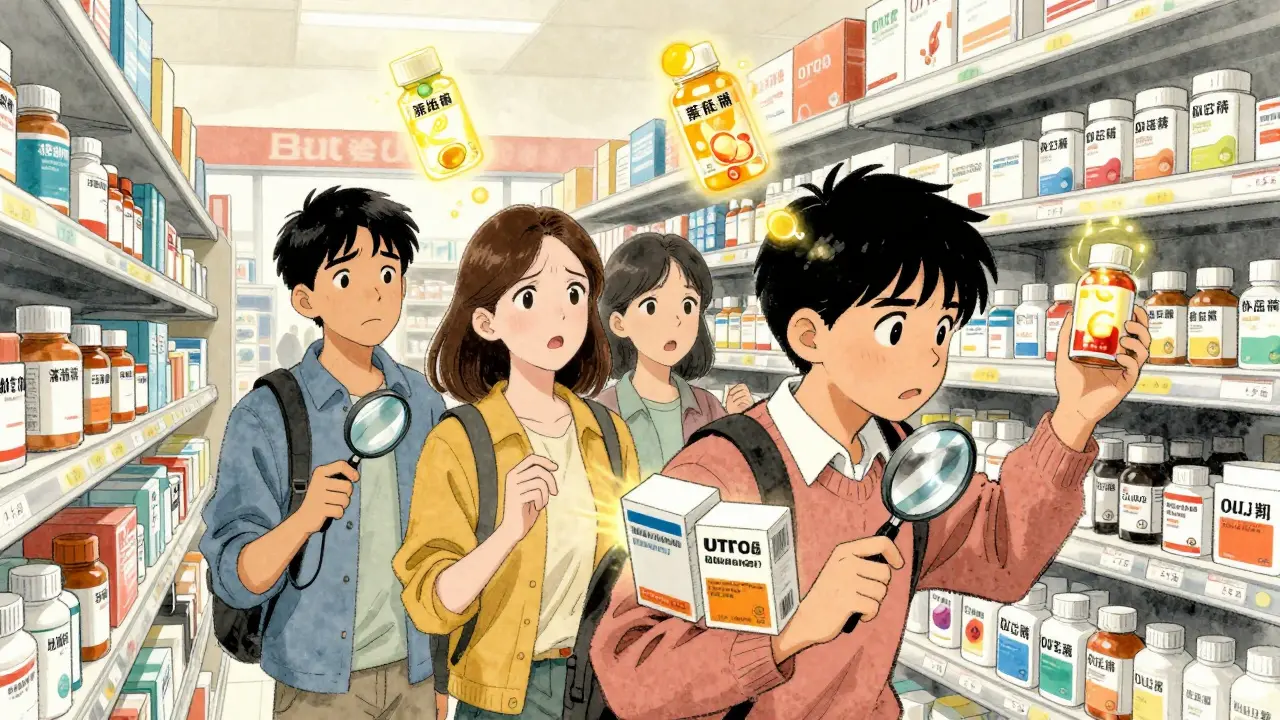
Every time you grab a bottle of pain reliever, cold medicine, or allergy pill from the shelf, you’re making a decision based on a label you probably don’t fully understand. You see "Tylenol," "Advil," or "DayQuil"-but what’s actually inside? The truth is, those brand names don’t tell you the whole story. What matters most are the active ingredients-the chemicals that do the real work in your body. And if you don’t know what they are, you could be putting yourself at risk.
What Exactly Is an Active Ingredient?
An active ingredient is the part of a medicine that causes the effect you want. It’s not the flavor, the color, or the shape of the pill. It’s the chemical that reduces fever, blocks allergies, or eases pain. For example, when you take Tylenol, the active ingredient is acetaminophen. When you take Advil, it’s ibuprofen. These names don’t change based on the brand. That’s why two completely different-looking bottles can contain the exact same medicine inside. The U.S. Food and Drug Administration (FDA) made this clear in 1999 by creating the Drug Facts label. Before that, labels were confusing. A 1995 study found that 78% of shoppers couldn’t find the active ingredient on the label. So the FDA stepped in. Now, every OTC medicine sold in the U.S. must have a standardized label with seven sections. The first one? Active Ingredients. And it’s not optional. Every bottle, box, or packet must list the name and exact amount per dose. No guesswork. No hidden terms.How to Read the Drug Facts Label
The Drug Facts label isn’t just there for show. It’s your safety tool. Here’s how to use it:- Find the "Active Ingredient" section. It’s always at the top. If you can’t find it, the label isn’t FDA-compliant.
- Look for the name and amount. It will say something like "acetaminophen 500 mg" or "ibuprofen 200 mg." The number is the exact dose per tablet, capsule, or teaspoon.
- Check if you’re already taking it elsewhere. This is where most mistakes happen. Cold medicines, sleep aids, and even some prescription drugs often contain the same active ingredient as your pain reliever.
- Compare doses. If you’re taking two products, add up the total daily amount. Don’t just look at one bottle.
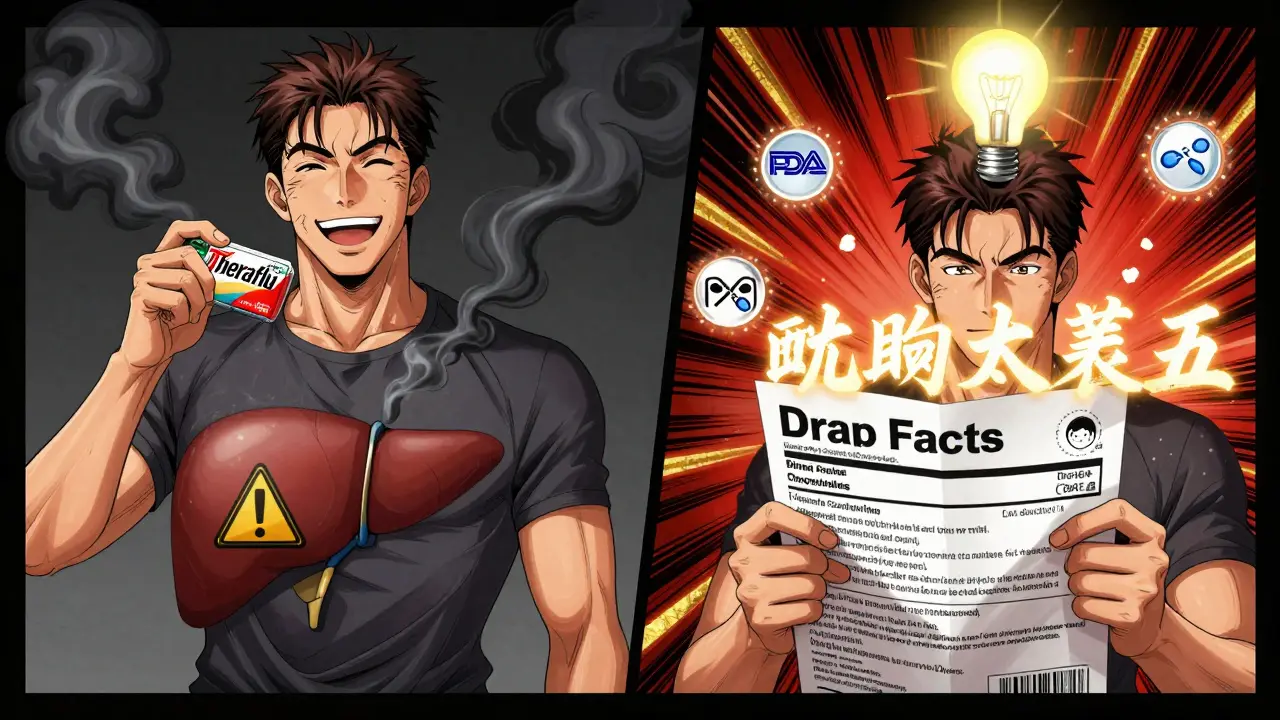
For example, if you take one Tylenol (500 mg acetaminophen) and then a bottle of TheraFlu Nighttime (650 mg acetaminophen per dose), you’ve already hit 1,150 mg before bed. The maximum safe daily dose for adults is 4,000 mg-but if you’re also drinking alcohol, taking other meds, or have liver issues, even 3,000 mg can be dangerous. That’s why emergency rooms see so many cases of accidental acetaminophen overdose. One Reddit user shared that they ended up in the ER after combining Tylenol with a nighttime cold medicine. They didn’t realize both had the same active ingredient.
The Big Five: Most Common OTC Active Ingredients
You don’t need to memorize all 800+ active ingredients on the market. But you should know the top five that make up nearly 75% of all OTC sales:- Acetaminophen (Tylenol, Excedrin, TheraFlu): Pain and fever reducer. Found in over 600 products. Maximum daily dose: 4,000 mg for adults.
- Ibuprofen (Advil, Motrin, Nuprin): Anti-inflammatory. Reduces pain, fever, and swelling. Maximum daily dose: 1,200 mg for OTC use.
- Diphenhydramine (Benadryl, Tylenol PM, ZzzQuil): Antihistamine. Causes drowsiness. Used for allergies and sleep. Maximum dose: 50 mg per dose for adults.
- Pseudoephedrine (Sudafed): Decongestant. Shrinks swollen nasal passages. Sold behind the counter due to misuse potential.
- Loperamide (Imodium): Anti-diarrheal. Often mistaken as harmless. But it’s an opioid-and abuse can cause heart problems or death.
Here’s the catch: OTC versions have lower doses than prescription ones. Prescription ibuprofen can be 800 mg per tablet. OTC? 200 mg. That’s why people think they can take more. But more doesn’t mean better. It means riskier.
Why Brand Names Trick You
You’ve probably seen this: "Aleve" on one shelf, "Naproxen Sodium" on another. Same thing. "Claritin" and "Loratadine"? Same. The brand name is marketing. The generic name is the science. A 2023 Consumer Reports survey found that only 28% of people knew that Aleve contains naproxen sodium. But 72% knew Tylenol has acetaminophen. Why? Because Tylenol is so common. But that’s not enough. If you’re allergic to red dye #40 and take Children’s Motrin because it’s "all-natural," you could end up with hives-because the inactive ingredients aren’t always obvious. That’s why you have to read the whole label.Combination Products: The Hidden Danger
Multi-symptom cold and flu products are the most dangerous. They combine three, four, even five active ingredients in one pill. One tablet might say: "acetaminophen 325 mg, dextromethorphan 15 mg, phenylephrine 5 mg." That’s pain relief, cough suppression, and a decongestant-all in one. If you already took acetaminophen for a headache, and then you take this cold medicine, you’re doubling up. And dextromethorphan? It’s a cough suppressant, but it’s also abused as a recreational drug. Phenylephrine? It can raise your blood pressure. If you’re on heart medication, that’s a problem. A 2022 Amazon review analysis showed that nearly 19% of reviews for multi-symptom cold medicines mentioned people didn’t realize they contained ingredients that conflicted with their prescriptions. One user wrote: "I took this because I thought it was just for cough. Didn’t see phenylephrine on the front. My BP spiked after one dose."What’s New in 2026?
The rules are changing. The CARES Act of 2020 forced the FDA to turn the OTC monograph system from a slow bureaucratic process into a legal one. By December 2023, every active ingredient had to be officially approved or removed. Now, in 2026, the next step is digital labels. The FDA is pushing for QR codes on every OTC package. Scan it, and you’ll see the full ingredient list, including inactive ones, with allergen warnings. Pilot tests showed a 47% improvement in understanding among people with low health literacy. By 2026, all new products will need them. Meanwhile, a $4.2 million public education campaign called "Know Your Active Ingredients" has already cut acetaminophen-related ER visits by 19% in stores that use the materials. The message is simple: Don’t guess. Check.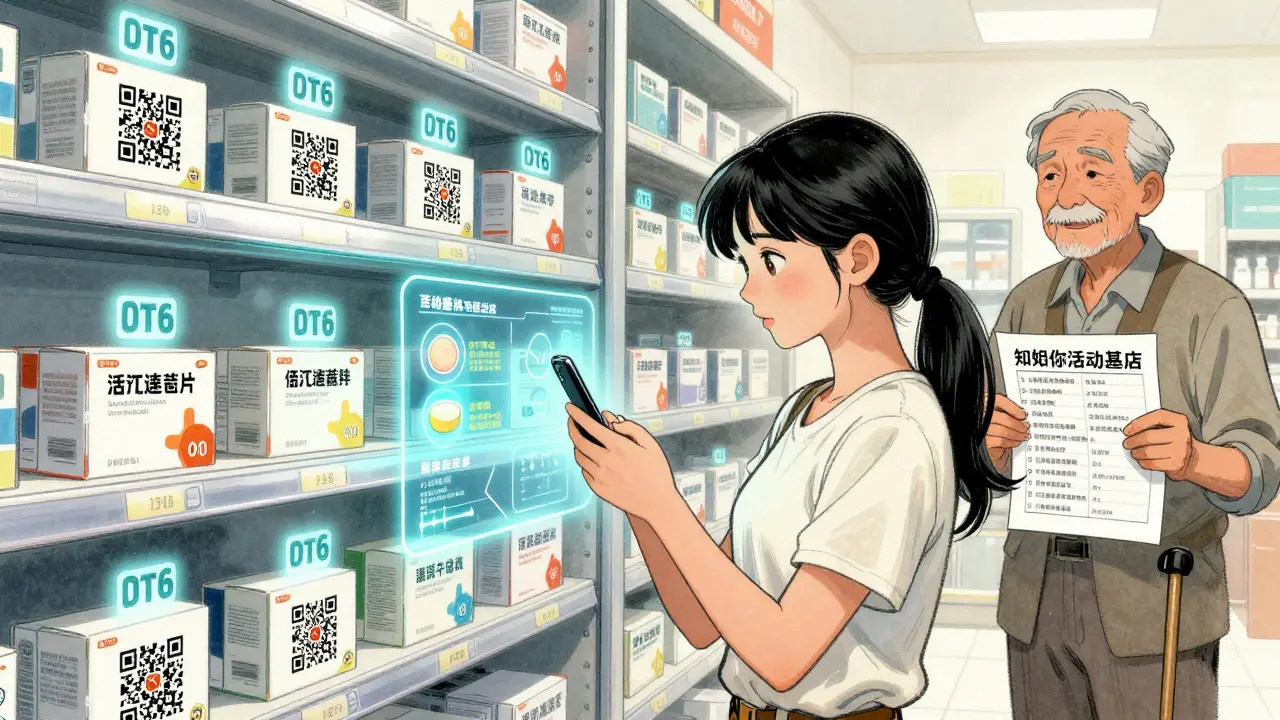
What You Should Do Today
You don’t need to be a pharmacist to stay safe. Here’s your quick action plan:- Always check the "Active Ingredient" line before buying anything.
- Write down the active ingredient and dose if you’re taking more than one OTC product.
- Never mix acetaminophen with alcohol or liver-affecting drugs.
- If you’re on blood pressure meds, avoid pseudoephedrine and phenylephrine.
- For kids, always check the dose per teaspoon or milliliter-children’s formulas are not just "smaller" versions. They often use different active ingredients entirely.
The FDA’s "Medicines in My Home" program offers a free printable chart listing the 35 most common active ingredients, their uses, and max daily doses. Download it. Tape it to your fridge. Use it every time you buy medicine.
When in Doubt, Ask
Pharmacists are trained to catch these mistakes. If you’re unsure whether two products clash, ask. It’s free. It’s fast. And it could save your liver-or your life.OTC doesn’t mean "risk-free." It means "available without a prescription." That’s it. You’re still using medicine. And medicine, even over-the-counter, can hurt you if you don’t know what you’re taking.
What’s the difference between active and inactive ingredients?
Active ingredients are the chemicals that produce the medical effect-like acetaminophen for pain or loratadine for allergies. Inactive ingredients are everything else: fillers, dyes, flavors, preservatives. They don’t treat anything, but they can cause allergic reactions. If you’re sensitive to red dye #40 or corn starch, you need to check the "Inactive Ingredients" section on the label.
Can I take two OTC medicines with the same active ingredient?
No. Taking two products with the same active ingredient can lead to overdose. For example, if you take Tylenol (acetaminophen) and then a cold medicine that also contains acetaminophen, you could easily hit 4,000 mg in one day-the maximum safe limit. That’s enough to cause liver damage. Always check the active ingredient list before combining anything.
Why does my ibuprofen say "200 mg" but my prescription says "400 mg"?
OTC ibuprofen is limited to 200 mg per tablet because higher doses increase the risk of stomach bleeding and kidney damage without clear added benefit for most people. Prescription versions are stronger because doctors monitor usage and can adjust for specific conditions like arthritis. OTC is for short-term, mild pain. Prescription is for ongoing, moderate-to-severe pain under medical supervision.
Is it safe to give my child adult OTC medicine if I cut the dose?
Never. Children’s medicines are formulated differently. The active ingredient may be the same, but the concentration, flavoring, and inactive ingredients are designed for kids. Giving an adult tablet-even cut in half-can lead to wrong dosing, choking hazards, or exposure to unsafe fillers. Always use a product labeled for children and follow the weight-based dosing chart on the label.
What should I do if I think I’ve taken too much acetaminophen?
Call poison control immediately at 1-800-222-1222 or go to the nearest emergency room. Acetaminophen overdose doesn’t always cause symptoms right away. Liver damage can start within hours, but signs like nausea or fatigue might not show up for a day. The antidote, N-acetylcysteine, works best if given within 8 hours. Don’t wait.


So many people just grab whatever's on sale without reading the label. I learned the hard way after mixing Tylenol with a cold med and ending up with a weird nausea that lasted days. Now I always check the active ingredient first. It's not glamorous, but it's how you stay safe.
Also, that FDA Drug Facts label? Thank you. It's the one thing that actually makes sense in a sea of marketing nonsense.
bro why are we even talking about this like it’s a revelation? everyone knows acetaminophen is in everything. the real issue is that big pharma wants you to buy 5 different brands so they can charge you 5x the price. it’s a scam. and now they’re putting qr codes on bottles like we’re all gonna scan them like it’s a tiktok trend. lol. wake up people.
also dextromethorphan is basically robitussin but they call it ‘cough suppressant’ so you don’t realize you’re basically taking a cheap high. #pharmabrainwash
The FDA’s Drug Facts label is one of the few regulatory wins in consumer health. Before 1999, labels were deliberately confusing. The fact that active ingredients are now required to be listed first, in plain language, with exact dosages, is a public health victory. No hype. No fluff. Just facts. And yet, most people still ignore it. The problem isn’t the label-it’s the consumer’s attention span.
QR codes? LOL. You really think the FDA cares about your liver? Nah. They’re just tracking you. Every scan = data point. Every purchase = profile. They’re building a database of who takes what, when, and how often. Then they’ll use it to deny insurance, raise premiums, or worse-force you into ‘wellness programs’ based on your OTC habits.
And don’t get me started on pseudoephedrine being behind the counter. That’s not about abuse-it’s about control. They want you to ask for permission. That’s fascism in a pharmacy aisle. 🕵️♂️💊👁️
I’ve been reading this post while sitting in the ER waiting room after my dad had a near-overdose from mixing NyQuil and his blood pressure med. He thought "it was just for sleep" and didn’t realize it had acetaminophen and phenylephrine.
I printed out that FDA chart you mentioned. Taped it to our fridge. Now my whole family checks before they take anything. It’s not dramatic. It’s just… basic. Why isn’t this taught in school? Why do we treat medicine like candy?
Also, I love that you mentioned inactive ingredients. My cousin is allergic to FD&C Red 40. She had a reaction to a children’s cold med because the label didn’t scream it. That’s not an accident. That’s negligence.
It is both lamentable and unsurprising that the average individual demonstrates such a profound lack of diligence when it comes to the consumption of pharmacological substances. One does not consume gasoline without reading the safety data sheet-why, then, does one consume acetaminophen without understanding its pharmacokinetics? The erosion of personal responsibility in the realm of self-medication is not merely a public health concern-it is a moral failure.
Shoutout to anyone who’s ever had to explain to their grandparent why they can’t just take two Advil because "one didn’t work."
Real talk: if you’re taking more than the OTC dose because you think it’s "harmless," you’re not being brave-you’re being reckless. Ibuprofen isn’t candy. Acetaminophen isn’t a suggestion. And yes, your pharmacist is there to help you, not judge you.
And if you’re reading this and you’ve never written down your meds? Do it today. Even if it’s just a sticky note. Your future self will thank you.
India has same problem. People buy 5 different cold pills at once. All have paracetamol. No one checks. Hospital admissions up 40% in last 5 years. Simple fix: read label. No excuse.
Okay, but let’s be real-how many of us actually read the "Inactive Ingredients" section? I didn’t even know there was one until last year. I thought "flavoring" meant orange or cherry, not "corn starch, propylene glycol, and artificial dye #40."
And then there’s the kids’ stuff. My niece had a rash after a children’s Tylenol. Turns out, it had FD&C Red 40. We never even thought to look. I mean, come on. We’re adults. We’re supposed to be smarter than this.
Also, why is loperamide even OTC? It’s an opioid. I get it’s for diarrhea, but I’ve seen TikTok videos of people taking 20 pills to get high. That’s not a medicine. That’s a liability.
The notion that consumers are somehow "victims" of misleading labeling is a myth perpetuated by those who refuse to exercise basic cognitive effort. The information is available. The labels are standardized. The warnings are explicit. The failure lies not with the FDA, the manufacturers, or the pharmacists-it lies with the individual who chooses ignorance over accountability. This is not a regulatory issue. It is a character issue.
I work at a pharmacy in Delhi. Every day, someone comes in asking for "something strong for fever" and takes three different brands at once. I show them the label. I point to the active ingredient. Sometimes they listen. Sometimes they don’t.
But I keep trying. Because someone has to. You don’t need a degree to care. Just a little patience and a lot of repetition.
Also, thank you for mentioning the free FDA chart. I printed 50 copies last month. Put them on the counter. People started asking for them. That’s how change happens-one person at a time.