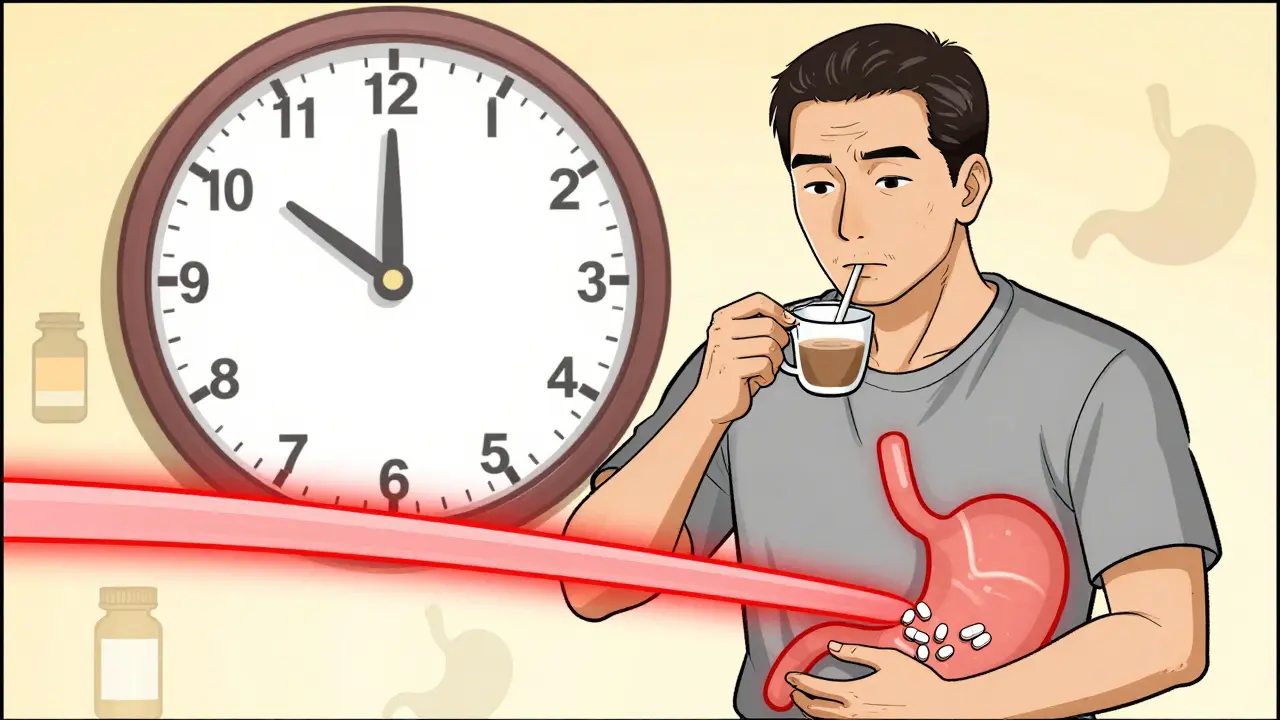
Imagine taking your thyroid pill at breakfast, then swallowing your iron supplement right after your coffee. Sounds harmless, right? But what if that one-minute delay between doses could cut your thyroid medication’s effectiveness by more than half? This isn’t hypothetical-it’s a common mistake that thousands of people make every day, and it’s one of the easiest drug interactions to fix. The secret isn’t in changing your pills. It’s in timing.
Why Timing Matters More Than You Think
Not all drug interactions are created equal. Some happen because two drugs fight each other inside your body-like one blocking the other’s path to the bloodstream. These are called time-dependent drug interactions (TDDIs). They don’t always show up in standard drug interaction checkers because they’re not about chemical clashes. They’re about when you take things. According to the FDA’s 2022 report on preventable adverse drug reactions, 20-30% of all documented drug interactions can be avoided simply by spacing out doses. That’s not a small number. That’s a huge opportunity to keep people safe without removing any medications they need. Take fluoroquinolone antibiotics like ciprofloxacin. If you take them with an antacid-say, Tums or Maalox-you’re basically swallowing a sponge. The aluminum or magnesium in the antacid grabs onto the antibiotic and traps it in your gut. Studies show this can slash absorption by up to 90%. But if you wait two hours between doses? The antibiotic works just fine. No side effects. No lost effectiveness. Same goes for levothyroxine, the most common thyroid medication. It needs an empty stomach and a clean path to your small intestine. If you take it with calcium, iron, or even a multivitamin, absorption drops to as low as 50%. Research from the Journal of Clinical Endocrinology & Metabolism in 2019 found that separating these by four hours maintains 95% absorption. That’s the difference between feeling sluggish all day and feeling like yourself.What Kind of Interactions Can Be Fixed With Timing?
The good news? Not all interactions are hopeless. Timing helps when the problem is absorption-not metabolism.- Absorption-based interactions: These are the easiest to fix. Examples include antibiotics like tetracycline (needs 2-3 hours before dairy or calcium), bisphosphonates like alendronate (take 30 minutes before food or other meds), and thyroid meds (separate from iron, calcium, or antacids by 4 hours).
- Metabolic interactions: These are trickier. If one drug slows down how your liver breaks down another (like metronidazole blocking warfarin metabolism), timing won’t help. You’ll need a dose change or a different drug.
- Pharmacodynamic interactions: When two drugs amplify each other’s effects (like blood thinners and NSAIDs increasing bleeding risk), spacing them out won’t reduce the danger. You need to rethink the combo entirely.
Real-Life Examples That Save Lives
Here’s what works in real clinics. At the University of California San Francisco Medical Center, pharmacist Jane Chen introduced a simple rule: no iron supplements within 4 hours of proton pump inhibitors (like omeprazole). Why? Because PPIs reduce stomach acid, which is needed to unlock iron for absorption. After 18 months of enforcing this timing, iron deficiency cases in older patients dropped by 32%. No new prescriptions. No expensive tests. Just better timing. Meanwhile, Kaiser Permanente rolled out a system-wide timing protocol across 40,000 providers in 2022. They trained staff, updated electronic records, and added automated alerts. Result? A 29% drop in hospital visits caused by drug interactions. That’s not just numbers-it’s people staying out of the ER. On the flip side, when timing isn’t explained clearly, things go wrong. Nurse Mark Johnson from AllNurses.com surveyed his ward and found that 40% of patients on 10+ medications didn’t follow their timing schedules. Why? They got confused. One patient took his thyroid pill with his calcium supplement because both were in the morning. Another skipped his antibiotic because he thought it was “too close” to his antacid. These aren’t careless mistakes-they’re system failures.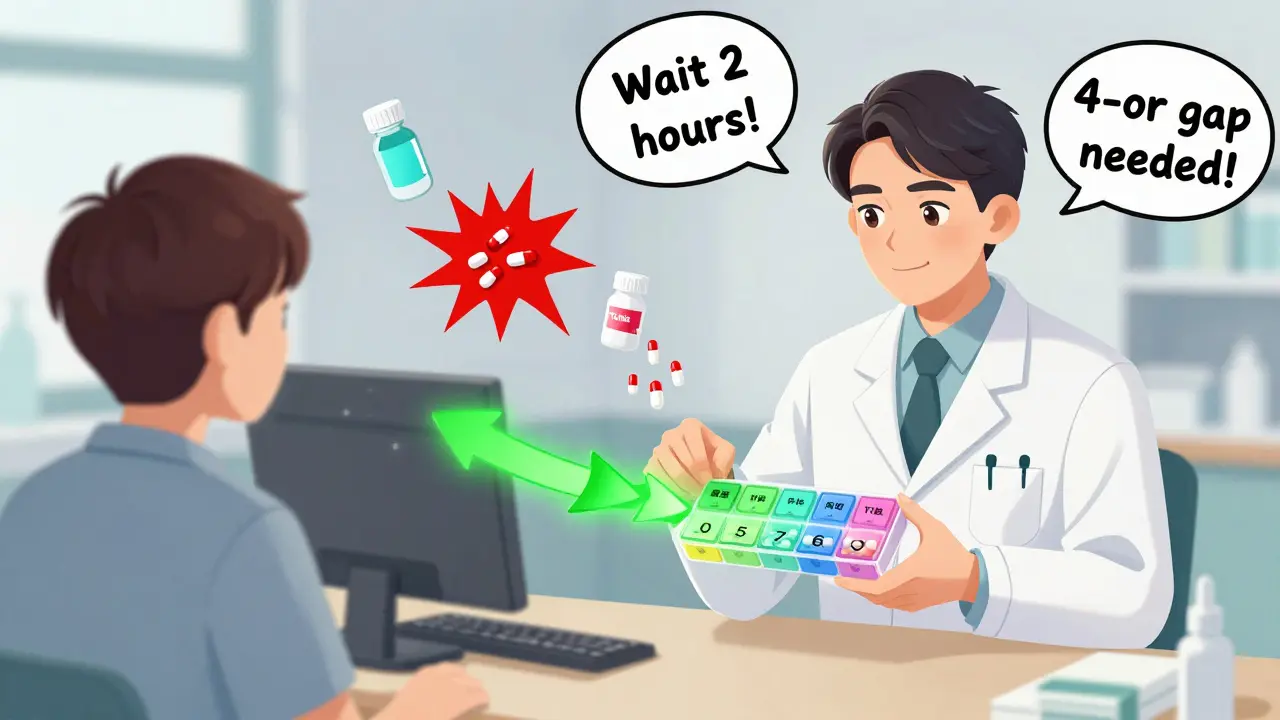
How to Get Started: Three Simple Steps
If you or someone you care for takes five or more medications, timing matters. Here’s how to fix it:- Make a full list. Write down every pill, supplement, and liquid you take-including over-the-counter stuff like antacids, vitamins, and herbal teas. Don’t skip anything. Even “harmless” things like milk or coffee can interfere.
- Check the timing rules. Use trusted sources like Lexicomp or the FDA’s drug interaction database. Look for phrases like “separate by 2 hours” or “take on an empty stomach.” Don’t rely on apps or Google. Use clinical resources.
- Build a schedule. Don’t just remember it. Write it down. Use a color-coded chart or a pill box with labeled compartments. Some people find digital tools like the Medisafe app helpful-they send alerts for each dose and remind you when to wait.
The Hidden Cost of Getting It Wrong
When timing is ignored, the consequences pile up. In Europe, the Dutch Medicines Evaluation Board found that 18% of preventable adverse drug events were due to poor timing practices. That means someone got sick-not because their medicine was bad, but because they took it at the wrong time. For older adults, this is especially dangerous. The CDC reports that 45% of U.S. adults over 65 take five or more medications. And they’re three times more likely to have time-dependent interactions than younger people. Why? Because their bodies process drugs differently. Their stomachs produce less acid. Their kidneys clear drugs slower. And they’re more likely to be on multiple prescriptions from different doctors. A 2023 Medscape survey found that 78% of primary care physicians find it “moderately to severely difficult” to coordinate timing for patients on complex regimens. That’s a red flag. If even doctors struggle, imagine how hard it is for patients.
Tools That Actually Work
You don’t need fancy tech to get it right. But you do need structure.- Pill organizers with separate compartments: A 7-day box with morning, afternoon, and evening slots reduces timing errors by 43%, according to the Agency for Healthcare Research and Quality. Label each slot with the drug name and time.
- Electronic alerts: Hospitals with CPOE systems (computerized order entry) now include TDDI alerts. These aren’t perfect-they trigger false alarms 45% of the time-but they’ve cut errors by 73% when used correctly.
- Digital apps: Medisafe, MyTherapy, and Dosecast all let you set custom timing alerts. A 2021 trial with 1,245 patients showed a 57% improvement in adherence when using these tools.
What Doesn’t Work
Timing isn’t magic. It won’t fix everything. If you’re on warfarin and your doctor adds metronidazole for an infection, spacing them out won’t help. Metronidazole blocks the liver enzyme that breaks down warfarin. The buildup can cause dangerous bleeding. The fix? Lower the warfarin dose or switch antibiotics-not wait two hours. Same with grapefruit juice and statins. It doesn’t matter if you take them 12 hours apart. The juice changes how your body processes the drug permanently that day. Avoid it entirely.Final Thought: Timing Is a Skill, Not a Guess
Medication timing isn’t about being perfect. It’s about being intentional. You don’t have to memorize every interaction. You just need to know which ones matter-and how to check them. The best part? You’re not alone. Systems are getting smarter. In 2023, Epic Systems released an AI-powered tool that adjusts timing recommendations based on kidney function and stomach pH. The FDA is moving toward personalized timing using genetic data. This isn’t science fiction-it’s happening now. But until then, the simplest tool is still the most powerful: a pen, a piece of paper, and the courage to ask, “When should I take this?”Can I take my medications with food if they’re spaced apart?
It depends. Some medications, like levothyroxine or bisphosphonates, need to be taken on an empty stomach-even if spaced apart from other drugs. Food, especially calcium-rich or high-fiber meals, can still block absorption. Always check the label or ask your pharmacist. For others, like antibiotics, taking them with a light meal might be fine as long as you wait the recommended time after eating.
What if I forget to space my medications? Should I skip a dose?
Never skip a dose unless your provider says so. If you took two interacting drugs too close together, don’t panic. Just wait until the next scheduled time to take your next dose. For example, if you took your thyroid pill and iron supplement together at 7 a.m., wait until 11 a.m. to take your next iron dose (if it’s scheduled for then). Don’t double up. Don’t skip. Just reset.
Are over-the-counter supplements safer than prescription drugs?
No. Many OTC supplements-especially calcium, iron, magnesium, and antacids-are just as likely to cause interactions as prescription drugs. In fact, because they’re sold without a prescription, people often assume they’re harmless. But a calcium tablet can block your antibiotic. A vitamin with iron can make your thyroid medicine useless. Always treat supplements like real medications.
Do I need to time my medications if I only take two or three?
Yes, if one of them is on the list of high-risk drugs. Even two medications can interact. For example, if you take ciprofloxacin and an antacid, timing matters. Or if you take levothyroxine and a daily multivitamin with iron, you need to space them. It’s not about the number of pills-it’s about which ones you’re taking.
Why don’t doctors always tell me about timing?
Many doctors are aware, but they’re pressed for time. A 2023 survey found that only 28% of outpatient clinics consistently document timing instructions in patient records. It’s not that they’re ignoring you-it’s that the system doesn’t make it easy. That’s why you need to ask. Say: “Are there any timing rules I should follow with these medications?”






Timing isn't just a logistical hack-it's a philosophical principle applied to physiology. The body doesn't operate on convenience; it operates on biochemistry, and biochemistry demands precision. When we treat medication timing as optional, we're essentially anthropomorphizing our biology-assuming it will accommodate our chaos. But the body doesn't care about your coffee schedule. It only cares about ion gradients, receptor occupancy, and absorption kinetics. This isn't about discipline. It's about humility. We're not in charge. The biochemistry is.
Time-dependent drug interactions (TDDIs) are the silent killers of adherence. You can have the perfect regimen, but if you take levothyroxine with your calcium-vitamin combo at 7 a.m., you're essentially throwing away 50% of your treatment. The fix? Structure. A pill organizer labeled by time. A 10-minute window. No exceptions. This isn't 'being picky'-it's pharmacokinetics 101. And yes, OTC supplements are just as dangerous as prescriptions. Period.
lol so wait... i'm supposed to wait 4 HOURS between my thyroid pill and my gummy vitamins?? 😭 i just thought i was being 'healthy' 🤦♀️
As someone who grew up in a culture where herbal teas and supplements are treated like water, this hit hard. In my family, 'natural' meant 'harmless.' But now I know-turmeric with blood thinners? Calcium with antibiotics? Even ginger tea can interfere. I’m reorganizing my whole medicine cabinet. Grateful for this post. 🙏
Stop pretending this is complicated. If you can't follow basic timing rules for your meds, you shouldn't be taking them. No one cares about your 'busy schedule.' Your life isn't that unique. Read the label. Or don't take it. Simple.
OMG I JUST REALIZED I’VE BEEN TAKING MY CIPRO WITH MY MILK FOR 3 YEARS 😭😭😭 I THOUGHT IT WAS FINE BECAUSE I ‘SPACED IT OUT’ BUT I DIDN’T EVEN KNOW ABOUT THE 2-HOUR RULE!! I’M GOING TO THE PHARMACY RIGHT NOW TO GET A PILL BOX!!
Thank you for this incredibly thorough and well-researched breakdown. I’ve worked in healthcare for over a decade, and even I was surprised by the 29% drop in ER visits from Kaiser’s protocol. This is exactly the kind of systemic, low-cost, high-impact intervention we need more of. I’ve already shared this with my elderly parents and my clinic’s patient education team. Truly invaluable.
I used to think I was doing fine-just took everything with breakfast. Then I got my thyroid levels checked and realized I was barely absorbing the med. It took a pharmacist asking, 'Do you take your iron with it?' to make me pause. Now I have a little chart taped to my fridge. It’s not perfect. But it’s better. And honestly? It’s made me feel more in control. Small changes, big effects.