
Sleep Aid Cognitive Risk Analyzer
Select a medication class below to analyze its mechanism of action and cognitive impact based on the research discussed in the article.
How it Works:
...
Cognitive Side Effects:
Sleep Aids is a broad category of pharmaceutical interventions designed to treat insomnia and other sleep disorders by modulating brain chemistry to induce drowsiness. These range from old-school sedatives to the newest receptor antagonists, and their impact on your cognitive health depends entirely on how they interact with your brain's receptors.
The Cognitive Cost of Common Sleep Meds
Not every sleep aid works the same way. If you're taking something that targets the GABA pathways, you're essentially slowing down your brain's overall activity. Benzodiazepines (BZDs) and their cousins, the Benzodiazepine Receptor Agonists (BzRAs) like Zolpidem (Ambien), are the most well-known. These drugs are effective for knocking you out, but they aren't precise. They hit GABA receptors indiscriminately, which can lead to amnesia, confusion, and a diminished ability to learn new things. In a striking study published in Science Translational Medicine, monkeys on high doses of GABA-modulating drugs were 20% less accurate on cognitive tests. For humans, this often translates to that dreaded "next-day grogginess" or a feeling that your brain is stuck in a thick syrup.Then there are the anticholinergics. These are often tucked into various prescriptions for sleep or even motion sickness. However, they carry a heavy cognitive load. Research led by Dr. Malaz Boustani at Indiana University linked these medications specifically to mild cognitive impairment (MCI). This means you might experience memory loss that doesn't quite stop you from functioning in daily life but is definitely noticeable. The good news? Some evidence suggests this specific type of impairment might be reversible if you stop the medication.
Comparing the Risk Profiles
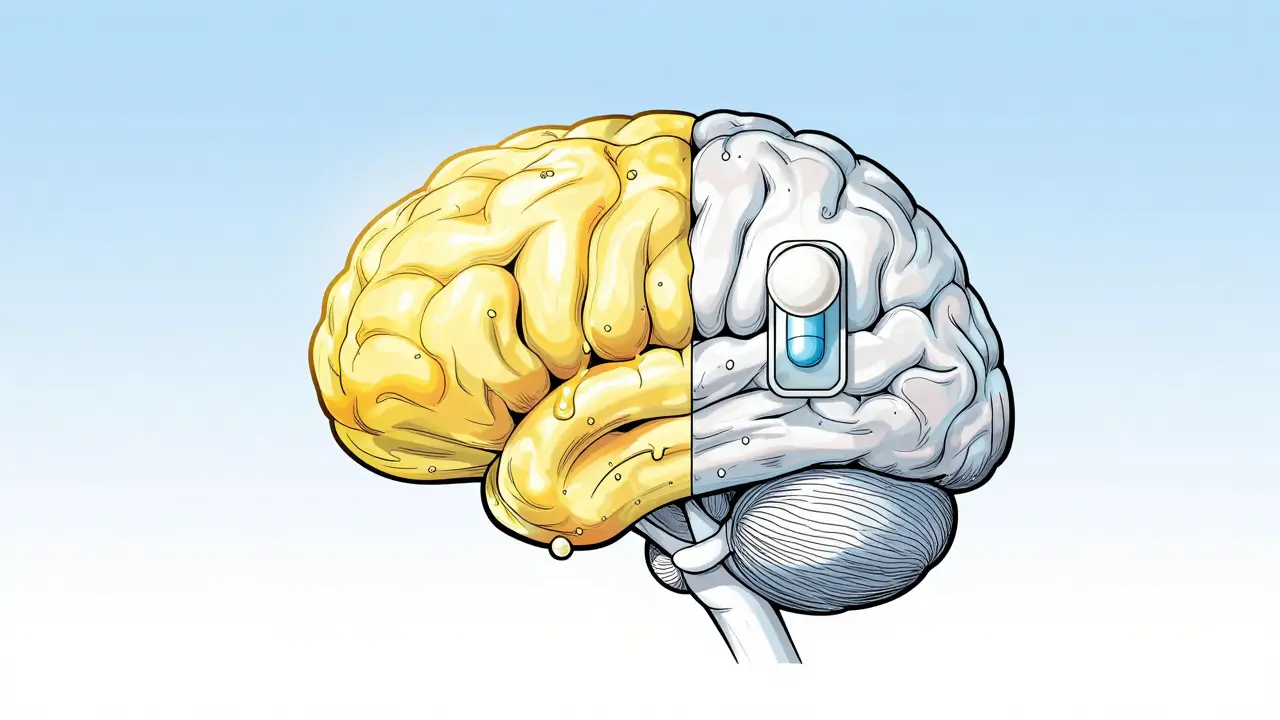
If you're trying to decide which path to take, it helps to see how these drugs stack up against each other. The biggest divide is between the older "sedative" approach and the newer "wake-blocking" approach. Dual Orexin Receptor Antagonists (DORAs), such as Suvorexant (Belsomra), work differently. Instead of forcing the brain into a sedative state, they block the orexin receptors that keep you awake. It's like turning off a light switch rather than drugging the whole room.
| Medication Class | Primary Mechanism | Common Cognitive Side Effects | Long-term Risk Level |
|---|---|---|---|
| Benzodiazepines / BzRAs | GABA Modulation | Amnesia, slow reaction time, brain fog | High (Linked to Dementia) |
| Anticholinergics | Acetylcholine Blockade | Memory loss, confusion | Moderate to High (MCI) |
| DORAs (e.g., Suvorexant) | Orexin Blockade | Minimal; some reports of daytime sleepiness | Low (Potential Neuroprotection) |
| Trazodone / Antidepressants | Serotonin/Histamine | Drowsiness, mild grogginess | Low to Moderate |
The Dementia Connection: What the Data Says
Is there a real link between sleeping pills and permanent brain decline? The data is a bit messy, but some trends are alarming. A 2021 study found that routine users of sleep medications had a 30% higher risk of developing dementia. However, this isn't a one-size-fits-all statistic. A University of California-San Francisco study of 3,000 older adults found that white participants who frequently used sleeping pills had a 79% higher chance of dementia, while Black participants didn't show the same association. This suggests that genetics, race, and other health factors play a huge role in how our brains react to these chemicals.On the flip side, there's a glimmer of hope. Some research into Suvorexant suggests it might actually *reduce* the levels of proteins associated with Alzheimer's. While Dr. Brendan Lucey warns that it's too early to start taking the drug just to prevent Alzheimer's, the fact that some meds might actually be neuroprotective is a huge shift from the "all pills are bad" narrative.
Real-World Experience: "Brain Fog" and Memory Lapses
If you look at user forums like Reddit's r/sleep or reviews on Drugs.com, the clinical data starts to look like real life. People taking zolpidem frequently report "memory lapses during the night"-essentially doing things they don't remember the next morning. About 78% of users in one community discussion complained of next-day grogginess. This "hangover" effect isn't just annoying; it's a sign that the drug is still affecting your cognitive processing hours after you've woken up.Older adults feel this the most. The American Geriatrics Society's Beers Criteria explicitly warns against using benzodiazepines or non-benzodiazepine hypnotics for seniors. Why? Because the risk of falls, motor vehicle accidents, and severe confusion is exponentially higher as we age. A dose that might just make a 30-year-old feel a bit sleepy could leave a 75-year-old completely disoriented.

Moving Toward a Better Alternative: CBT-I
If you're worried about your cognitive health but still can't sleep, the gold standard isn't a pill-it's Cognitive Behavioral Therapy for Insomnia (CBT-I). This isn't just "talking about your feelings"; it's a structured program that retrains your brain to sleep. It involves things like sleep restriction and stimulus control.Here is the reality check: CBT-I is harder than taking a pill. You have to commit to 6-8 weekly sessions, and it takes about 2-3 weeks to see a difference. However, the results are durable. Unlike medication, which you might become dependent on, CBT-I gives you the tools to sleep naturally. For those who can't afford in-person therapy (which can cost over $1,500), digital platforms like Sleepio offer a cheaper alternative, often ranging from $300 to $500, with similar effectiveness.
How to Transition Safely
If you're currently taking a sleep aid and want to quit, the most important rule is: **do not stop abruptly.** Stopping benzodiazepines or BzRAs cold turkey can cause "rebound insomnia," where your sleeplessness returns worse than ever, along with intense anxiety and withdrawal symptoms.Instead, follow a gradual tapering plan over 4 to 8 weeks. Work with your doctor to slowly lower the dose while simultaneously starting CBT-I. This "bridge" approach allows your brain's GABA receptors to reset without sending you into a state of panic or total wakefulness. The goal is to move from a chemically induced sleep to a biologically natural one, protecting your memory and cognitive sharpness in the process.
Will taking a sleep aid for one night cause permanent memory loss?
No, a single dose typically won't cause permanent damage. However, you may experience temporary "anterograde amnesia," where you struggle to form new memories while the drug is active. The long-term risks of cognitive decline and dementia are associated with routine, chronic use over months or years.
Are "natural" sleep aids like melatonin safer for cognition?
Generally, yes. Melatonin is a hormone your body already produces and doesn't carry the same risk of dementia or severe cognitive impairment as benzodiazepines. However, it can still cause grogginess or vivid dreams in some people. Always consult a professional to ensure it doesn't interact with other medications.
What is the difference between "brain fog" and MCI?
Brain fog is a subjective feeling of mental confusion or lack of clarity, often temporary and caused by medication side effects. Mild Cognitive Impairment (MCI) is a clinical diagnosis where memory or thinking is noticeably impaired beyond what is normal for your age, but not severe enough to interfere with all activities of daily living.
Why are DORAs like Suvorexant considered safer?
DORAs are safer because they target the "wake" system (orexin) rather than the "sleep" system (GABA). By blocking the signals that keep you awake, they promote sleep without sedating the entire brain, which reduces the risk of amnesia and severe cognitive impairment.
Can CBT-I really replace a prescription pill?
Yes, for many people. Clinical evidence shows that CBT-I is more effective in the long run because it treats the root cause of insomnia rather than just the symptoms. While pills work faster, CBT-I provides a permanent solution without the cognitive side effects.







This is such a helpful breakdown of how these things actually work in the brain. I've known a few people who swear by their nighttime pills but always seem a bit spaced out during our morning chats. Definitely makes me think twice about the 'quick fix' route.
honestly just sounds like people cant handle basic hygiene and need a pill for everything lol. like just put your phone away and stop eating cheese at midnight maybe then you'll sleep without nuking your brain
The distinction between the sedative approach and the wake-blocking approach is quite illuminating. It is prudent to exercise extreme caution when altering one's pharmaceutical regimen.
It is absolutely catastrophic that we have allowed a culture of chemical dependence to permeate our society to such a degree! The mere prospect of a thirty percent increase in dementia risk is a harrowing indictment of modern medicine's failure to prioritize cognitive integrity over immediate convenience! We are effectively lobotomizing ourselves in the pursuit of eight hours of unconsciousness!
One must wonder if the pursuit of a 'perfect' night's sleep is merely a symptom of a society terrified of the stillness of consciousness. We categorize these effects as 'side effects' as if the disruption of our neural chemistry were a secondary concern rather than the primary event. The dichotomy between the biological need for rest and the pharmaceutical simulation of it is a fascinating, if grim, study in human contradiction. To suggest that a digital platform can 'retrain' a brain is a quaint, almost naive, interpretation of neuroplasticity. We are not software to be updated; we are organic entities struggling against the artificial constraints of a twenty-four-hour productivity cycle. The obsession with 'efficiency' in sleep is simply the final frontier of capitalism's encroachment into our subconscious. I find the focus on DORAs particularly amusing, as if switching from a sledgehammer to a scalpel removes the fact that we are still operating on the brain without a true understanding of the soul's requirement for darkness. It is a tragedy of the highest order that we mistake sedation for restoration. The cognitive cost is not just memory loss, but the loss of the capacity to endure the discomfort of existence without a chemical buffer. We are trading our waking wisdom for a dreamless void. Truly, a bargain for the ages.
American medicine is the only one daring to tackle this with such scale.
Keep pushing through guys! CBT-I is a total game changer for the neuroplasticity of your circadian rhythms. Just stay positive and keep the grind going!
I totally agree that we need more options like CBT-I for everyone to access.
It's so important to emphasize the tapering process here. Many people just stop and then spiral into a panic, which just makes the insomnia worse.
Sure, the 'data' says one thing, but who is funding these studies? Follow the money. They tell us DORAs are safe now because the patents on the old stuff are expiring and they need a new gold mine. They want us dependent on 'neuroprotective' drugs so we never actually fix the environment that's keeping us awake. It's all a cycle designed to keep you in the system.
Sleep... is the silent mirror... of our fragmented souls...